

Tencent's TokenFormer Fixes a Hidden Collapse Destroying Unified Recommender Models
Tencent researchers identify a failure mode called Sequential Collapse Propagation and propose a unified transformer that fuses feature interaction and sequence modeling without dimensional degradation.
 PRO
- Tencent identifies Sequential Collapse Propagation, where low-rank static field tokens dimensionally collapse behavior sequence representations in unified backbones.
- TokenFormer is a decoder-only architecture treating fields, behaviors, and targets as one token stream.
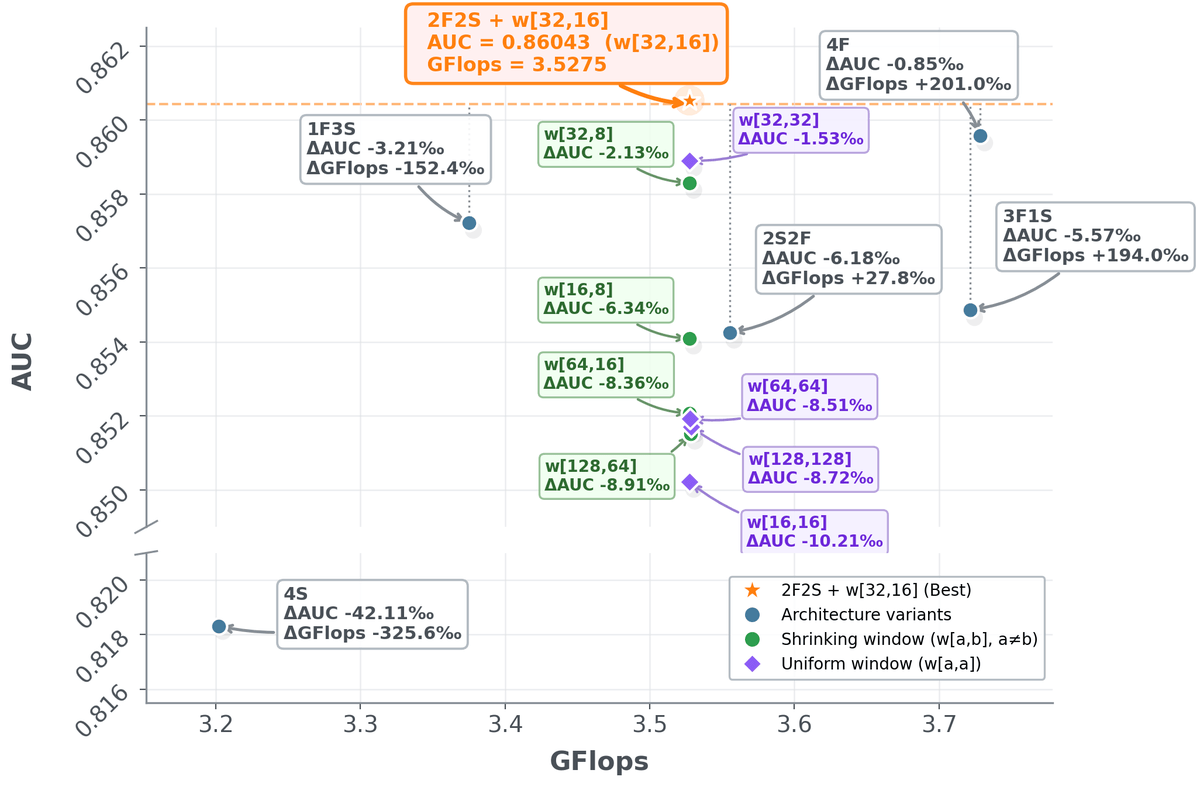
- BFTS attention runs full attention in lower layers, shrinking sliding windows in upper layers, then discards static tokens.
- NLIR gate multiplies attention output by a sigmoid projection, restoring effective rank of behavior tokens.
- WeChat Channels A/B test on 5% traffic delivered 4.03% GMV uplift; serving throughput rose 5.5× via decoupled user encoding.
- Referenced in the UniRank benchmark alongside OneTrans, UniMixer, and UltraHSTU.
Recommender systems have historically been built as two disconnected worlds. One camp models correlations among sparse categorical fields like user demographics, item category, or context. The other treats user behavior as a sequence, using self-attention to capture how interests evolve over time. Bolting these together in a single transformer sounds obvious, but a new paper from Tencent shows the naive way of doing it silently degrades the model.
The team introduces TokenFormer, a unified decoder-only architecture where static fields, behavior tokens, and target items all live in one token stream. What makes the paper worth reading is the failure mode it fixes, not just the architecture itself.
A hidden failure mode in unified recommenders
The paper names a phenomenon called Sequential Collapse Propagation (SCP). When you naively unify feature interaction and sequence modeling in a shared backbone, interaction with dimensionally ill non-sequence fields causes dimensional collapse in the sequence features. In plain terms: many static fields in industrial systems have low cardinality or heavy skew, so their embeddings occupy a narrow subspace. In a decoupled model that stays isolated. In a shared transformer, those low-rank tokens attend to the behavior tokens and drag them down into the same cramped subspace.

The figure above tells the story. A sequence-only transformer keeps a healthy singular value spectrum but is less discriminative because it ignores static signals. Adding static tokens to a vanilla transformer bumps mutual information with labels, but the spectrum decays much faster, meaning the sequential representations lose their effective rank. TokenFormer aims to keep the discriminability gain while restoring the spectral health.
Two ideas doing the heavy lifting
This story is for Pro members
You've reached the end of the free preview. Upgrade to AlphaSignal Pro to read the full article - and everything else behind the paywall.
Comments
