

Tencent's HY-World 1.5 Open-Sources Real-Time AI World Generation at 24 FPS
Tencent open-sources WorldPlay, the first real-time interactive world model that generates explorable 3D environments at 24 FPS with long-term geometric consistency
 PRO
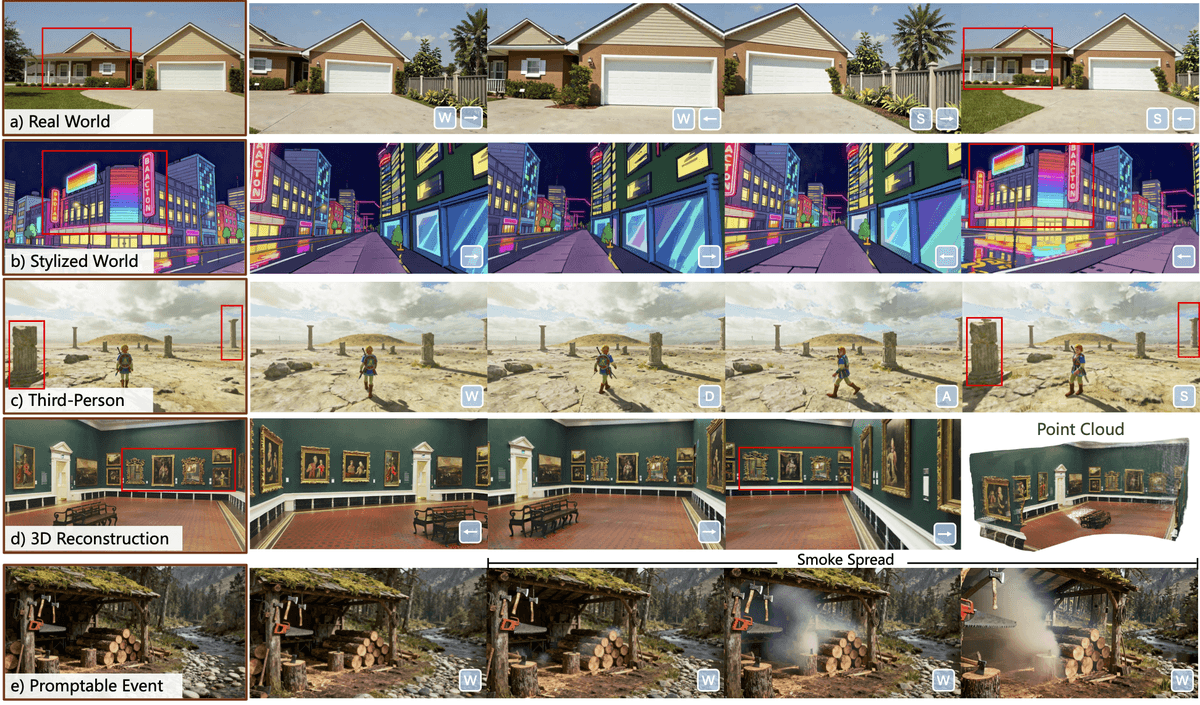
- First open-source real-time world model: HY-World 1.5 (WorldPlay) generates interactive 3D environments at 24 FPS from text or images.
- Solves the speed-memory tradeoff: Context Forcing distillation and Reconstituted Context Memory maintain geometric consistency without sacrificing real-time speed.
- State-of-the-art benchmarks: Outperforms Gen3C, ViewCrafter, GameCraft, and others on both short-term and long-term reconstruction metrics.
- Two model sizes: 8B HunyuanVideo-based model (recommended) and a lightweight 5B WAN-based model for smaller GPUs.
- Full training pipeline released: Includes pre-training, RL post-training (WorldCompass), distillation code, and inference scripts. GitHub
- Online demo available: Try it without local setup at Tencent's WorldPlay demo; weights on Hugging Face.
Building a world model that is both fast enough to interact with in real time and geometrically coherent over long distances has been an open problem for years. Tencent's Hunyuan team just open-sourced HY-World 1.5 (WorldPlay), a streaming video diffusion model that claims to solve both at once: 24 FPS interactive generation from a single image or text prompt, with a scene that remembers its own geometry when you walk away and come back.
While HY-World 1.0 could generate immersive 3D worlds, it relied on a lengthy offline generation process. HY-World 1.5 bridges this gap with WorldPlay, a streaming video diffusion model that enables real-time, interactive world modeling with long-term geometric consistency. The result feels closer to a game engine than a video generator: users can control the virtual camera in real time using a keyboard, mouse, or controller, exploring AI-generated scenes as if playing a game.
The speed-memory wall, cracked
Previous world models could generate impressive 3D worlds but typically through a slow, offline process. Achieving real-time interaction meant sacrificing the long-term consistency of the environment -- objects would morph, textures would flicker, and the geometry would drift over time. WorldPlay attacks this with four interlocking ideas.
- Dual Action Representation: A Dual Action Representation enables robust action control in response to keyboard and mouse inputs. Camera moves are encoded both as discrete tokens and as continuous 6-DoF pose deltas, giving the model two complementary signals for the same action.
- Reconstituted Context Memory: Reconstituted Context Memory dynamically rebuilds context from past frames and uses temporal reframing to keep geometrically important but long-past frames accessible, effectively alleviating memory attenuation. Think of it as a smart cache that prioritizes the frames that anchor the scene's 3D structure, not just the most recent ones.
This story is for Pro members
You've reached the end of the free preview. Upgrade to AlphaSignal Pro to read the full article - and everything else behind the paywall.
Comments
