
Tencent's HunyuanVideo Beats Runway Gen-3 as a Fully Open 13B Model
Tencent's HunyuanVideo has grown from a single 13B text-to-video model into a full open-source ecosystem rivaling closed-source leaders like Runway and Sora
 Pro
Takeaways
- 13B open-source model: HunyuanVideo is the largest open-source video generation model, outperforming Runway Gen-3 and Luma 1.6 in professional evaluations.
- Full ecosystem: The repo has expanded to include I2V, HunyuanCustom, and Avatar models, all sharing the same DiT backbone.
- HunyuanVideo-1.5: A lighter 8.3B successor runs on consumer GPUs, with a step-distilled variant generating videos in 8–12 steps (75% faster on RTX 4090).
- Key architecture: Dual-stream transformer, MLLM text encoder, 3D Causal VAE, and built-in prompt rewriting distinguish it from earlier open-source models.
- Hardware requirements: Base model needs 60–80GB VRAM; community GGUF quantization brings it down to 8GB, and FP8 saves ~10GB vs full precision.
- Diffusers integration: Available via HuggingFace and ComfyUI, with multi-GPU parallel inference via xDiT achieving 5.64x speedup on 8 GPUs.
HunyuanVideo started as a bold claim: an open-source video generation model that could match or beat closed-source giants like Runway Gen-3 and Luma 1.6. That claim has held up. What began as a single text-to-video checkpoint has since grown into a layered ecosystem of foundation models, conditional variants, and audio-driven animation tools , all sharing the same underlying architecture and all fully open-source.
The foundation: 13B parameters, fully open
With 13 billion parameters, HunyuanVideo achieves leading performance across video quality and motion stability, and is fully open-source on GitHub and Hugging Face. According to professional human evaluation results, HunyuanVideo outperforms previous state-of-the-art models, including Runway Gen-3, Luma 1.6, and three top-performing Chinese video generative models. The evaluation used 1,533 text prompts and was scored by more than 60 professional evaluators across three criteria: text alignment, motion quality, and visual quality.
Tencent's 13B-parameter DiT generates 5–15 second clips at 720p / 24fps with cinematic motion coherence that rivals closed-source Sora and Runway Gen-3. The base model supports multiple aspect ratios at both 540p and 720p, with 129 frames per clip (~5.4 seconds at native frame rate).
Four architectural bets that paid off
The model's design is built around four interlocking innovations that separate it from earlier open-source video models:
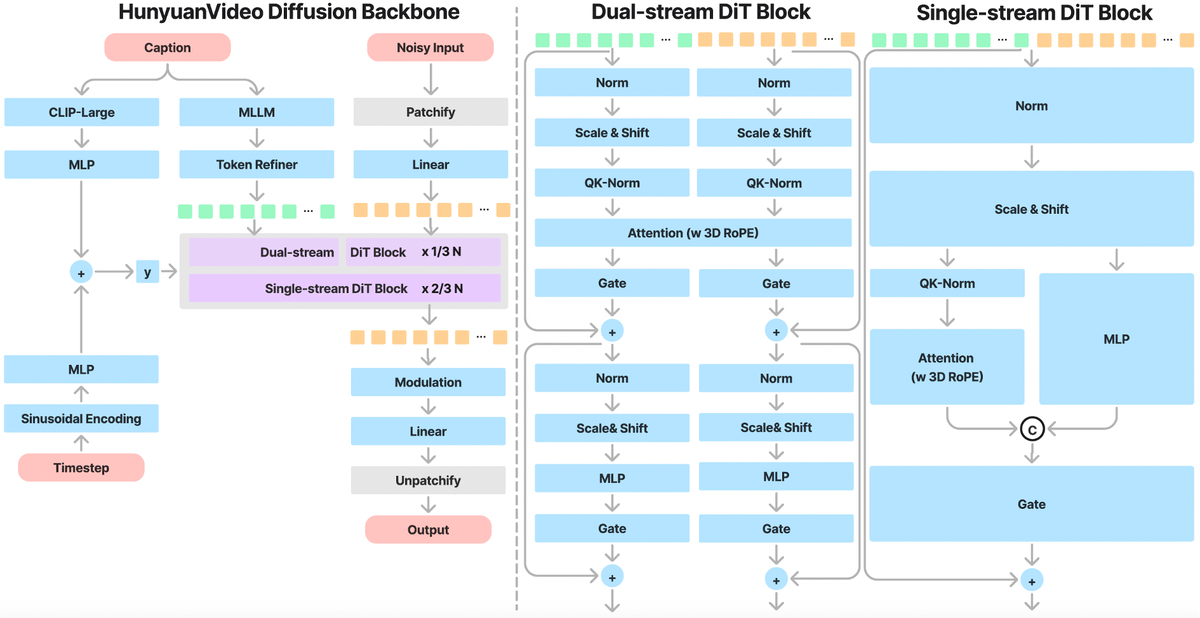
- Dual-stream to single-stream transformer: HunyuanVideo employs a "dual-stream to single-stream" hybrid model design. Video and text tokens are processed independently through multiple Transformer blocks, then concatenated and fused in a single-stream phase. This lets each modality develop its own representations before they interact , a cleaner design than forcing joint attention from the start.
- MLLM text encoder: Instead of the standard T5 or CLIP encoders used by most video models, HunyuanVideo uses a Multimodal Large Language Model (MLLM) with a decoder-only architecture as its text encoder. This gives it superior ability in image detail description and complex reasoning, and lets it act as a zero-shot learner by following system instructions prepended to user prompts. An extra bidirectional token refiner is added on top to compensate for the causal attention limitation of decoder-only models.
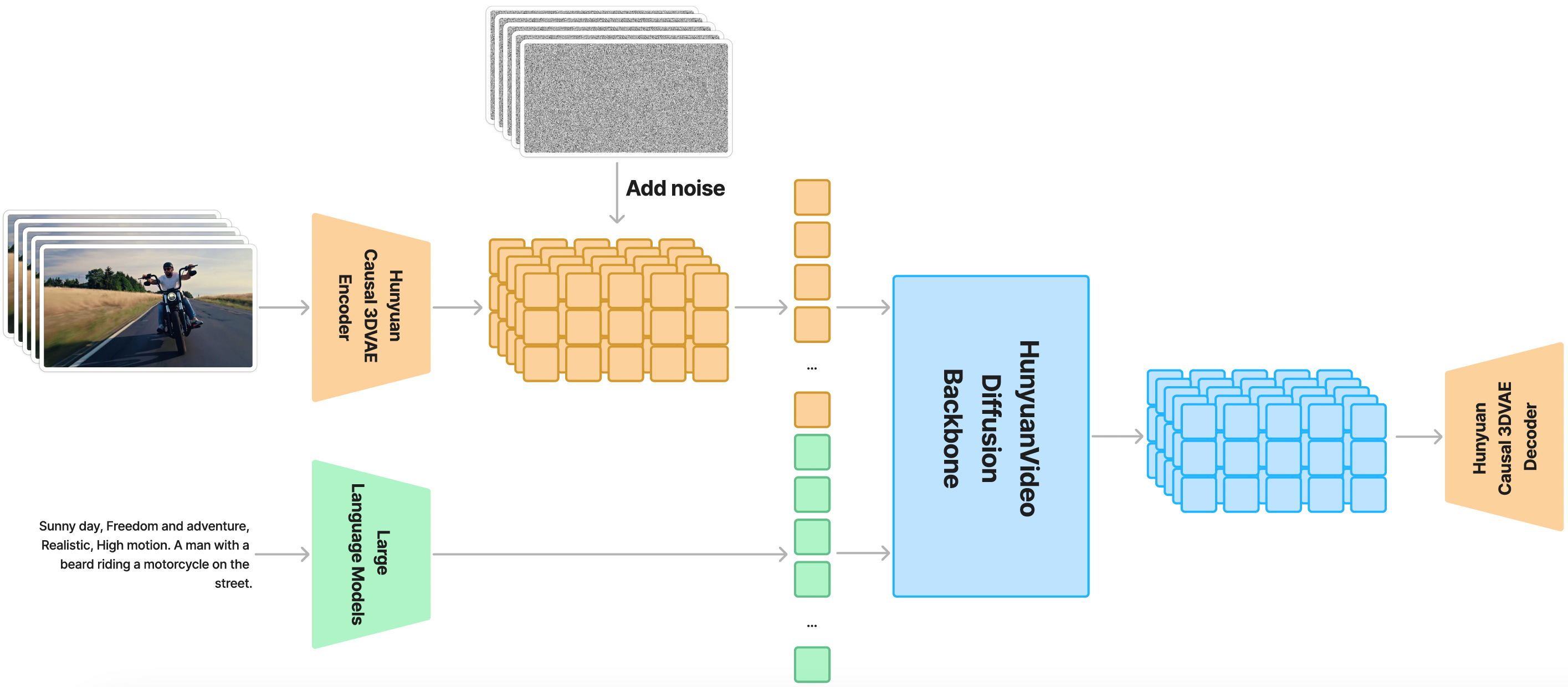
- 3D Causal VAE: HunyuanVideo is built on a 3D causal VAE that compresses video into a compact latent space. The system operates in this compressed space, where Gaussian noise is progressively denoised conditioned on text or image inputs, and the resulting latent is decoded back into pixel-space video. The compression ratios are 4x temporal, 8x spatial, and 16x channel , dramatically reducing the token count for the diffusion transformer.
- Prompt rewriting: A fine-tuned version of Hunyuan-Large handles prompt rewriting in two modes: Normal mode (better intent understanding) and Master mode (enhanced composition, lighting, and camera movement descriptions for higher visual quality).

A growing ecosystem, not just a model
The cadence of releases through 2025 transformed HunyuanVideo from a single text-to-video checkpoint into a layered ecosystem of foundation, conditional, and audio models, all sharing the same underlying DiT architecture and VAE compression scheme. Each new release extends the base model with lightweight conditioning modules rather than replacing it , a smart architectural choice that compounds value over time.
The key releases in the ecosystem:
- HunyuanVideo-I2V: An image-to-video model based on HunyuanVideo. It uses a token replace technique in which a portion of the input latent sequence is overwritten with tokens derived from the reference image, anchoring the first frames of the generated clip to the input.
- HunyuanCustom: A multi-modal customized video generation framework that emphasizes subject consistency while supporting image, audio, video, and text conditions. Use cases include virtual try-on, singing avatars, and video subject replacement.
- HunyuanVideo-Avatar: A multimodal diffusion transformer-based model capable of simultaneously generating dynamic, emotion-controllable, and multi-character dialogue videos. The system supports multi-style avatars encompassing photorealistic, cartoon, 3D-rendered, and anthropomorphic characters.
- HunyuanVideo-1.5: A video generation model that delivers top-tier quality with only 8.3B parameters, significantly lowering the barrier to usage. It runs smoothly on consumer-grade GPUs, making it accessible for every developer and creator.
What it's good at , and where it struggles
One thing HunyuanVideo genuinely does well is multi-person scenes. Its multi-person interactions are a relative strength, and visuals remain clear even when motion coherence breaks down. If your content regularly features two or more subjects, this matters more than it might seem.
Where it struggles: complex motion paths with perspective shifts. Testing a skydiving prompt occasionally produced jumps from close-up to distant shot mid-clip , jarring. Wan 2.1 outperformed HunyuanVideo in terms of motion smoothness, scene consistency, and spatial accuracy based on benchmark tests. The model also generates video without audio , you'll need to add sound separately.
The hardware reality
The base 13B model is not lightweight. At full precision, you need at minimum 60GB of VRAM for 720p output, with 80GB recommended. That means an A100 or H100 for the full-quality version. However, the community has built multiple paths to lower the bar significantly:
- FP8 quantization (E4M3 format) saves approximately 10 GB of GPU memory compared to full precision.
- GGUF quantization (Q8, Q6, Q4 variants) enables running on GPUs with 8 GB or less of VRAM.
- On RTX 4090, end-to-end generation time with the step-distilled 1.5 model is reduced by 75%, and a single RTX 4090 can generate videos within 75 seconds.
- Multi-GPU parallel inference via xDiT scales nearly linearly: on 8 GPUs, a 720p 129-frame video drops from ~1904 seconds to ~338 seconds (5.64x speedup).
Running it yourself
Getting started with the base model is straightforward on Linux with a capable GPU. Clone the repo, set up a conda environment with PyTorch 2.6.0, and run inference with a single command:
python3 sample_video.py \
    --video-size 720 1280 \
    --video-length 129 \
    --infer-steps 50 \
    --prompt "A cat walks on the grass, realistic style." \
    --flow-reverse \
    --use-cpu-offload \
    --save-path ./results
HunyuanVideo is integrated into the Hugging Face Diffusers library, making it accessible through a standard Python API. This integration simplifies model loading, inference, and pipeline customization for developers already familiar with the Diffusers ecosystem. A Gradio server is also included for a quick local UI. Docker images are available for both CUDA 11.8 and 12.4.
The community built a lot on top of it
The open-source release triggered a wave of community contributions that have become essential parts of the workflow for most users. Notable ones include:
- ComfyUI-HunyuanVideoWrapper by Kijai , FP8 inference, video-to-video, and image-prompted video generation
- FramePack by Lvmin Zhang , packing input frame context for next-frame prediction, enabling longer generations
- FastVideo by Hao AI Lab , consistency distillation and sliding tile attention for faster inference
- TeaCache , cache-based acceleration that reuses intermediate computations across denoising steps
- RIFLEx by Tsinghua University , video length extrapolation beyond the training distribution
What this changes for the field
Tencent's team developed a new attention mechanism called SSTA that makes HunyuanVideo 1.5 nearly twice as efficient as competitors without sacrificing quality. More broadly, the HunyuanVideo family has demonstrated that the performance gap between open and closed-source video generation is no longer a given. By releasing the code and weights of the foundation model and its applications, the goal is to bridge the gap between closed-source and open-source video foundation models , empowering everyone in the community to experiment with their ideas, fostering a more dynamic and vibrant video generation ecosystem.
The practical implication: teams building video generation pipelines for content creation, e-commerce, virtual avatars, or research no longer need to depend on API access to closed models. The full stack , from text-to-video to image animation to audio-driven avatars , is now available as open weights, with active community tooling and HuggingFace Diffusers integration. The question has shifted from "can open-source match closed-source quality?" to "how fast can the open-source ecosystem iterate?"