

Tencent Open-Sources Hy3, a 295B Model That Runs Like a 21B
Tencent's 295B MoE open-weights model rivals trillion-parameter flagships on agentic tasks at a fraction of the inference cost

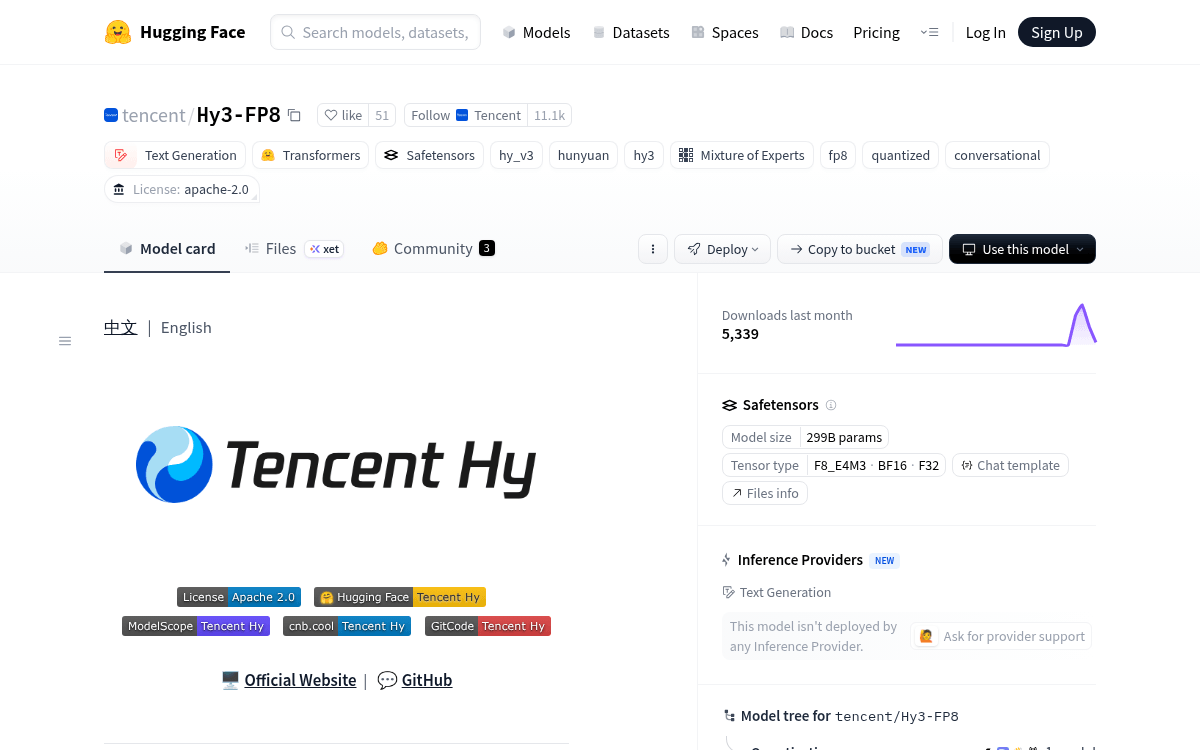 PRO
PRO- Open-sourced under Apache 2.0: Tencent released Hy3 and Hy3-FP8 weights publicly on Hugging Face and ModelScope.
- 295B MoE, 21B active: Only 21B parameters activate per token, making inference far cheaper than a dense model of equivalent capacity.
- Hallucination rate cut in half: Internal evals show hallucination dropped from 12.5% to 5.4% and multi-turn issue rate fell from 17.4% to 7.9%.
- Production-grade tool calling: SWE-Bench accuracy variance across Cline, CodeBuddy, and KiloCode scaffoldings stays within 4%.
- Aggressive pricing: Tencent Cloud API at ~$0.14/M input tokens; OpenRouter offered free access for two weeks post-launch.
- FP8 variant available: The Hy3-FP8 checkpoint halves VRAM requirements, making self-hosting on 8 H20-class GPUs practical.
Tencent just open-sourced Hy3, the official release of its Hunyuan 3 language model, and the headline number is a little misleading. Yes, it has 295 billion parameters. But thanks to a Mixture-of-Experts (MoE) architecture, it only activates 21 billion of them per token. That means inference costs scale with a 21B-class model while the model's knowledge capacity stays closer to a 295B-class one. The model demonstrates significantly enhanced performance relative to models of the same size, while achieving intelligence comparable to flagship models with two to five times its parameter scale.
From rebuilding its infrastructure in late January 2026, to the launch of Hy3 preview in April, and now to the latest release of Hy3, Tencent completed its full model-development loop in less than six months. The final release comes after gathering feedback from 50+ products and scaling up post-training with higher quality data. This is not a research demo -- it's a model that has already been stress-tested across Tencent's own product ecosystem.
The architecture under the hood
Hy3 uses a dense-MoE hybrid architecture. Each MoE layer has 192 routed experts plus one always-active shared expert. A router picks a small subset of experts per token, so only 21B of the 295B total parameters do work on any given token. This is the core efficiency trick: compute scales with active parameters, but the model's breadth of knowledge scales with total capacity.
Tencent also ships a 3.8B multi-token-prediction (MTP) layer that helps the model predict more than one token per step for faster decoding. MTP is a speculative decoding technique where the model drafts multiple future tokens simultaneously, then verifies them in one pass -- effectively increasing throughput without sacrificing quality. The model also supports a 256K token context window and comes with three selectable reasoning modes:
This story is for Pro members
You've reached the end of the free preview. Upgrade to AlphaSignal Pro to read the full article - and everything else behind the paywall.
Comments
