

Technion Researchers Turn 'Vibe Testing' Into a Reproducible AI Benchmark
Researchers turn the informal practice of vibe-testing into a structured evaluation pipeline, and show that personalized prompts can flip which model wins.
 PRO
- Researchers formalize vibe-testing as personalized inputs plus user-aware output criteria, with code released.
- Survey of 51 users: 82% vibe-test models, 86% saw benchmark-vs-experience mismatch.
- 40 in-the-wild comparison reports analyzed to derive input and output dimension taxonomies.
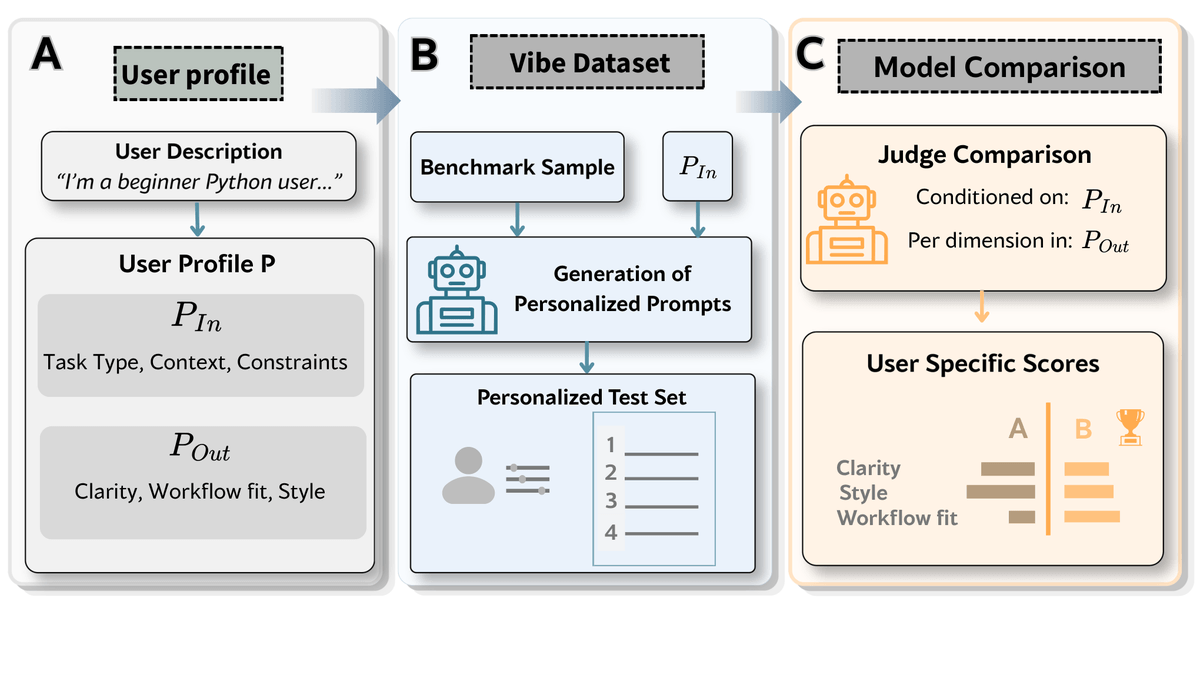
- Proof-of-concept pipeline profiles a user, rewrites benchmark prompts, and runs pairwise LLM judging.
- On MBPP+, personalization flips winners: GPT-5.1 vs GPT-OSS-20B Beginner win rate goes 3% to 77%.
- Artifacts released at technion-cs-nlp.github.io/vibe-testing-llms, including prompts, personas, and corpus.
Anyone who has swapped between frontier models knows the feeling: one model wins the benchmarks, but another one just feels better for the actual work you do. A new paper from researchers at the Technion and Hebrew University tries to pin down that gap, formalize the informal practice of vibe-testing, and turn it into a reproducible evaluation pipeline. Their paper shows that when you tailor both the prompt and the judging criteria to a specific user, the preferred model often flips compared to the raw benchmark ranking.
Why leaderboards lie about daily use
Popular evaluation suites report performance as aggregated scores on standardized tasks, but those numbers often miss how useful a model is inside a real workflow. To close the gap, users run informal experiments on tasks that mirror their own work. The authors surveyed 51 technical users and analyzed 40 public model comparison reports from blogs, YouTube, and Reddit to figure out what people actually do.
The survey numbers are striking. 82% of respondents said they had vibe-tested models, and reported experimenting often (mean=5.31 on a scale of 1 to 7). 86% had encountered a model that felt significantly different from what its benchmark scores would suggest, with workflow and style fit topping the list of things standard evaluations miss.

Two knobs users turn without realizing
Vibe-testing has structure even when it looks improvised. The authors define it as an interaction-based evaluation practice in which evaluators adapt both the input they test and the criteria used to judge output, aiming to capture aspects of practical utility that standard benchmarks may miss. They organize this into two families of recurring dimensions:
- Input dimensions: task type, complexity, real-world context, persona framing, underspecification level, constraint tightness, and available reference material.
This story is for Pro members
You've reached the end of the free preview. Upgrade to AlphaSignal Pro to read the full article - and everything else behind the paywall.
Comments
