

Super Rad's Microsandbox Gives AI Agents Hardware-Level Isolation at Docker Speed
Microsandbox brings hardware-isolated microVMs to your laptop with sub-100ms boot times, SDKs in four languages, and secrets that never enter the VM
 PRO
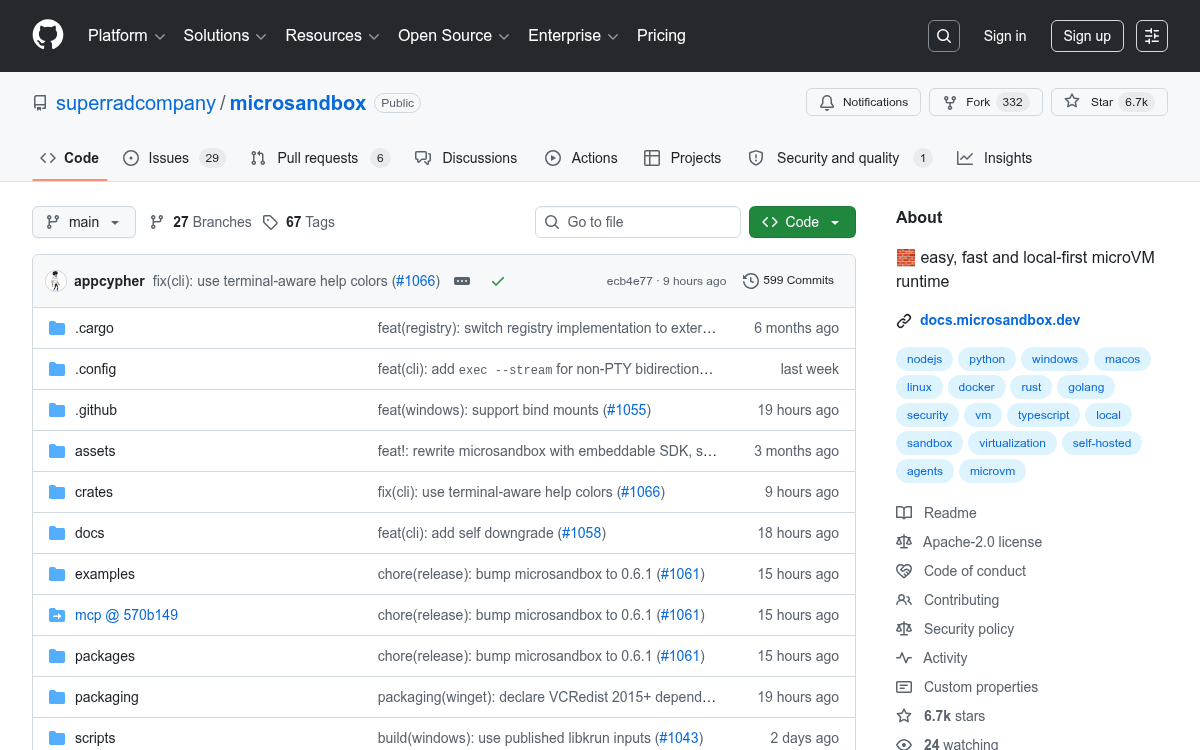
- Microsandbox is an open-source, YC-backed microVM runtime for running untrusted AI agent code with hardware-level isolation — GitHub repo
- Uses libkrun (not Firecracker) for sub-100ms boot times on Linux/macOS/Windows with a dedicated kernel per sandbox
- Secrets never enter the VM: real credentials are swapped in only on verified TLS handshakes to allowlisted hosts
- SDKs available in Python, TypeScript, Rust, and Go; MCP server lets any compatible agent control sandboxes directly
- Self-hosted and free under Apache 2.0; cloud platform is in closed beta — local runtime has no usage fees
- Still pre-1.0 beta with known gaps: no GPU passthrough, cold starts grow with image size, breaking changes expected
Microsandbox is an open-source, local-first microVM runtime built specifically for running untrusted workloads , AI agent code, user-submitted scripts, plugins, CI jobs , with hardware-level isolation and a developer experience that feels like Docker. Built in Rust by Super Rad Company (a YC-backed startup), it has crossed 6,700 GitHub stars and is shipping releases at a fast clip, currently at v0.6.1.
The container escape problem nobody wants to talk about
The thesis behind microsandbox is that containers are insufficient for running truly untrusted AI-generated code , shared kernels mean sophisticated attacks can escape. This is not a theoretical concern. Containers share a fatal flaw: the host kernel is a shared attack surface. One container escape compromises everything. As AI agents gain the ability to write and execute arbitrary code, this attack surface becomes a live production risk.
The emergence of microVM technologies like Firecracker and libkrun has rendered the old dichotomy of "slow, secure VMs versus fast, insecure containers" largely obsolete. They offer a compelling "best of both worlds" approach that has become the new standard for high-security, ephemeral code execution. Microsandbox is betting that this technology should be as easy to use as docker run.
What's under the hood
Microsandbox uses libkrun, a lightweight virtualization library from the containers project that leverages KVM (Linux) or Hypervisor.framework (macOS) for hardware isolation. Unlike Firecracker (used by E2B and AWS Lambda), libkrun includes its own Virtual Machine Monitor and uses Transparent Socket Impersonation (TSI) for networking , avoiding the overhead of virtual network interfaces.
Average boot times are under 100 milliseconds. It boots faster than Docker on bare-metal Linux, with full hardware isolation. Each sandbox gets its own Linux kernel, filesystem, and network boundary , not just namespaces on a shared host kernel.
This story is for Pro members
You've reached the end of the free preview. Upgrade to AlphaSignal Pro to read the full article - and everything else behind the paywall.
Comments
