

Suno's Bark Turns Text Into Laughing, Sighing, Multilingual Audio
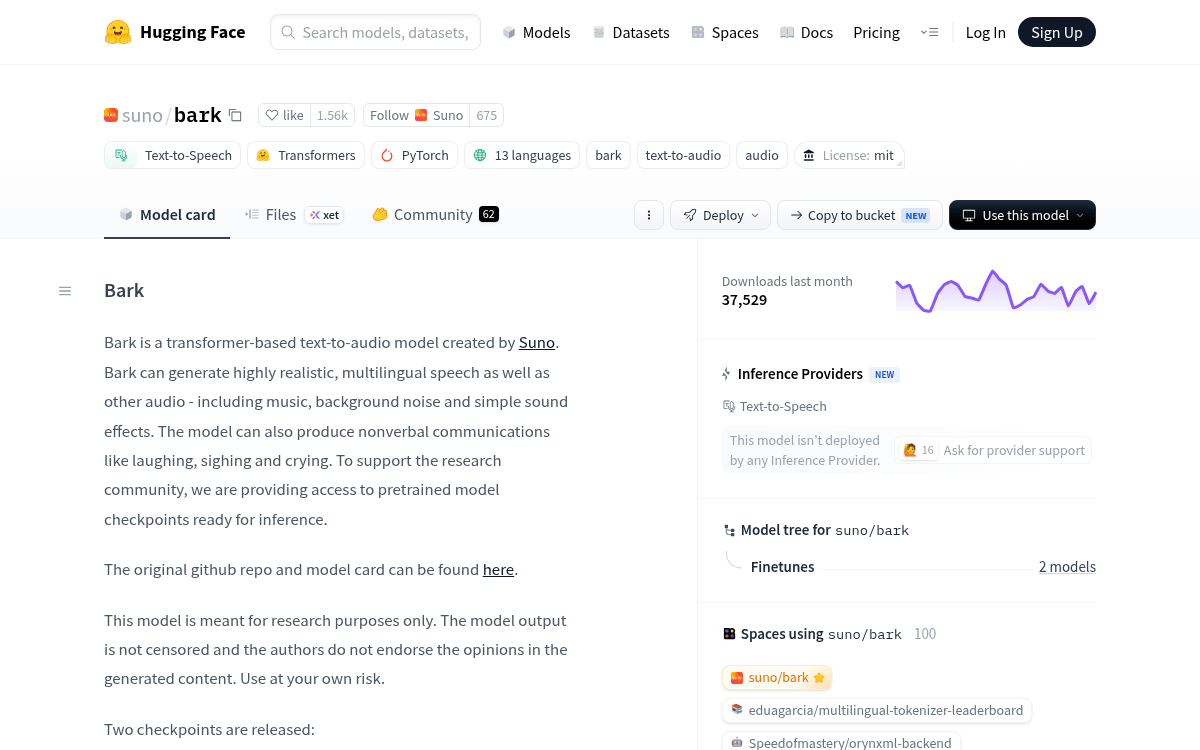
Suno's open-source Bark model is trending again on Hugging Face, offering multilingual speech, music, sound effects, and even laughter from plain text prompts.
 PRO
- Suno's Bark is a transformer text-to-audio model generating speech, music, and sound effects from prompts.
- MIT-licensed with pretrained checkpoints on Hugging Face, runnable via Transformers pipeline in under 10 lines.
- Supports 13 languages plus nonverbal cues like [laughs], [sighs], and speaker tags such as WOMAN or NARRATOR.
- Three-stage architecture: text to semantic tokens, semantic to coarse EnCodec tokens, coarse to fine tokens.
- Needs roughly 12GB VRAM for the full model, or 8GB with SUNO_USE_SMALL_MODELS=True environment flag.
- Ships a detection classifier in the official repo to flag Bark-generated audio downstream.
Suno's Bark model keeps resurfacing on Hugging Face's trending charts, and there's a reason. Most text-to-speech systems stop at a clean voice reading. Bark treats audio as one big generative problem, so a single prompt can produce speech, background noise, music snippets, and nonverbal sounds like laughing or sighing.
The model is transformer-based, MIT-licensed, and runs locally through Hugging Face Transformers or Suno's own bark library. Its card has collected around 1,500 likes and tens of thousands of downloads, and community forks continue to spin up wrappers for voice cloning, podcast generation, and long-form narration.
Speech is only part of the job
Bark generates highly realistic multilingual speech alongside music, background noise, simple sound effects, and nonverbal communication such as laughing, sighing, and crying. That last capability is what separates it from a normal TTS engine.
The trick is architectural. Bark converts input text directly to audio without an intermediate phoneme representation, which lets it generalize to arbitrary instructions beyond speech, including music lyrics and non-speech sounds. You can drop cues like [laughs], [sighs], [music], or ellipses for hesitation directly into the text, and the model will interpret them as part of the generation rather than trying to read them aloud.
This story is for Pro members
You've reached the end of the free preview. Upgrade to AlphaSignal Pro to read the full article - and everything else behind the paywall.
Comments
