

Sun Yat-sen's OMFA Handles Virtual Try-On and Try-Off Without Masks
A single diffusion model handles virtual try-on, try-off, and arbitrary-pose garment transfer without segmentation masks or clean product photos.
 PRO
- OMFA unifies virtual try-on and try-off in a single diffusion model without segmentation masks or product-photo garments.
- Bidirectional Tweedie Diffusion treats both tasks as latent completion, with only the target latent noised.
- SMPL-X pose conditioning enables arbitrary-pose and multi-view try-on from one portrait image.
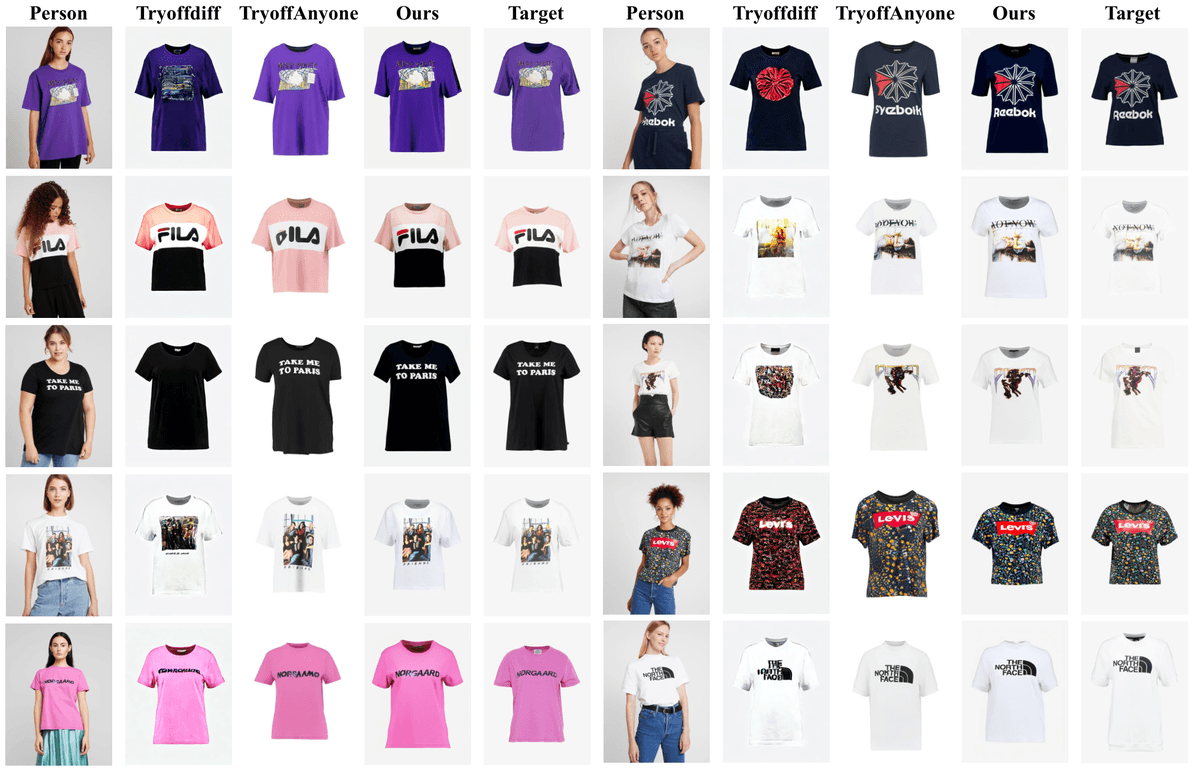
- Beats IDM-VTON, CatVTON, MV-VTON, and TryOffDiff on VITON-HD and DeepFashion-MultiModal benchmarks.
- Built on Stable Diffusion XL, fine-tuned at 768x1024 on 4 A800 GPUs for 65,000 steps.
- Code available at github.com/aaaqianqian/OneModelForAll; project page at onemodelforall.github.io.
Most virtual try-on systems have a dirty secret: they only work when you feed them a pristine product photo of the garment on a white background. Try to lift a shirt off a person in a casual snapshot and stick it on someone else, and the results fall apart. A new paper from Sun Yat-sen University and X-Era AI Lab proposes OMFA (One Model For All), a unified diffusion framework that handles try-on, try-off, and pose transfer inside a single network, without any segmentation masks at inference time.
The paper argues that the field has been treating three closely related problems as separate pipelines when they are really the same problem viewed from different angles. OMFA models garment-person transformations bidirectionally within a single architecture, removing the need for garment templates or segmentation masks.

Why current try-on models are stuck
The dominant recipe for diffusion-based virtual try-on relies on two crutches: clean garment templates (sometimes called exhibition garments) and segmentation masks to isolate clothing regions. That works in an e-commerce catalog, but not when a user snaps a picture of a friend's jacket and wants to see themselves wearing it.
Workarounds exist but come with pain. Some methods extract garments directly from images using segmentation algorithms, but these techniques often suffer from boundary artifacts, occlusion issues, and shape distortion. Others reformulate the problem as virtual try-off, reconstructing a canonical garment image from a dressed person, though such approaches treat try-on and try-off as independent tasks and overlook their inherent duality. Pose is another sore spot: 2D try-on models generally lock output to the input pose, and 3D approaches struggle because high-quality 3D garment data is scarce.
This story is for Pro members
You've reached the end of the free preview. Upgrade to AlphaSignal Pro to read the full article - and everything else behind the paywall.
Comments
