

Study Finds AI Fairness Breaks Down When LLMs Negotiate With Each Other
New research shows fairness in multi-agent LLM systems emerges from negotiation between agents, not from any single aligned model in isolation.
 PRO
- Study runs 600 hospital triage debates between two LLM agents to test if fairness emerges from negotiation.
- One agent is RAG-aligned to an ethical framework (Rawls, Mill, Nozick, Gilligan, Parfit, Dworkin); other is neutral or adversarial.
- Neither agent produces fair allocations alone, but joint outcomes satisfy fairness criteria neither would reach individually.
- Aligned agents moderate bias through contestation, not override, acting as corrective patches on biased counterparts.
- Even explicitly aligned agents show intrinsic prioritarian bias, consistent with known left-leaning LLM tendencies.
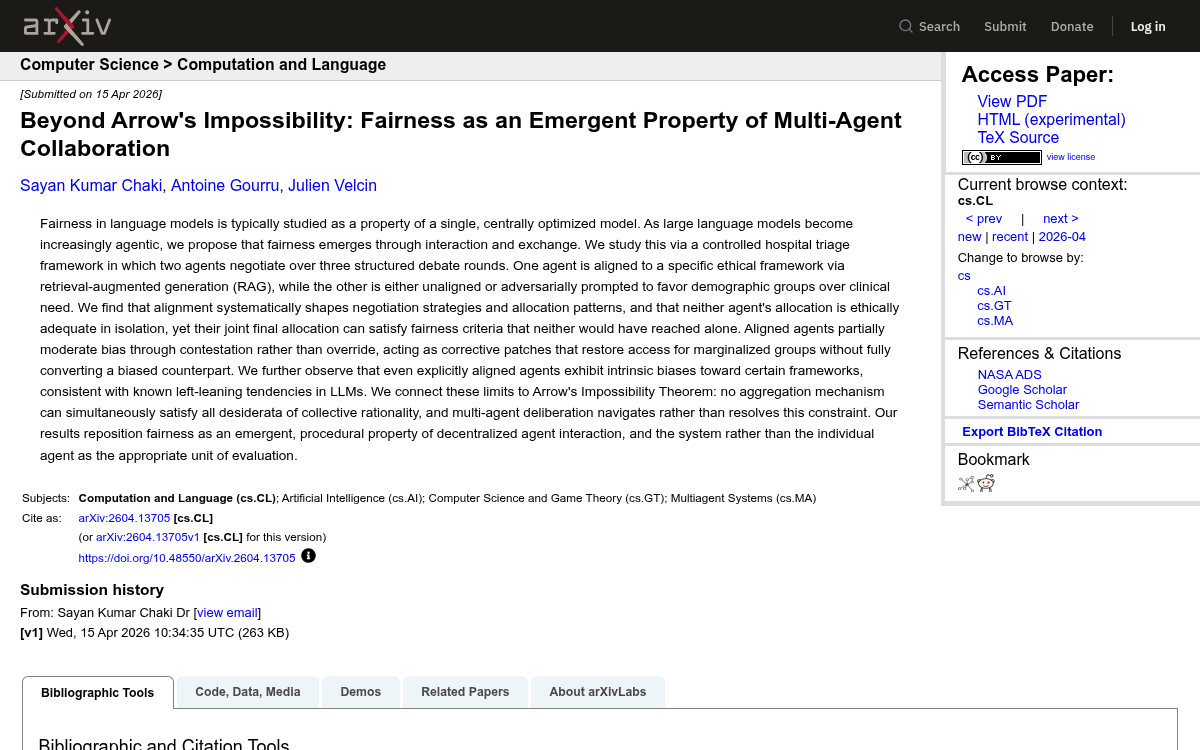
- Full paper on arXiv connects results to Arrow's Impossibility Theorem.
A new study argues that when large language models act as agents that negotiate with each other, fairness is not something you can bake into a single model. It emerges, or fails to emerge, from the back-and-forth between agents. The authors run 600 controlled hospital triage debates between two LLMs and find that a single ethically aligned agent often falls short on its own, while the joint allocation produced through debate can satisfy fairness criteria that neither party would have reached alone.
The paper from researchers at Laboratoire Hubert Curien and LIRIS frames this as a structural property rather than a bug. They connect it directly to Arrow's Impossibility Theorem, the classic social choice result that no aggregation rule over individual preferences can simultaneously satisfy every criterion of collective rationality. Multi-agent deliberation does not resolve that constraint. It navigates around it through argument.
Why solo fairness tests miss the point
Most fairness work in ML treats a model as a lone decision-maker: prompt it, grade the output against some criterion, repeat. That framing breaks down once you have agentic systems where multiple LLMs divide labor, share information, and negotiate outcomes in domains like clinical triage and financial approvals. The results are no longer a function of any single model's objective. They are a function of the interaction protocol.
To probe this, the authors design what they call a non-degenerate resource allocation problem. In a degenerate version, every ethical framework agrees on the ranking, so alignment becomes irrelevant and the task collapses to sorting. A non-degenerate problem requires that different welfare functionals (utilitarian, egalitarian, Rawlsian, prioritarian, care ethics, and libertarian) disagree about the optimum. Only then can you observe how alignment actually shapes negotiation.
This story is for Pro members
You've reached the end of the free preview. Upgrade to AlphaSignal Pro to read the full article - and everything else behind the paywall.
Comments
