

StateM Hits 95.3% on Terminal-Bench Without Changing a Single Model Weight
A new agent runtime called StateM pushes Terminal-Bench 2.1 to 95.3% without retraining, and reaches frontier scores on DeepSeek for about $15 in API calls.
 PRO
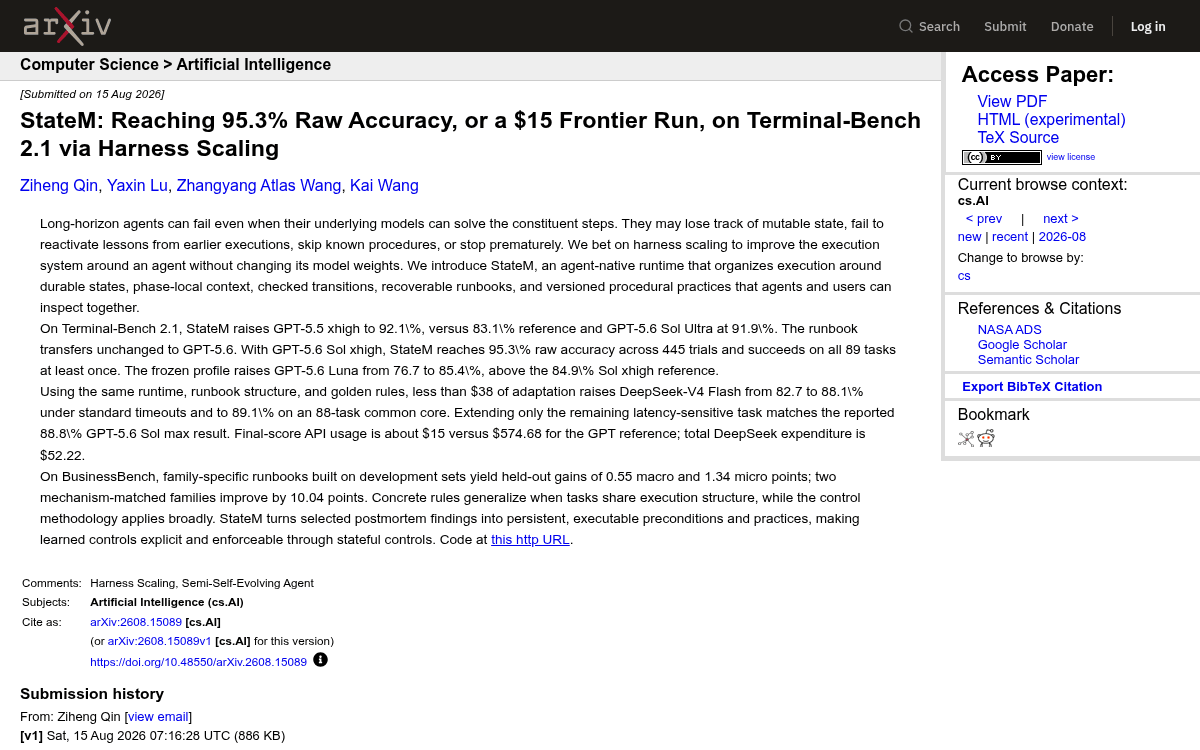
- StateM harness pushes GPT-5.6 Sol xhigh to 95.3% on Terminal-Bench 2.1 without touching model weights.
- DeepSeek-V4 Flash matches frontier 88.8% for a total spend of only $52.22 in API calls.
- Runbook transfers unchanged across model versions and families, lifting Luna from 76.7% to 85.4%.
- Runtime encodes postmortem lessons as durable states, checked transitions, and versioned procedures.
- BusinessBench gains are modest overall but reach 10 points on structurally similar task families.
- Full code, reproduction kit, and 440-trial artifact are publicly released.
A team of researchers has shown you can push a coding agent to the top of a hard benchmark leaderboard without touching a single model weight. The trick is rebuilding the scaffolding around the model. Their system, called StateM, is a runtime harness that wraps a frozen LLM in durable states, checked transitions, and versioned runbooks. It reaches 95.3% raw accuracy on Terminal-Bench 2.1 with GPT-5.6 Sol xhigh, while a DeepSeek-V4 Flash configuration matches frontier scores for roughly the price of a large pizza.
The failure mode nobody trains away
Long-horizon agents keep tripping over the same rakes. They lose track of mutable state, fail to reactivate lessons from earlier executions, skip known procedures, or stop prematurely, even when the base model is perfectly capable of solving each individual step. Anyone who has watched an agent forget a working directory, redo a migration it already completed, or declare victory halfway through a build has seen this in the wild.
The dominant response has been to train harder: more RL, more tool-use fine-tuning, bigger context windows. The authors bet on a different axis, arguing that scaling the harness can improve execution without changing model weights. In practice that means treating the runtime, rather than the model, as the place where reliability lives.
What StateM actually is
StateM is a runtime system that improves long-horizon agent execution through durable states, recoverable runbooks, and enforceable procedural controls, all without altering model weights. It organizes execution around durable states, phase-local context, checked transitions, recoverable runbooks, and versioned procedural practices that agents and users can inspect together.
A few of those terms are worth unpacking, since they are the whole game:
This story is for Pro members
You've reached the end of the free preview. Upgrade to AlphaSignal Pro to read the full article - and everything else behind the paywall.
Comments
