

SSMB Learns Blur-Proof Keypoints Without Deblurring or Labeled Data
A new keypoint detector skips deblurring entirely, learning directly from blurred images through self-supervision and beating supervised baselines on matching and localization.

 PRO
PRO- SSMB detects keypoints directly on motion-blurred images with no deblurring step and no handcrafted teacher.
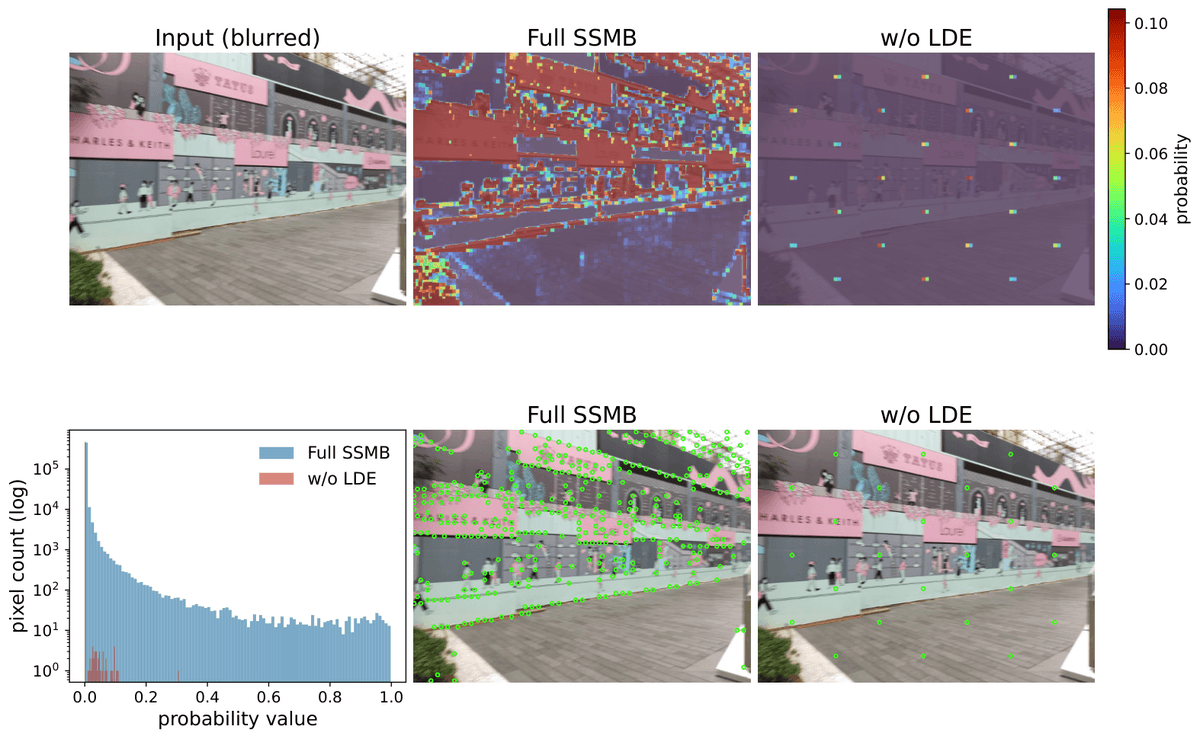
- A Local Discriminability Enhancement module restores fine local structure lost to global attention mixing.
- Training uses two self-supervised stages: synthetic geometry pretraining, then sharp-blur pair consistency.
- Reports state of the art among sparse detectors on matching, pose estimation, and visual localization under blur.
- Beats both supervised and self-supervised baselines across all evaluated tasks in the paper.
- Code, models, and datasets promised upon acceptance; nothing public yet.
Keypoint detection underpins SLAM, structure-from-motion, visual localization, and image matching. It works well on sharp images and collapses on blurry ones — exactly the conditions cameras face at night, on drones, or on anything moving fast. A new paper called SSMB proposes a self-supervised detector that skips deblurring entirely and learns which keypoints are actually repeatable under blur, rather than treating the degraded image as if it were sharp.
Why existing approaches break under blur
The dominant strategies are deblur-then-detect, or train a network to imitate a handcrafted detector like SIFT run on the sharp version of an image. Deblurring pipelines are computationally expensive and can introduce artifacts on severely blurred frames, where a single image simply preserves too little information. Imitation-based training bakes in the assumptions of the handcrafted detector, which was never designed with blur in mind. Neither approach targets repeatability under blur directly, and both fail in predictable ways when deployed in real conditions.
A label-free recipe with no deblurring
SSMB (Self-Supervised Motion Blur) drops both strategies. It learns keypoints from scratch using a two-stage self-supervised training scheme, then augments the network with a module designed to counteract what transformer-style global mixing does to fine local structure.
This story is for Pro members
You've reached the end of the free preview. Upgrade to AlphaSignal Pro to read the full article - and everything else behind the paywall.
Comments
