

SparseWorld-TC Ditches BEV Grids and Beats Self-Driving AI by 18.7%
A new transformer-based world model ditches VAE codebooks and bird's-eye-view grids, forecasting future 3D driving scenes directly from camera images with 18.7% higher mIoU.
 PRO
- SparseWorld-TC forecasts future 3D driving occupancy end-to-end from camera images, skipping VAE tokenization and BEV grids entirely.
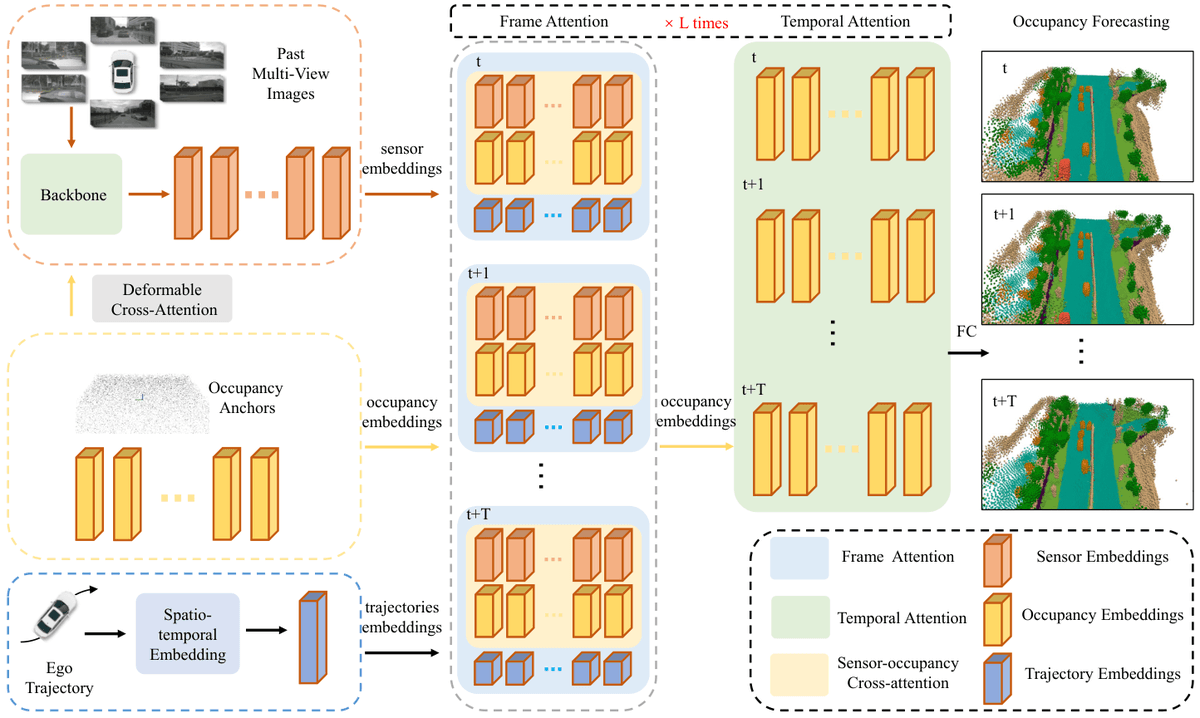
- Uses sparse 3D anchor queries fused with image features via a full-attention transformer, inspired by GPT and VGGT.
- Beats prior state-of-the-art on Occ3d-nuScenes by 18.7% mIoU (26.42 vs 22.26) and 11.7% IoU for 1-3s forecasting.
- Small variant with ResNet-50 hits 25.60 mIoU while running roughly 2x faster than the Large model.
- Trajectory conditioning stays robust with predicted trajectories and improves with more accurate ones.
- Code released as CVPR 2026 Oral at MrPicklesGG/SparseWorld-TC.
A team of researchers has taken a hard look at how autonomous driving world models predict future 3D scenes and concluded that two of the field's most common design choices, VAE tokenization and bird's-eye-view projection, are holding performance back. Their answer, SparseWorld-TC, throws both out and replaces them with a sparse, transformer-based pipeline that reads camera images end-to-end. It landed as a CVPR 2026 Oral, and the numbers explain why.
On the Occ3d-nuScenes forecasting benchmark, SparseWorld-TC-Large outperforms the previous state-of-the-art by 18.7% in mIoU (26.42 vs. 22.26) and 11.7% in IoU (49.21 vs. 44.07). That is a substantial jump for a task where recent papers have been trading a few tenths of a point.
Why grids and codebooks hit a ceiling
An occupancy world model tries to answer a specific question: given what a self-driving car has seen for the last couple of seconds, what will the surrounding 3D space look like one to three seconds from now, and how will it change if the car follows a particular trajectory? The dominant recipe has been a two-stage pipeline. First, encode the current scene into a compressed representation using a variational autoencoder (VAE) that quantizes it into discrete tokens, similar to how VQ-VAEs work in image generation. Then, run a GPT-style autoregressive model on those tokens to roll the scene forward in time.

The authors argue this stack has two structural weaknesses. Discrete tokenization caps how much information the model can carry forward, because everything has to fit through a finite codebook. Bird's-eye-view projection, the flat top-down grid that most driving perception systems standardize on, bakes in geometric assumptions that make it hard for the network to reason about vertical structure and fine-grained motion. When observations get squeezed into a limited-vocabulary representation before any forecasting happens, the ceiling shows up clearly in long-horizon predictions.
This story is for Pro members
You've reached the end of the free preview. Upgrade to AlphaSignal Pro to read the full article - and everything else behind the paywall.
Comments
