

Shanghai Jiao Tong's DialRouter Cuts AI Conversation Costs 80% Using AlphaGo-Style Search
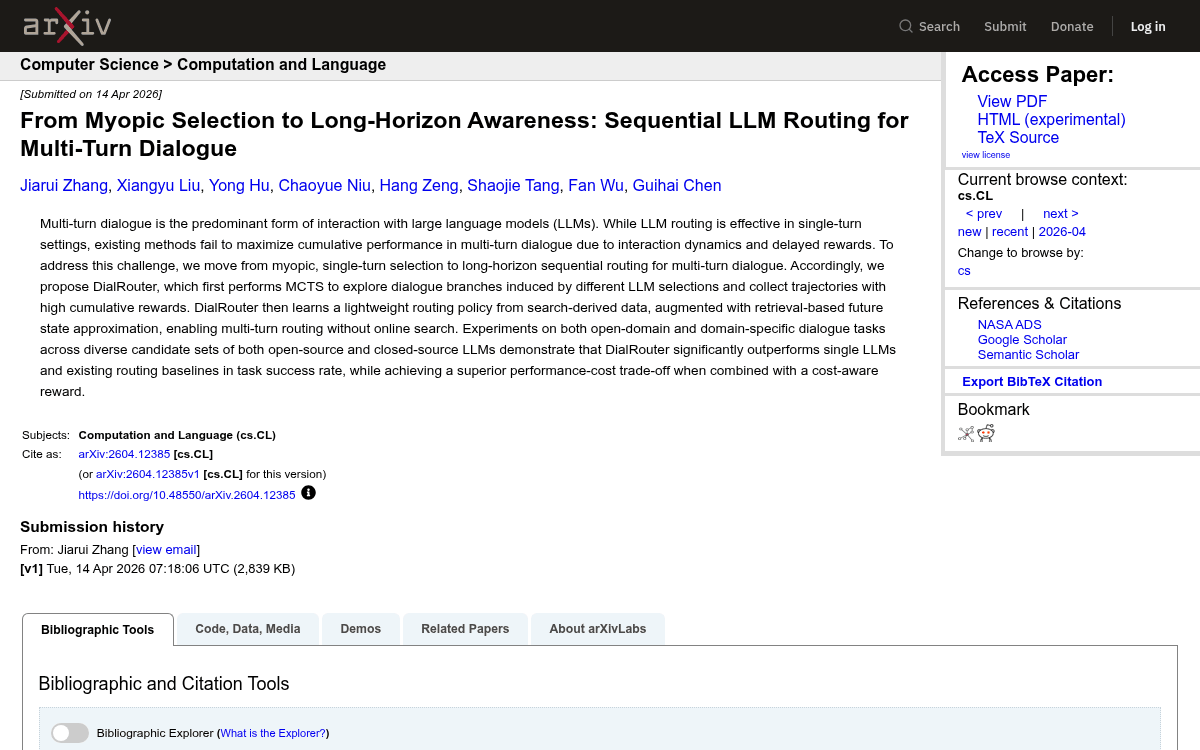
A new routing framework uses Monte Carlo Tree Search to pick the best LLM at each dialogue turn, boosting task success rates by 5 to 6 percent.
 PRO
- DialRouter reframes LLM routing as a long-horizon problem instead of independent per-turn selections.
- MCTS with a user simulator explores dialogue branches and collects high-reward routing trajectories for training.
- A lightweight Qwen2.5-0.5B router is trained via behavior cloning, avoiding online search at inference.
- Retrieval-based future state approximation using BGE-M3 helps the router anticipate dialogue evolution.
- Beats strongest single LLMs by 5 to 6 percent in success rate and reduces cost by roughly 80 percent.
- Tested on ShareGPT, JDDC e-commerce, and MedDG medical dialogue with Qwen, Llama, and closed-source pools.
Most LLM routers were built for a single, isolated question. You send a query, the router picks the cheapest capable model, and everyone goes home. Real usage of ChatGPT, Gemini, or Qwen looks nothing like that. Conversations sprawl across turns, users refine their goals, and a model's response at turn three shapes what the user asks at turn four. A new paper from Shanghai Jiao Tong University argues that treating each turn independently leaves substantial performance on the table, and proposes DialRouter to fix it.
Why per-turn routing keeps losing
In single-turn interaction, users seek a correct answer to a clearly defined query, and the router simply selects the best-performing model. Multi-turn dialogue is a different beast. Picking different LLMs under the same context elicits different follow-up user queries, sending the conversation down distinct trajectories, and the reward for whether the user's overall intent was fulfilled only shows up at the end.
That combination of dynamic branching and delayed rewards breaks the assumptions behind existing routers like RouteLLM, RouterDC, or Avengers. A locally optimal choice at a given turn does not necessarily yield a globally optimal dialogue outcome. Costs pile up too: every time you switch models the KV cache is invalidated and the whole history has to be re-encoded at full input pricing.
This story is for Pro members
You've reached the end of the free preview. Upgrade to AlphaSignal Pro to read the full article - and everything else behind the paywall.
Comments
