

SentrySearch Lets Anyone Search Hours of Raw Video in Plain English
SentrySearch lets you type a plain-English query and instantly extract the matching clip from hours of raw dashcam footage — no transcription, no tagging required.
 PRO
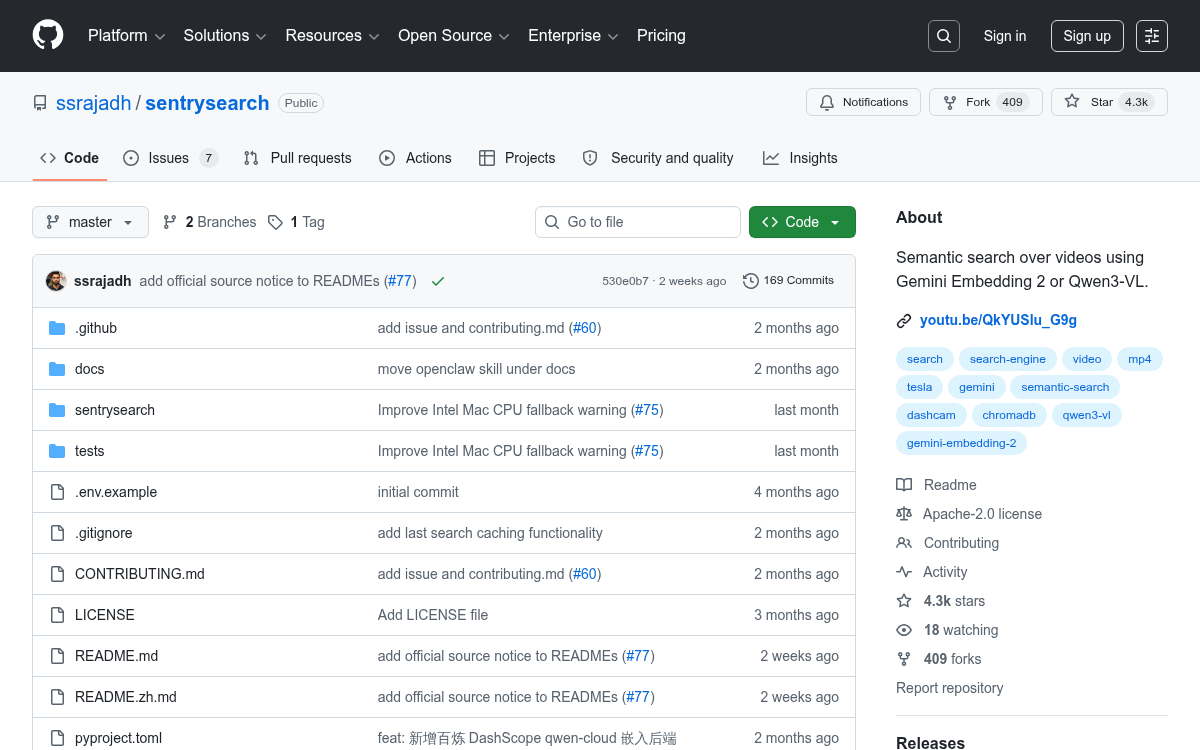
- What it is: SentrySearch is an open-source Python tool for semantic text-to-clip search over raw MP4/MOV footage.
- How it works: Videos are chunked, embedded as vectors using Gemini Embedding 2 or Qwen3-VL, stored in ChromaDB, and matched against text/image queries by cosine similarity.
- Two backends: Gemini API (cloud, ~$2.84/hr of footage) or local Qwen3-VL-Embedding (free, 2B/8B, runs on GPU/Apple Silicon).
- Key features: Image-as-query search, anomaly-based highlights mode, Tesla telemetry overlay, and a sibling tool ecosystem (SentryMerge, SentryBlur).
- Limitations: No OCR or audio transcription; chunk boundary events may be missed; local backend requires a dedicated GPU.
- Available now: Apache 2.0 license, 4,300+ GitHub stars, Python 3.11/3.12 required.
SentrySearch is an open-source Python tool that brings semantic search to raw video files. You describe a scene in plain English , "red truck running a stop sign" , and it finds the exact moment across hours of footage, trims the clip, and saves it. No manual tagging, no transcription pipeline, no frame-by-frame scrubbing. It works on any .mp4 or .mov file, not just Tesla dashcams, and runs entirely on your own machine.
The repo has picked up over 4,300 stars since launch, and it's easy to see why. Anyone who has sat through hours of dashcam footage looking for a specific incident knows the pain this solves.
The engine underneath
The key insight powering SentrySearch is that modern multimodal embedding models can project video and text into the same vector space , meaning a text query and a video clip can be directly compared with a cosine similarity score, no intermediary needed.
Gemini Embedding 2 is Google's first fully multimodal embedding model. It maps text, images, video, audio, and PDFs into a single unified vector space, enabling cross-modal comparison and retrieval using a shared semantic representation. Unlike earlier multimodal approaches such as CLIP, which pair a vision encoder with a text encoder and align them with contrastive learning after the fact, Gemini Embedding 2 is built on the Gemini foundation model itself , meaning it inherits deep cross-modal understanding from the ground up.
Video retrieval is where Gemini Embedding 2 pulls furthest ahead , over 17 points above Voyage on Youcook2 and over 13 points on Vatex. The practical upshot: a text query like "car cutting me off" is directly comparable to a 30-second video chunk at the vector level, with no captioning or speech-to-text step in between.
The alternative backend, Qwen3-VL-Embedding, is fully open-source and runs locally. Qwen3-VL-Embedding is built on the Qwen3-VL foundation model and provides an end-to-end pipeline for high-precision multimodal search by mapping diverse modalities , text, images, document images, and video , into a unified representation space, using a multi-stage training paradigm from large-scale contrastive pre-training to reranking model distillation. Both 2B and 8B parameter sizes are available to accommodate diverse deployment requirements.
This story is for Pro members
You've reached the end of the free preview. Upgrade to AlphaSignal Pro to read the full article - and everything else behind the paywall.
Comments
