

Sapient Intelligence's PRAXIST Runs Parallel AI Agents to Replace Manual Research Loops
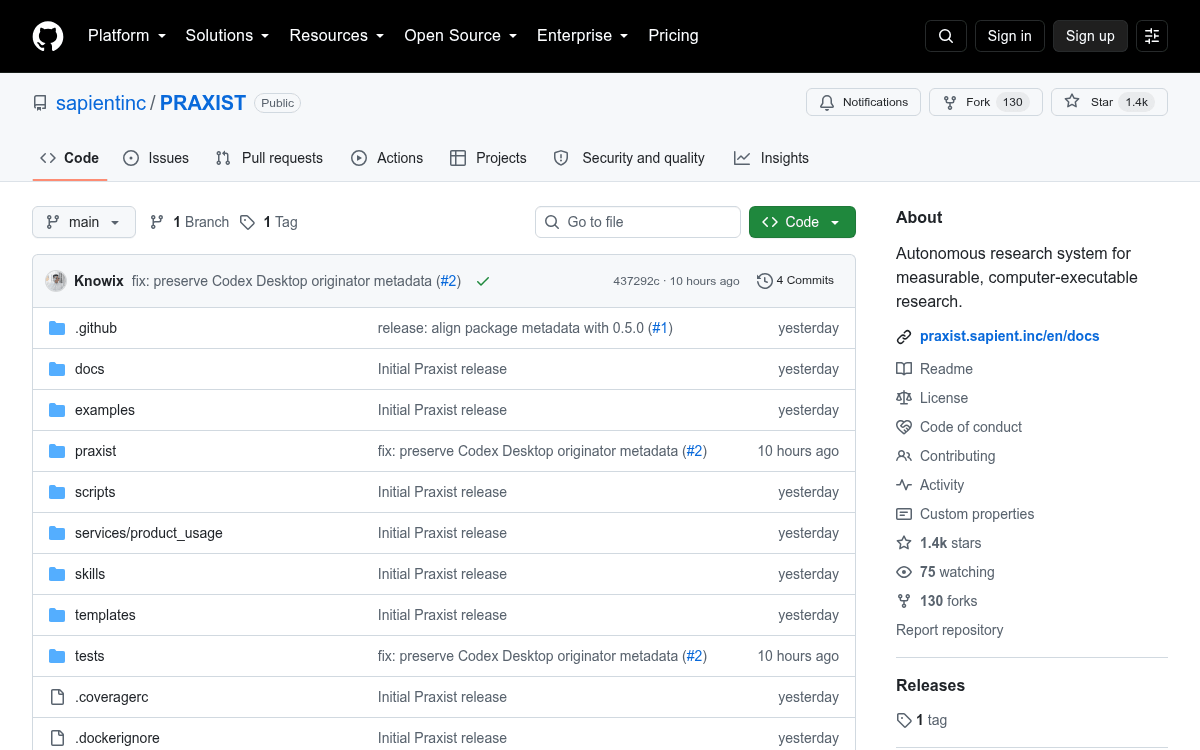
Sapient Intelligence open-sourced PRAXIST, an orchestration system that turns any runnable project with a measurable metric into a self-directed research loop.

 PRO
PRO- Sapient Intelligence released PRAXIST, an autonomous research orchestration system on GitHub.
- Runs parallel research peers across generations, evolving methods and architectures rather than tuning hyperparameters.
- Uses Quality-Diversity allocation and a Deep Innovation Gate to escape local optima during search.
- Works via Codex or Claude Code takeover; Codex-native mode requires no API key.
- Fair Source License: free commercial use for organizations under US$1M annual revenue.
- Requires Python 3.11+, a runnable baseline, and at least one measurable metric to launch.
Sapient Intelligence, the lab behind the Hierarchical Reasoning Model, has released PRAXIST, an open framework that treats research as a persistent process rather than a bag of one-off prompts. Instead of tuning hyperparameters inside a fixed search space, it spins up parallel agents that can rewrite methods, swap architectures, and carry evidence forward across generations of experiments.
Praxist targets measurable research problems that can be executed on a computer, turning an already runnable project into a continuous, evidence-driven research run. Across successive generations, parallel agents develop candidate solutions, evaluators convert results into structured evidence, and a planning panel synthesizes that evidence into the agenda for the next generation. The cycle keeps going until it converges on a solution or burns through the budget.
Where it slots into your stack
The design draws a hard line between orchestration and science. Praxist owns research orchestration, lifecycle, evidence protocols, replay, scheduling, and extension interfaces. The task project owns the objective, executable code, evaluator, metrics, baselines, prompts, roles, and domain constraints. That separation is why the same runtime can drive a JAX rocket-recovery simulator or a native Rust port of the same problem without knowing anything domain-specific.
This story is for Pro members
You've reached the end of the free preview. Upgrade to AlphaSignal Pro to read the full article - and everything else behind the paywall.
Comments
