

Sakana AI's Namazu Tackles What Google Translate Gets Wrong About Japanese Tone
Sakana AI launches a free Japanese translation tool powered by Namazu, its Japan-adapted model, with translate, proofread, and Q&A modes
- Sakana AI launched Sakana Translate, a free web tool for Japanese, English, and Chinese bidirectional translation.
- Powered by Namazu, Sakana's post-trained adaptation of DeepSeek-V3.1 and Llama 3.1 405B for Japanese cultural context.
- Three modes: Translate (up to ~5,000 chars, streaming), Proofread (diff-highlighted edits), and Ask (in-context follow-up questions).
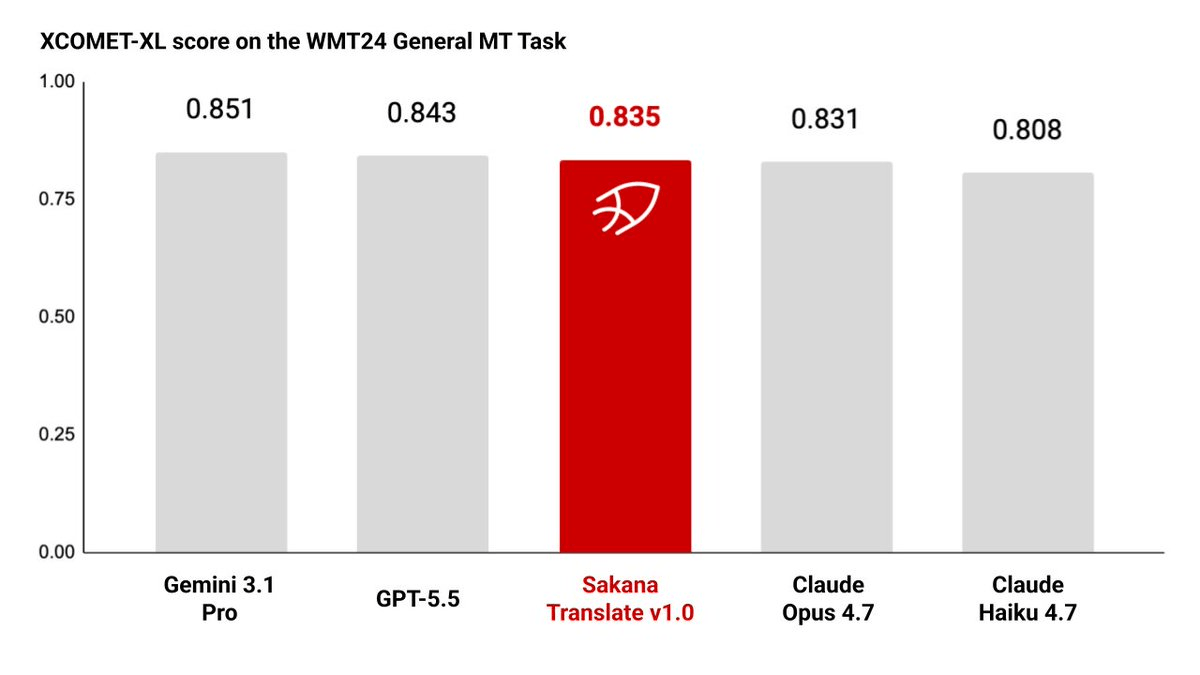
- Benchmarked on WMT 2024 with XCOMET-XL; scores place it in the same band as leading frontier models.
- Designed to preserve Japanese register, honorifics, and cultural nuance that generic tools flatten or miss.
- Enterprise roadmap includes API access, SSO, audit logs, on-premises deployment, and industry-specific engines.
Sakana Translate is Sakana AI's new translation feature inside Sakana Chat, and it is live today for free. It handles bidirectional translation between Japanese, English, and Chinese, and it is built on Namazu, the company's model series specifically adapted for Japanese language and culture. The pitch is simple: most translation tools get the grammar right but miss the tone, and tone is often the whole point.
Three modes, not just a text box
The tool ships with three distinct modes that cover the full workflow of working across languages:
- Translate: Paste up to roughly 5,000 Japanese characters and get a streaming translation in real time. Handles emails, slides, articles, and web pages.
- Proofread: Submit a draft and get it refined for naturalness, politeness, tone, and register. Changes are shown with diff highlighting so you can see exactly what shifted and why.
- Ask: Follow up on any translation result directly in context. Clarify a nuance, request an alternative phrasing, or ask why a particular word was chosen, without leaving the page.
The Ask mode is the most interesting addition from a workflow perspective. It collapses the loop between translator and dictionary into a single interface, which is genuinely useful when you are trying to understand why a phrase works, not just what it means.
The model underneath
Namazu is a model series announced earlier this year that uses post-training techniques to adapt existing open-weight models, including DeepSeek-V3.1-Terminus and Meta's Llama 3.1 405B, for Japan's cultural context. Post-training here means taking a fully trained base model and running a second, targeted training pass on curated data, rather than building from scratch.
Benchmarks indicate that the Namazu models maintain parity with their base models across key areas like reasoning, knowledge, and coding, suggesting the fine-tuning process does not significantly degrade the model's fundamental abilities. The translation-specific version powering Sakana Translate was evaluated on the WMT 2024 General Translation task using XCOMET-XL, a learned metric trained to approximate human quality judgments. Results placed Sakana Translate within the score band trailing closely behind the leading frontier models, demonstrating competitive quality as a translation engine.
The qualitative case is arguably more compelling than the benchmark number. Standard tools tend to flatten Japanese into grammatically correct but tonally neutral English. Sakana Translate's stated goal is to preserve register, the social distance encoded in how formal or casual a sentence is, which matters enormously in Japanese business communication.
Where it actually shines
The two example outputs in the official blog post illustrate the target use cases well. A business email opening with formal Japanese honorifics comes out in polite but natural English, preserving the deferential tone rather than flattening it. An English text containing the internet shorthand "Iykyk" (If you know, you know) comes out as casual, conversational Japanese that matches the original register. Both are things that generic translation tools routinely get wrong.
The practical sweet spots are:
- Business email drafting and review between Japanese and English
- Reading foreign-language articles or documents without switching tabs
- Checking whether a draft email sounds appropriately formal or informal to a native speaker
- Learning Japanese by asking follow-up questions about specific phrasing choices
The bigger picture: sovereign AI for Japan
Namazu is described as a demonstration of "post-training technology for building models that meet the cultural, value-based, and security requirements of each country." ChatGPT, Claude, and Gemini were not designed from the start with Japanese politics, culture, legal systems, or business practices in mind. Sakana Translate is the consumer-facing expression of that thesis applied to a concrete, high-frequency task.
Mitsubishi Electric announced an investment in Sakana AI, with the company's valuation reaching $2.65 billion, making it the largest AI company originating from Japan. Sakana Translate is the first product that puts that Japan-specific capability directly in front of everyday users, rather than keeping it inside a general-purpose chat interface.
The roadmap signals a more serious enterprise play is coming. Looking ahead, Sakana AI is planning industry-specific translation engines, file translation, and glossary integration, along with enterprise-focused capabilities including API access, SSO, audit logs, and on-premises deployment. The free web app is essentially the public beta for a product line that will eventually target corporate Japan's substantial need for high-quality, culturally aware translation at scale.
How to try it
Sakana Translate is available to anyone for free at translate.sakana.ai. All three modes are accessible with a single account registration. There is no API yet, but the enterprise contact form is live for teams that want to get ahead of that roadmap.
Comments
