

Sakana AI's Fugu-Ultra v1.1 Beats GPT-5.5 and Claude on Coding Benchmarks
Sakana AI's Fugu-Ultra v1.1 upgrades its multi-model orchestration system with gains of up to 7.9 points across benchmarks, at the same price as v1.0

- Fugu-Ultra v1.1 is live: Sakana AI updated its multi-model orchestration system with gains of up to 7.9 benchmark points over v1.0, at no price change.
- Benchmark highlights: 82.1% on TerminalBench 2.1, 73.7% on SWE-Bench Pro, 95.5% on GPQA-Diamond, beating GPT-5.5, Opus 4.8, and Gemini 3.1 Pro.
- How it works: Fugu is a trained orchestrator that dynamically routes queries to a pool of frontier models (GPT-5.5, Claude Opus 4.8, Gemini 3.1 Pro) and coordinates their outputs.
- Pricing: $5/$30 per 1M input/output tokens for pay-as-you-go; subscriptions from $20–$200/month. Free second month if you subscribe before end of July 2026.
- Access: OpenAI-compatible API, also available on OpenRouter, Vercel, and opencode. Not available in EU/EEA.
- Caveat: All benchmarks are Sakana-reported and not yet independently verified; latency is higher than single-model calls for Fugu-Ultra.
Fugu-Ultra v1.1 is live. Sakana AI's orchestration-based model system gained up to 7.9 benchmark points over v1.0, with the sharpest improvements on ProgramBench and Terminal Bench 2.1. The price is unchanged, so existing users get a better model at no extra cost.
An orchestra, not a model
Fugu is a system that orchestrates a pool of existing frontier models behind a single OpenAI-compatible API. A learned conductor reads your query and decides which combination of GPT-5.5, Claude Opus 4.8, and Gemini 3.1 Pro should handle it, and how they should collaborate. Fugu is itself a language model trained to call various LLMs in an agent pool, including instances of itself recursively.
The underlying logic is that different frontier models have different strengths. GPT tends to lead in math, Gemini in scientific recall, Opus in software engineering and debugging. Fugu learns when to call each one and how to combine their outputs into something stronger than any single model could produce alone.
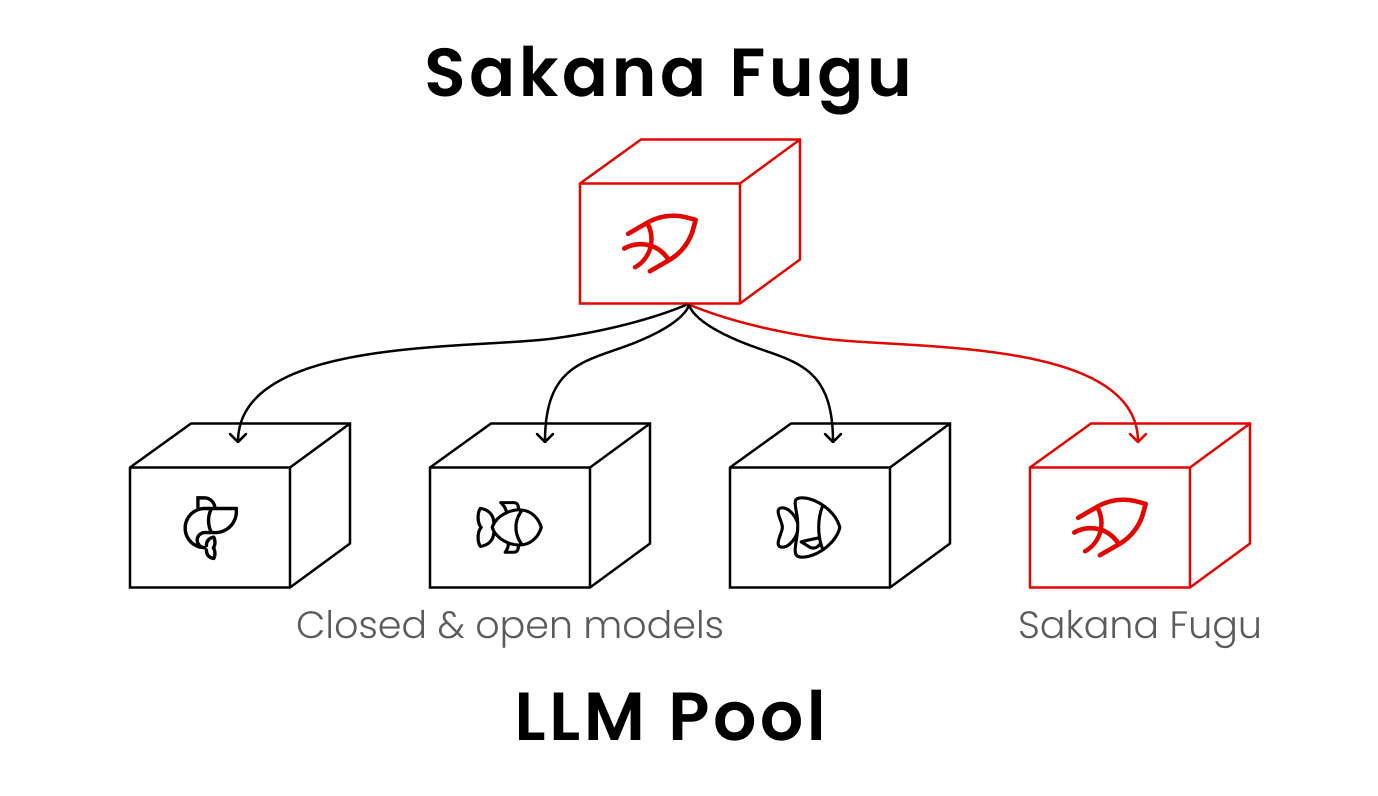
For v1.1, Sakana incorporated the latest frontier model releases into the agent pool. As the underlying models improve, Fugu routes to better workers, and the orchestration layer learns to exploit their new capabilities.
What the benchmarks show
Gains are concentrated in developer-relevant tasks:
- Terminal Bench 2.1: Fugu Ultra scores 82.1%, ahead of GPT-5.5 (78.2%), Claude Opus 4.8 (74.6%), and Gemini 3.1 Pro (70.3%). The benchmark tests agentic coding in a live terminal, including file manipulation, shell commands, and multi-step execution.
- SWE-Bench Pro: Fugu Ultra scores 73.7%, ahead of Claude Opus 4.8 (69.2%), GPT-5.5 (58.6%), and Gemini 3.1 Pro (54.2%).
- GPQA-Diamond (graduate-level science): Both Fugu and Fugu-Ultra hit 95.5%, above Gemini's 94.3% and GPT-5.5's 93.6%.
- Humanity's Last Exam: Fugu-Ultra reaches 50.0%, edging Claude Opus 4.8 (49.8%) and GPT-5.5 (41.4%).
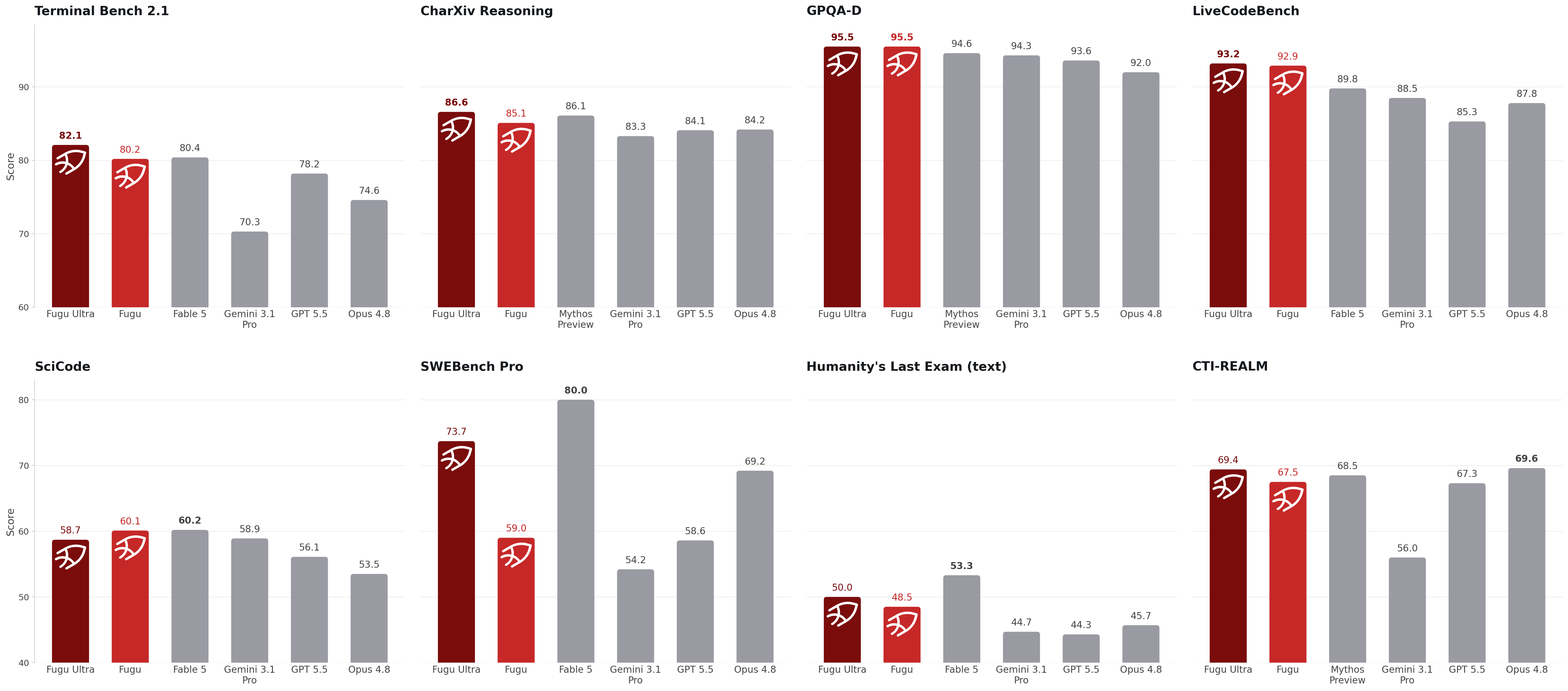
One caveat: all numbers are Sakana-reported and have not been independently reproduced by third-party labs. Comparisons to Fable 5 and Mythos Preview also need an asterisk. Fable 5 is export-controlled and absent from Fugu's pool, so those figures reflect parity by claim rather than head-to-head evaluation.
How the orchestration works
Fugu and Fugu-Ultra use different training approaches, each targeting a different point on the quality-latency tradeoff.
Fugu (the faster, balanced variant) trains in two stages. First, it learns which model suits each query type through supervised fine-tuning on single-step tasks, attaching a lightweight selection head to a language model backbone that outputs a probability distribution over worker models rather than generating text. Routing decisions are fast. Then it refines using evolutionary optimization (sep-CMA-ES) on real multi-turn agentic trajectories from coding environments like Claude Code and Codex.
Fugu-Ultra builds on the Conductor framework, trained with reinforcement learning (GRPO) to design full agentic workflows in natural language. Rather than picking one model, it decomposes a query into subtasks, assigns them to specific agents, and defines how those agents communicate. The result is higher quality at the cost of additional latency, making it best suited to complex tasks that benefit from combining multiple specializations.
The system supports up to five-step workflows and uses a deliberate memory architecture: agents are isolated from each other within a single workflow to prevent one agent's reasoning from constraining the others, but share memory across turns in a multi-turn conversation. This prevents what the team calls "orchestration collapse," where the first agent to act steers all subsequent agents down the same path.
In practice, Fugu-Ultra learns non-obvious collaboration patterns. For a hard math problem, it might use Gemini and GPT as independent solvers, then bring in GPT as the aggregator to resolve their disagreement. For a software engineering task, it might use GPT to build and Opus to debug, alternating between them at critical junctures. These topologies emerge from training rather than hand-designed rules.
Where it excels, where it doesn't
Fugu-Ultra performs best on:
- Agentic coding: SWE-Bench Pro and Terminal Bench results suggest real gains for complex, multi-file software engineering tasks.
- Long-horizon research: Early users report patent landscape analyses completing in hours rather than days.
- Paper reproduction: Autonomous operation for hours, reading papers, implementing, training, and evaluating.
- Cybersecurity analysis: The specialized Fugu-Cyber variant scores 86.9% on CyberGym.
- Scientific reasoning: Strong results on Humanity's Last Exam and GPQA-Diamond.
GPT-5.5 wins MRCRv2 with 94.8% versus Fugu Ultra's 93.6%. MRCRv2 tests long-context recall, specifically whether a model can retrieve specific information from very long documents. Latency is also a real tradeoff for Fugu-Ultra, which coordinates multiple agents per query. For fast, interactive responses, the standard Fugu model is the better choice.
Getting started
Fugu is available through an OpenAI-compatible API, so you can swap it in with minimal code changes:
import os
from openai import OpenAI
client = OpenAI(
    api_key=os.environ["FUGU_API_KEY"],
    base_url=os.environ["FUGU_BASE_URL"] + "/v1",
)
response = client.chat.completions.create(
    model="fugu-ultra",
    messages=[{"role": "user", "content": "Your task here"}]
)
print(response.choices[0].message.content)
Fugu models support OpenAI-compatible built-in tools in the Responses API. To enable web search, add the web_search tool to your request's tools array, the same way you would with OpenAI models. Fugu is also available on OpenRouter, Vercel AI Gateway, and opencode.
Pricing
Fugu Ultra is priced at $5 per 1M input tokens, $30 per 1M output tokens, and $0.50 per 1M cached input tokens, with higher rates above 272K context. Subscription plans run from $20/month (Standard) to $100/month (Pro, 10x usage) to $200/month (Max, 20x usage). Sakana is running a promotion through the end of July 2026: subscribe and get a free second month. Fugu-Cyber is only available on the pay-as-you-go token plan.
The broader bet Sakana is making is that orchestration is a new scaling axis, one that sidesteps training a bigger model from scratch. As new frontier models ship, Sakana says it takes roughly two weeks to retrain and evaluate updated Fugu models before rolling them out. Every time GPT, Claude, or Gemini improves, Fugu improves with it.
Comments
