

Sakana AI's Fugu Ultra Beats GPT-5 by Orchestrating Rival Models
Sakana AI's Fugu Ultra matches Fable 5 and Mythos Preview by orchestrating a swappable pool of frontier models through a single OpenAI-compatible API.

- Generally available now: Sakana Fugu is a multi-agent orchestration system delivered as a single OpenAI-compatible API endpoint.
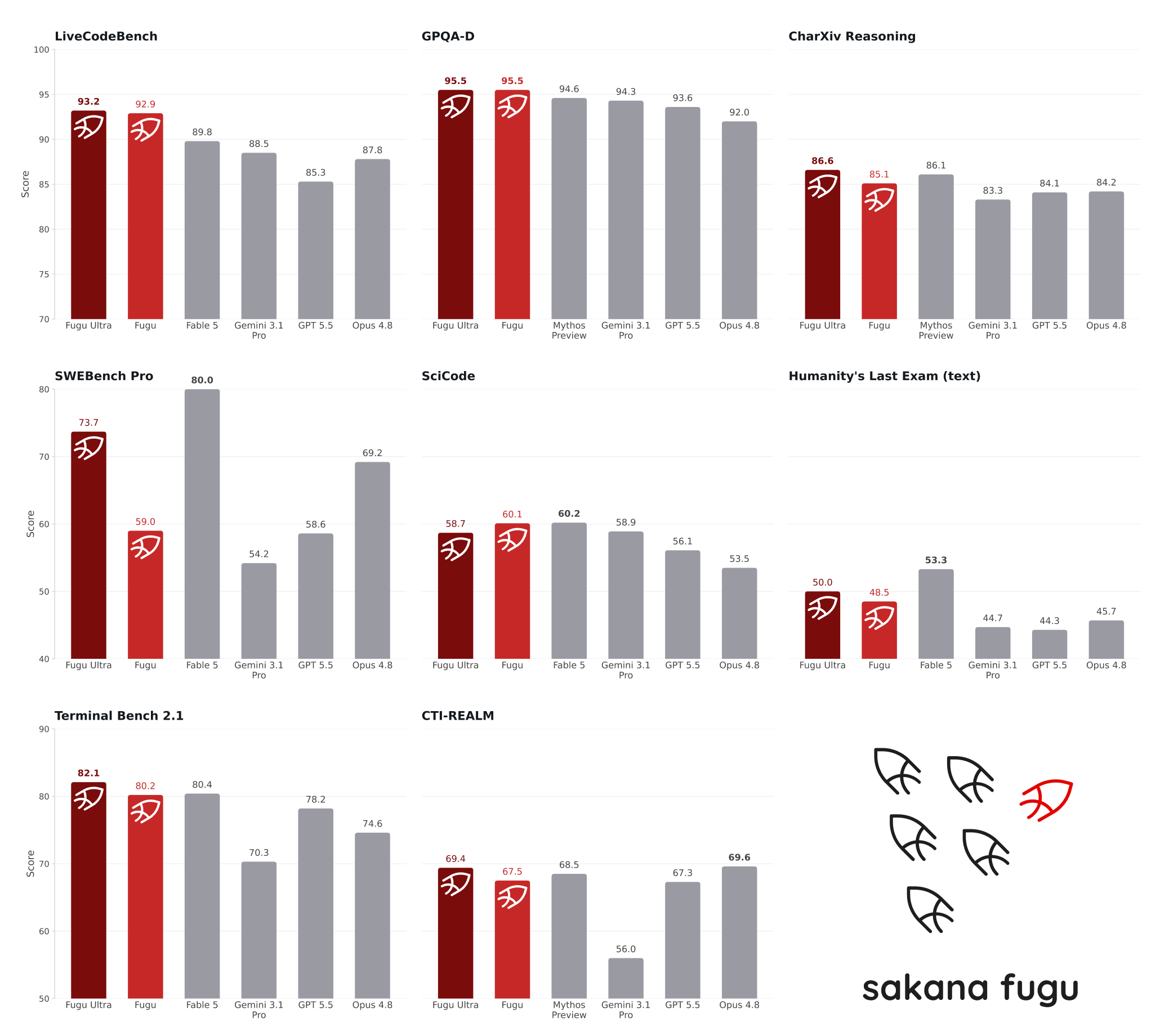
- Frontier-level benchmarks: Fugu Ultra matches Anthropic's Fable 5 and Mythos Preview on SWE Bench Pro (73.7), LiveCodeBench (93.2), and GPQA-D (95.5).
- Geopolitical angle: Built explicitly as a hedge against export controls -- the agent pool is fully swappable so no single vendor restriction can break the system.
- How it works: A small LLM trained via reinforcement learning to orchestrate a pool of frontier models, assigning Thinker/Worker/Verifier roles and calling itself recursively.
- Pricing: Subscriptions from $20-$200/month; Fugu Ultra pay-as-you-go at $5 input / $30 output per 1M tokens.
- Key limitation: Routing decisions are proprietary and not exposed; Fugu Ultra's agent pool is fixed and cannot be customized.
Sakana Fugu is a new kind of AI product: not a bigger model, but a model that commands other models. Built by Tokyo-based Sakana AI, it wraps a full multi-agent orchestration system behind a single API endpoint. You send a request, and Fugu decides whether to answer directly or assemble a team of specialized frontier models to tackle it. The complexity never reaches your code.
Fugu dynamically orchestrates the world's best models to tackle complex, multi-step tasks, accessible through a single model API. At launch, it comes in two variants: Fugu, tuned for low latency and everyday work, and Fugu Ultra, the flagship model optimized for maximum answer quality on hard, multi-step problems.
The Geopolitical Trigger
The timing of this launch is not accidental. Recent disruptions in the AI landscape have demonstrated the severe risk of single-vendor dependency. For an organization or a nation, relying on a single company's APIs for critical infrastructure, finance, or governance is a material vulnerability. Specifically, export controls imposed on Anthropic's Fable and Mythos models showed that access can shift or disappear overnight due to changing regulatory boundaries, export controls, and foreign policies.
Fugu's architecture is a direct answer to that problem. Because Fugu is powered by models trained to be powerful orchestrators with an underlying pool of entirely swappable agents, if a single provider restricts access, Fugu dynamically routes around the disruption. The agent pool is designed to be modular: swap out a restricted model, fold in a new one, and the system keeps running.
How It Actually Works
The Fugu model is itself a small language model that learns to call other LLMs. In the course of training, it can learn to call itself, enabling test-time scaling. This recursive self-calling is key: the orchestrator can spin up corrective workflows when its first coordination strategy fails, without any retraining.
Fugu achieves superior performance by dynamically coordinating and orchestrating a diverse pool of powerful models. Instead of using domain knowledge to prescribe team organization, roles, or workflows, Fugu learns to dynamically assemble agents from a pool and coordinate them through non-obvious but highly efficient collaboration patterns.
The underlying research comes from two ICLR 2026 papers: TRINITY and the Conductor. The Conductor is a small language model trained via reinforcement learning to automatically orchestrate a diverse pool of worker LLMs. It dynamically analyzes inputs, distributes labor among workers, and coordinates among agents, achieving state-of-the-art results on difficult reasoning and coding benchmarks, outperforming individual frontier models as well as expensive human-designed multi-agent pipelines.
In practice, the Conductor learned some surprisingly clever strategies: to achieve record scores on coding benchmarks, it frequently assigned Gemini 2.5 Pro and Claude Sonnet 4 to act as high-level planners, and only brought in GPT-5 at the very end to write the final optimized code.
Benchmark Numbers Worth Knowing
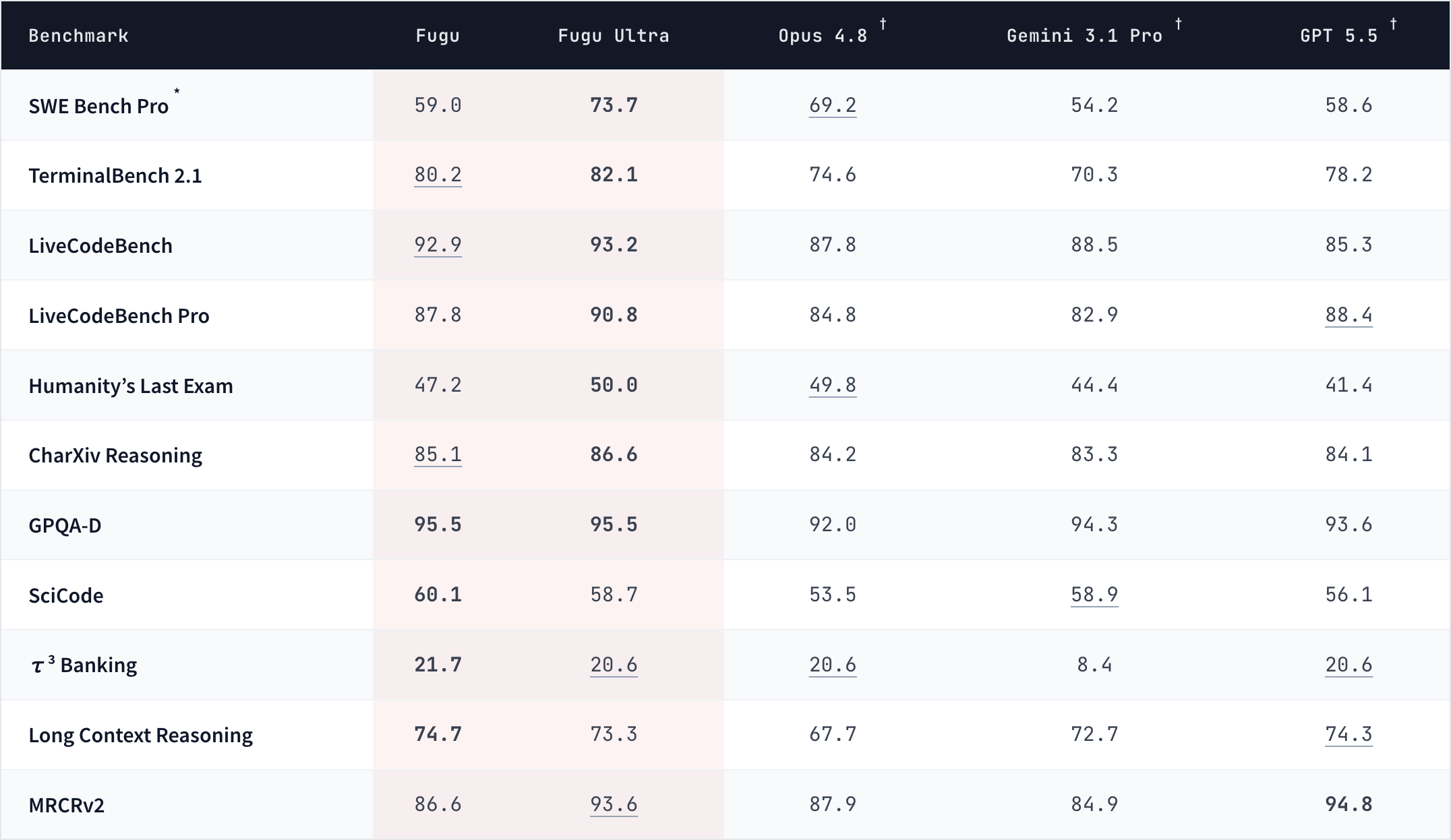
Fugu Ultra stands shoulder-to-shoulder with leading models like Fable 5 and Mythos Preview across the industry's most rigorous engineering, scientific, and reasoning benchmarks, delivering frontier capability without the risk of export controls. Here is how it stacks up against the publicly accessible frontier models:
| Benchmark | Fugu | Fugu Ultra | Opus 4.8 | Gemini 3.1 Pro | GPT 5.5 |
|---|---|---|---|---|---|
| SWE Bench Pro | 59.0 | 73.7 | 69.2 | 54.2 | 58.6 |
| TerminalBench 2.1 | 80.2 | 82.1 | 74.6 | 70.3 | 78.2 |
| LiveCodeBench | 92.9 | 93.2 | 87.8 | 88.5 | 85.3 |
| GPQA-D | 95.5 | 95.5 | 92.0 | 94.3 | 93.6 |
| Humanity's Last Exam | 47.2 | 50.0 | 49.8 | 44.4 | 41.4 |
| SciCode | 60.1 | 58.7 | 53.5 | 58.9 | 56.1 |
One important caveat: a footnote in Sakana's benchmark table deserves a closer look. The Opus 4.8 SWE-Pro score is Anthropic's self-reported number from a custom scaffold, while Sakana ran its own evaluations on the mini-swe-agent scaffold, meaning the headline comparison is between two slightly different evaluation setups.
What Early Users Are Actually Building
Fugu's value shows up most clearly in long, messy, real-world workflows, which is exactly what Sakana focused on during the beta program with close to 500 early users. The use cases that emerged fall into a clear pattern:
- Automated research: One researcher mapped a patent landscape across ~20 papers and several patents -- normally 3-4 days of work -- and got a full analysis in a few hours, including connections between papers they would never have spotted alone.
- Code review: A software engineer reported Fugu Ultra surfacing over 20 issues in a codebase where other tools flagged only 3.
- Security assessment: Given a single scoped instruction, Fugu drove a full end-to-end security assessment covering recon, XSS/SQLi checks, auth review, and a clean report with evidence and retest steps.
- Paper reproduction: From one simple request, Fugu worked autonomously for nearly four hours -- reading a paper, implementing, training, evaluating, and analyzing gaps. On one CUDA task it delivered over a 100x speedup in a single session.
- Agentic ML research: In an AutoResearch experiment running 123 experiments over ~14 hours on a single H100, Fugu Ultra achieved the best mean bits-per-byte score, ahead of all three frontier model baselines.
One enterprise platform executive noted that Fugu showed unusually strong persona stability across long sessions, holding its identity where other models drift -- and for agent products, that may matter more than raw benchmark scores.
The Assumption That Needs Updating
The standard mental model in the field is that better performance requires a bigger, more expensive model. Fugu challenges that directly. This automated coordination achieves state-of-the-art results on difficult reasoning and coding benchmarks, outperforming individual frontier models as well as expensive human-designed multi-agent pipelines, at a fraction of the cost and with fewer API calls than competitors.
The emphasis on multi-model coordination and autonomous agent selection implies a strategy to sit as a control layer between enterprises and underlying large language models. This is a meaningful architectural bet: that the value in AI infrastructure will increasingly accrue to the orchestration layer, not the model layer. Sakana has been building toward this for a while, with earlier projects like evolutionary model merging, The AI Scientist, and AB-MCTS all showing that multiple frontier models working together through structured coordination can outperform individual models on difficult reasoning tasks. Fugu is the commercial expression of that entire research program.
Pricing and Access
Sakana Fugu is generally available today. Both Fugu and Fugu Ultra are accessible through a single OpenAI-compatible API, with subscription tiers for everyday use and a pay-as-you-go plan for heavier and enterprise workloads. Subscription tiers are:
- Standard: $20/month -- lightweight daily use
- Pro: $100/month -- 10x Standard usage, for regular coding and research sessions
- Max: $200/month -- 20x Standard usage, for heavy long-running workloads
For enterprise pay-as-you-go, Fugu Ultra is priced at $5/M input tokens and $30/M output tokens (rising to $10/$45 for contexts above 272K tokens). Fugu's pricing is based on the top-tier model active in the pool at any given moment -- you never pay stacked model fees. You can get started at the Sakana console.
One thing Fugu does not expose: which underlying models it used for a given query. The routing logic is proprietary by design. For teams with compliance requirements, the standard Fugu model lets you opt specific providers out of the pool entirely -- though Fugu Ultra's pool is fixed to deliver its full performance.
Comments
