

Sakana AI's Fugu and Namazu Now Write and Run Code Inside Chat
Sakana Chat adds its orchestrator model Fugu, a refreshed Namazu, and in-browser Python execution — making frontier-grade AI accessible without an API

- Sakana Chat updated: adds Sakana Fugu (multi-agent orchestrator) and a new-generation Namazu to its free browser interface.
- Code execution live: models now run Python in a sandbox and preview HTML, Word, and slide outputs directly in the chat panel.
- File attachments: images, PDFs, and Office files can be attached across all models for analysis and transformation.
- Namazu is a Kimi K2.6 fine-tune specialized for Japanese business; FairPoliticsQA score jumped from 34.1% to 56.3% over the base model.
- Fugu is an orchestrator based on ICLR 2026 papers TRINITY and Conductor, routing tasks across a pool of frontier LLMs dynamically.
- Pricing: Chat is free; Namazu API starts at $0.95/1M input tokens; Fugu subscriptions run $20–$200/month.
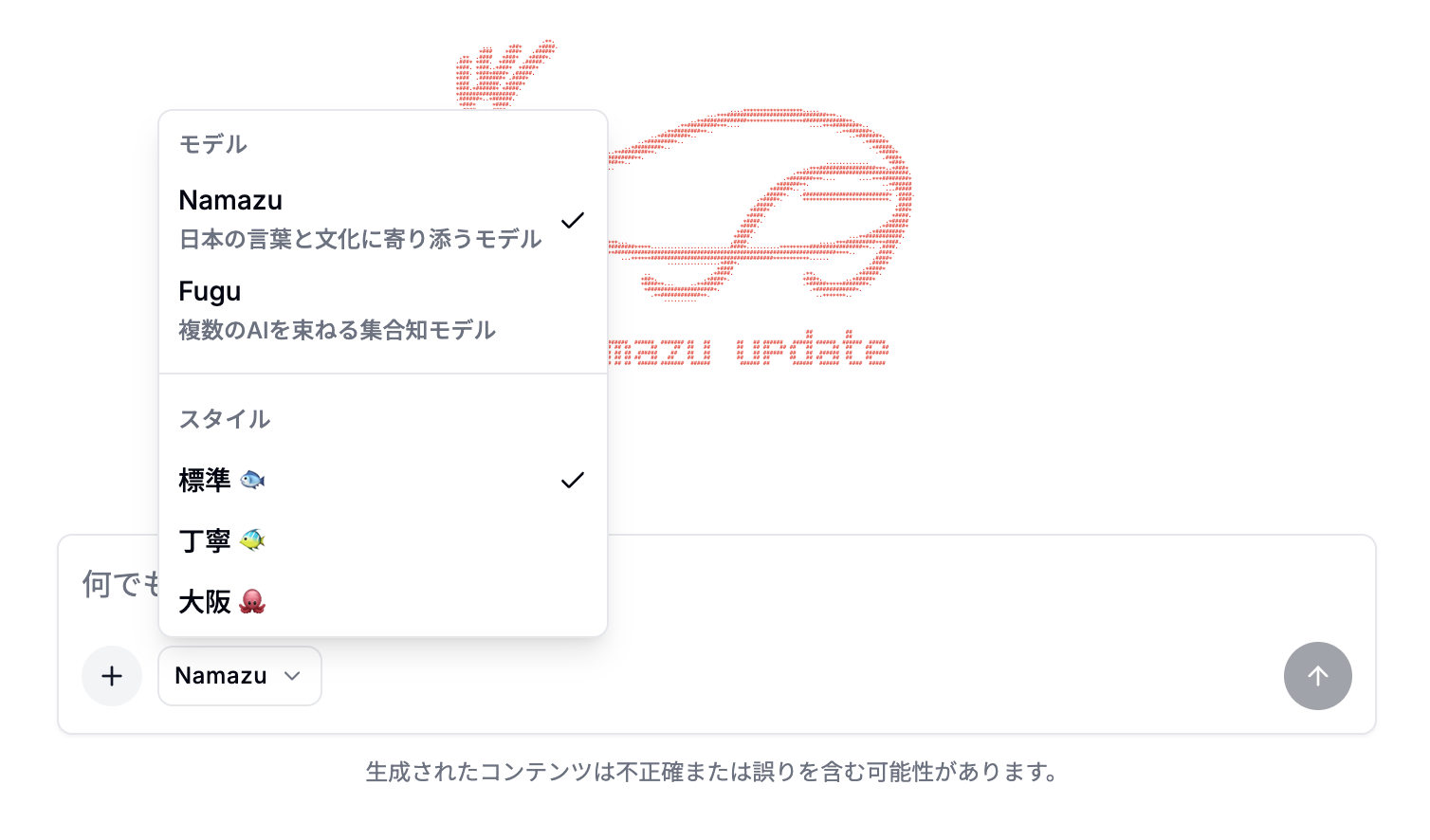
Sakana Chat, the Tokyo-based lab's free browser interface, just received its biggest update since launch. The new version adds two models to choose from , the newly introduced Sakana Fugu and a next-generation Sakana Namazu , and pairs them with sandboxed Python execution that lets the model produce and preview real deliverables inside the chat window.
Two very different models, one interface
Fugu and Namazu are built on fundamentally different ideas, and understanding that distinction matters for knowing which one to reach for.
Sakana Fugu is an orchestrator model. Rather than being a single neural network you query, Fugu is a conductor that bundles AIs , Sakana AI itself describes it as "a full multi-agent system accessible via a single API." It is grounded in two ICLR 2026 papers on learned model orchestration , TRINITY and the Conductor , which show how systems can learn to assemble, route, and coordinate expert agents for each task instead of relying on hand-designed workflows. In practice, a single Fugu request can fan out to multiple underlying frontier models playing Thinker, Worker, and Verifier roles, then synthesize a single answer back to you.
Sakana Namazu is a different animal entirely. Namazu is a fine-tune of Moonshot AI's open-weight Kimi K2.6, aimed at Japanese language and Japanese business use. Sakana states plainly that it was adapted using in-house data , including tuning to reduce unnecessary refusals and limit bias in outputs. On Japanese-specific benchmarks, the adaptation shows: FairPoliticsQA (a measure of political neutrality) jumped from 34.10% on the base model to 56.30% on Namazu.