


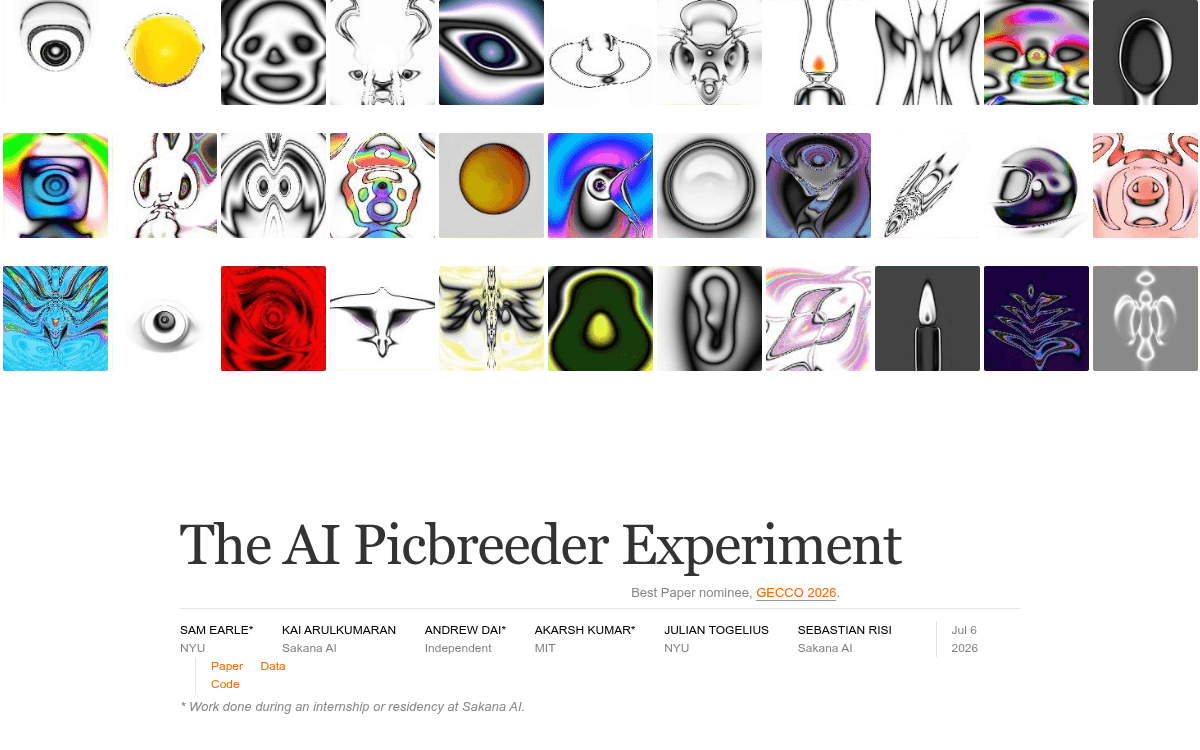
What happens when you take one of the most fascinating human creativity experiments ever run on the internet, and replace every human with a frontier AI model? That is exactly what a team from Sakana AI, MIT, and NYU set out to answer. Their paper, nominated for a best paper award at GECCO 2026, revisits Picbreeder -- a now-defunct website where thousands of users collaboratively evolved abstract images into recognizable art, with no goal, no target, and no instructions. The results are a fascinating and humbling look at what AI still cannot do.
The Original Experiment: Fishing for Images
Picbreeder was built around a deceptively simple idea. It put an interactive evolutionary interface in the hands of the public so that every lineage ever produced by anyone could be explored and continued by anyone else, making users participants in a massive online collaboration to explore the space of possible images. Users did not draw or design anything. Instead, they selected images they found interesting from a grid of candidates, and those selections drove an evolutionary algorithm forward.
The images themselves are not pixels in the traditional sense. Each one is encoded as a Compositional Pattern-Producing Network (CPPN) -- a small neural network that takes pixel coordinates as input and outputs a color. Think of it as a recipe for an image rather than the image itself. Through the process of branching from other images, and through continually increasing image complexity made possible by the underlying NEAT algorithm, evolved images proliferate unlike in any other interactive evolutionary computation system. NEAT (NeuroEvolution of Augmenting Topologies) is the key: it evolves not just the weights of the network, but its structure -- adding new nodes and connections over time, allowing images to grow in complexity across generations.
The magic of Picbreeder was that nobody planned the outcomes. Faces, animals, vehicles, and skulls emerged gradually across many sessions and many different users. Over seven years of operation, the site accumulated almost 10,000 evolved images and over 1,000 users. The best creations were not conceived -- they were stumbled upon.

Swapping Humans for AI Agents
The Sakana team automated the entire Picbreeder loop using vision-language model (VLM) agents. The setup runs 10 agents in parallel, all sharing a growing archive of published images. Each agent session works like this:


Don't miss what's next in AI
Join 300,000+ engineers and researchers who get the signal, not the noise.
- Full access to in-depth AI research breakdowns
- Be the first to know what's trending before it hits mainstream
- Daily curated papers, repos, and industry moves