

Sakana AI Opens Namazu API to Developers Building Japanese Enterprise Apps
Sakana AI opens its Japanese-specialized Namazu LLM as an API, built on Kimi K2.6 with Japan-specific fine-tuning, built-in web search, and OpenAI-compatible endpoints.
- Sakana Namazu API is live -- Sakana AI's Japanese-specialized LLM is now available via API at console.sakana.ai
- Built on Kimi K2.6 -- fine-tuned with proprietary data for Japanese language and business contexts, not trained from scratch
- Beats base model on Japan-specific benchmarks -- FairPoliticsQA score jumped from 34.10% to 56.30%; outperforms K2.6 on JFBench and translation
- Web search and code execution built in -- no extra scaffolding needed for agentic workflows
- Drop-in OpenAI replacement -- change
base_urland API key, existing code works unchanged - Enterprise-focused -- targets the gap between costly frontier models and raw open-weight models for Japanese business use
Sakana Namazu is now available as a commercial API. The Tokyo-based lab had been running Namazu inside its Sakana Chat product for months, and the consistent feedback was simple: people wanted to call it from their own code. The model is live at console.sakana.ai, and if you already have an OpenAI-compatible client, switching over is a two-line change.
What Namazu actually is
Namazu is built on Kimi K2.6, the open model published by Moonshot AI. Using its own in-house data, Sakana adapted the model to Japanese and to Japanese business contexts, tuned it to reduce unnecessary refusals, and worked to limit bias in its outputs. The result is a targeted fine-tune of an already strong open-weight base, aimed squarely at the Japanese enterprise market.
Kimi K2.6 handles text, image, and video input, supports thinking and non-thinking modes, and covers dialogue and agent tasks with stable long-horizon coding, instruction-following, and self-correction. Sakana's fine-tuning preserves those strengths while layering on Japanese fluency and cultural context the base model lacks.
The gap it fills
The Japanese enterprise LLM market has a real problem. Frontier models are costly, and using an open model as-is leaves open questions about output quality and data handling. Namazu targets the middle: a model adapted to Japanese business workflows, served through a familiar API, at a price point below the frontier tier. Sakana AI is a Tokyo-based startup founded in 2023 by co-founders including David Ha and Llion Jones, both authors of the original Transformer paper "Attention Is All You Need."
Where it beats the base model
Sakana ran Namazu against Kimi K2.6 across six benchmarks. The results split cleanly into two categories.
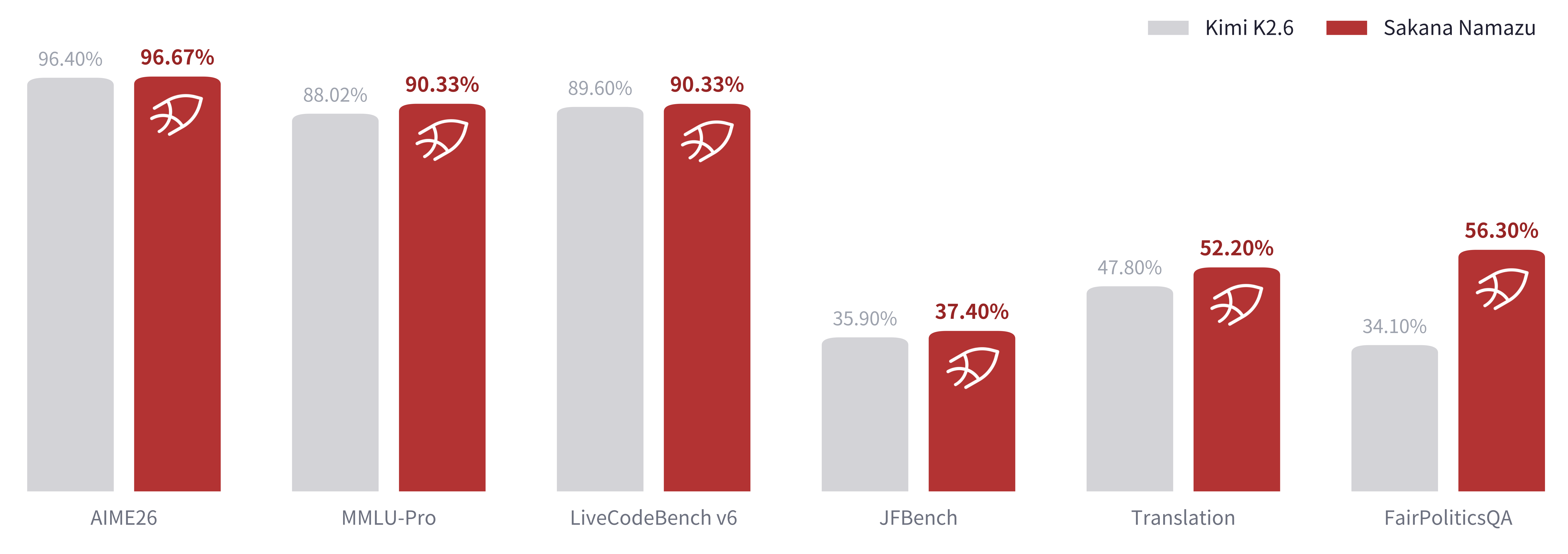
On general reasoning, Namazu holds its ground:
- AIME26 (mathematical reasoning) -- performance preserved from K2.6
- MMLU-Pro (broad knowledge and reasoning) -- on par with base
- LiveCodeBench v6 (coding) -- competitive with base
On Japan-specific tasks, it pulls ahead:
- JFBench -- measures instruction-following in Japanese; Namazu outperforms K2.6
- Japanese-English translation -- accounts for Japan-specific proper nouns and honorific language; Namazu wins
- FairPoliticsQA -- measures whether answers stay neutral rather than leaning toward any one country's values; Namazu jumped from 34.10% to 56.30%, reflecting stronger Japan-specific knowledge and reduced Western cultural bias in its outputs
The FairPoliticsQA jump is the most telling number. Most open models are trained on predominantly English and Western data, which quietly bakes in cultural assumptions. Namazu's fine-tuning actively corrects for that.
Built-in tools, not bolt-ons
Namazu ships with web search and code execution as built-in tools. You don't wire them up yourself; they're available out of the box. That matters for agentic workflows, where the model needs to loop between searching, reading, and writing without you building the scaffolding.
Sakana demonstrated three concrete use cases:
- Market research reports -- the model runs the entire job autonomously, from drafting a research plan through repeated web searches, cross-checking sources, and writing the final report
- Customer support and order analytics -- a Japanese-specialized model handles everything end to end, from answering inquiries to aggregating and analyzing order data
- Creative direction -- a fish light show demo where handing the model a single theme like "the world of the ocean" triggers a full autonomous loop: the model picks a motif, gathers reference images via web search, and generates code to choreograph roughly 1,000 fish into that shape
Dropping it into existing code
If you already have code written against an OpenAI-compatible API, updating base_url is all it takes. The model supports OpenAI-compatible function calling and image recognition, so existing tool-use patterns carry over without modification.
from openai import OpenAI
client = OpenAI(
    api_key="YOUR_SAKANA_API_KEY",
    base_url="https://api.sakana.ai/v1",
)
response = client.chat.completions.create(
    model="sakana-namazu",
    messages=[{"role": "user", "content": "市場調査レポートを作成してください。"}],
)
print(response.choices[0].message.content)
Pricing and access
Sakana hasn't published a specific per-token rate card at launch, describing it as a "low unit price" positioned below frontier model costs. The pricing page is the authoritative source for current rates. The API is available now through the Sakana console, and enterprise deployments are in scope as well, with inquiries handled through a separate form.
For context: Sakana AI's valuation has reached $2.65 billion, making it the largest AI company originating from Japan. Namazu is the company's first direct API product aimed at enterprise developers, signaling a shift from research lab to production infrastructure provider. Teams building Japanese-language products who have been patching together general-purpose models now have a purpose-built alternative with a proper API surface.
Comments
