

Ryan Keisler Open-Sources the 2022 Model That Sparked ML Weather Forecasting
Ryan Keisler open-sources the graph neural network from his influential 2022 paper, delivering 10-day global weather forecasts in under a minute.
 PRO
- Ryan Keisler open-sourced the graph neural network from his 2022 weather forecasting paper under MIT license.
- 10-day global forecasts run in under one minute on GPU, two minutes on 8-vCPU CPU.
- Three-stage architecture: encoder to H3 hexagonal mesh, 9 message-passing rounds, decoder back to lat/lon.
- Supports initialization from either ERA5 reanalysis or live ECMWF IFS analysis via CLI flag.
- Includes JAX autodiff sensitivity script computing d(forecast)/d(initial_conditions) for any target.
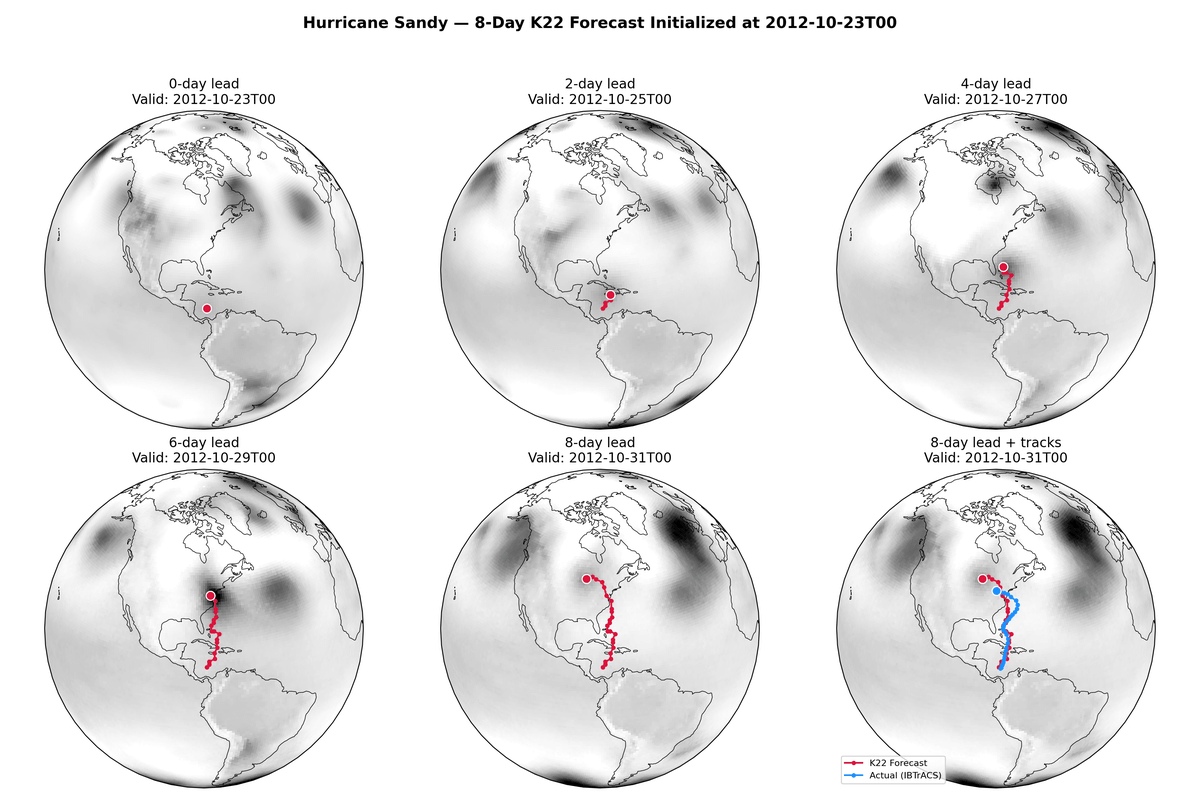
- Ships with evaluation, sensitivity, and Hurricane Sandy tracking scripts.
The 2022 paper that helped kick off the machine learning weather forecasting wave finally has an official code release. Ryan Keisler open-sourced the model from Forecasting Global Weather with Graph Neural Networks, giving anyone with a laptop the ability to run global atmospheric forecasts that were, until recently, the domain of national supercomputing centers.
The release is intentionally lightweight. A 10-day global forecast runs in under a minute on a GPU, roughly two minutes on an 8-vCPU machine, and the entire pipeline is a single Python script with a JAX backend. It ships under an MIT license with scripts for evaluation, sensitivity analysis, and a Hurricane Sandy case study.
How the model actually works
The system learns to step the current 3D atmospheric state forward by six hours, and multiple steps chain together to produce skillful forecasts several days out. Under the hood, it is a three-stage graph neural network:
- Encoder maps ERA5 latitude and longitude fields onto an H3 hexagonal mesh (Uber's spherical grid system, which avoids the pole distortion of a rectangular lat/lon grid).
- Processor runs 9 rounds of message passing on that mesh, where each hexagonal cell exchanges information with its neighbors.
This story is for Pro members
You've reached the end of the free preview. Upgrade to AlphaSignal Pro to read the full article - and everything else behind the paywall.
Comments
