

Runway's Solaris Renders Interactive Apps as Live Video, No Code Needed
Runway's Solaris skips the code layer entirely, generating live app interfaces frame by frame and beating top LLMs on visual reconstruction tests.
- Runway introduced Solaris, its first Interface World Model, generating app UIs frame by frame with no code.
- Built on Gen-4.5 and GWM-1, it splits reasoning (LLM) from rendering (world model) at 720p in real time.
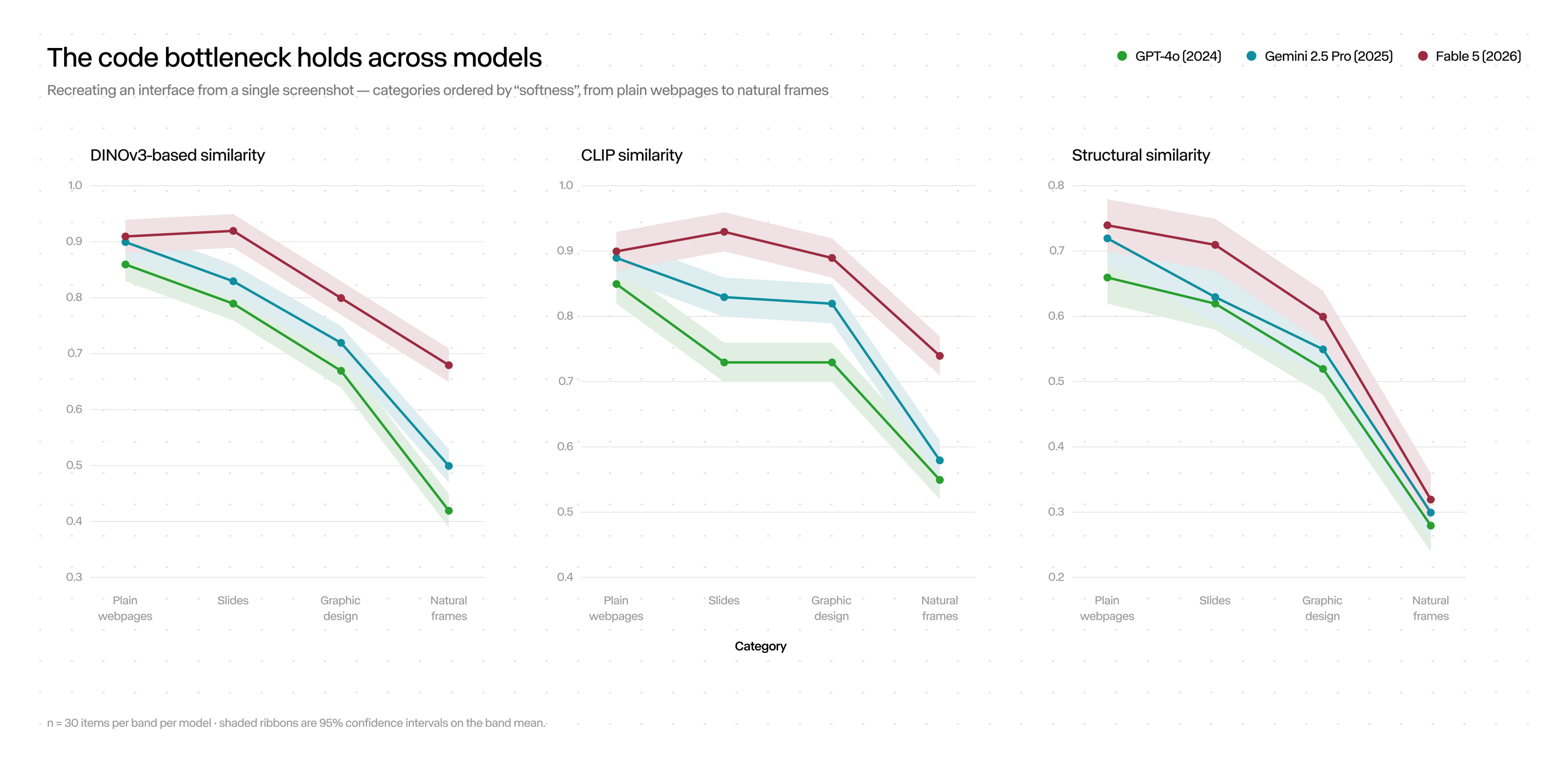
- Beats GPT-4o, Gemini 2.5 Pro, and Fable 5 on interface reconstruction using SSIM and DINOv3 similarity metrics.
- User study of 250 participants preferred Solaris over Claude Opus 5 in 61% of instruction-following comparisons.
- Current limits include text rendering, session coherence, factual grounding, and accessibility API integration.
- Not publicly available; early access via form, targeting apps, storefronts, tutorials, and agent training environments.
Runway just unveiled Solaris, which it describes as the first entry in a new model family it calls Interface World Models. Instead of an operating system loading pre-built apps written in code, the OS itself generates the interface visually, frame by frame, as you interact with it. No HTML, no components, no framework, just pixels being synthesized in real time in response to your clicks and drags.
Solaris builds on GWM-1, Runway's autoregressive general world model on top of Gen-4.5, which produces frames sequentially, runs in real time, and accepts interactive controls like camera pose, robot commands, and audio. Where GWM-1 aimed at simulating physical environments, Solaris repurposes the same underlying video machinery to simulate software.
The translation tax on every app you use
Runway's argument starts with a critique of how software gets made today. A designer builds a pixel-perfect mockup, and then engineers translate that mockup into code so it can actually respond to input. Every behavior has to be explicitly programmed, which means shipped software is a lossy compression of the design, frozen before the first user shows up. The visual fidelity of the original mockup rarely survives the trip through a UI framework.
Solaris cuts that translation step out. A single world model handles both rendering and interaction, so there is no intermediate representation to lose information to. The team frames this as a way to unify two historically separate systems: the ones that know things (search, LLMs) and the ones that respond in real time (game engines, JavaScript). An Interface World Model has to do both simultaneously.
How the model actually renders an app
The architecture splits reasoning from rendering. An LLM interprets what the user asked for, decides whether the current scene should mutate or transition to a new one, and produces the text prompts that steer Solaris. Solaris itself handles the visual output, one frame at a time.
Getting a video diffusion model to run at interactive speeds required three engineering moves:
- Autoregressive generation: each frame depends only on prior frames, not a full clip refined over dozens of denoising steps.
- Step distillation: the many-step denoising process was compressed into just a few steps.
- Self-training: the fast model was trained on its own outputs to keep visual quality stable over long sessions.
User inputs like clicks and drags are treated as conditioning for the next frame, the same way text prompts and reference images already condition video generation. Because the model only ever sees past interactions, it learns how actions map to visual outcomes without anyone hand-coding those behaviors. Runway calls this "redefining the mouse": click on a cat in a scene, and your next clicks might paint its fur pattern onto whatever you touch.
Measuring how much LLMs lose in translation
To justify the whole premise, Runway ran a reconstruction benchmark. They asked frontier multimodal LLMs to recreate 30 interfaces from a single screenshot, spanning simple webpages, image-heavy layouts, and natural photographs. Fidelity was scored two ways: SSIM (structural similarity in place) and a DINOv3 feature comparison that tolerates layout shifts by matching each region to its closest match anywhere in the reconstruction.
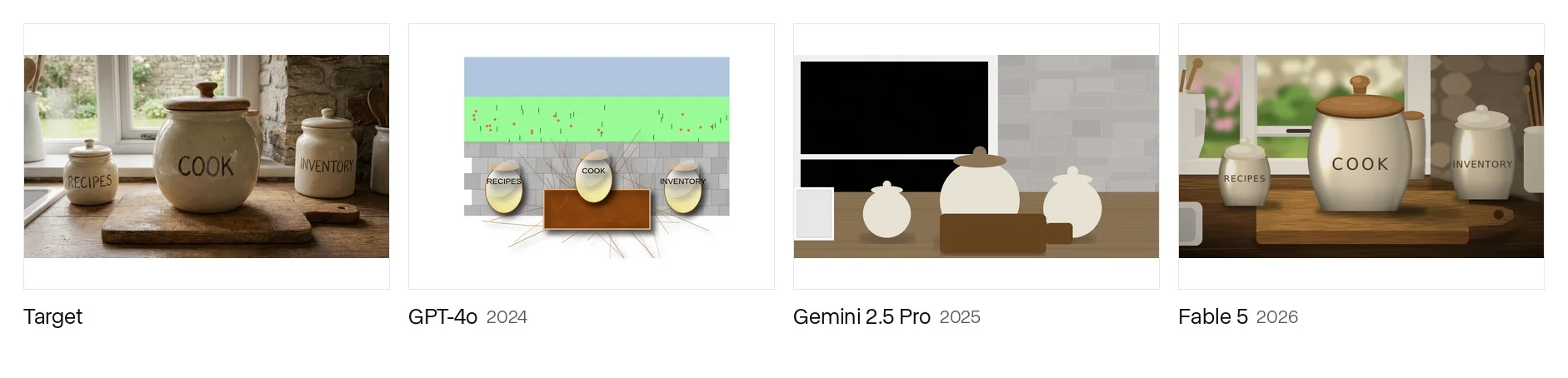
The trend is clear across models: reconstruction quality falls off a cliff as visual complexity increases. Text-based intermediate representations cannot carry all the information in a rich visual scene, and even small deviations in text or layout can change how an interface behaves.
Runway then went a step further with a head-to-head user study against Claude Opus 5. Starting from identical images and interaction requests, they collected nearly 7,500 pairwise judgments from 250 participants across 30 interaction examples. Solaris was preferred 61% of the time versus 24% for the coded result on instruction following, and 71% versus 21% on whether the interaction felt natural within the scene. The gap on "natural behavior" is the more telling one, since it reflects whether the model understands how objects, materials, and lighting should respond, beyond simply hitting the requested change.
Where it breaks
Runway is candid about what Solaris cannot do yet, and the list matters if you are thinking about production use:
- Text rendering: stable, legible type remains one of the hardest problems in video generation, which is awkward for a system meant to render UIs. Runway suggests a hybrid where image models handle text-heavy views during brief pauses.
- Trust and grounding: a convincing wrong answer is worse than none. Today the model is anchored by the starting frame; richer conditioning on verified product data and documents is an active research area.
- Long sessions: maintaining coherence over extended, open-ended interactions remains unsolved.
- Accessibility: generated pixels do not play nicely with screen readers or accessibility APIs.
What becomes possible
If the model keeps improving on the same trajectory as image and video generation did, a few interaction patterns start looking plausible. Storefronts become generated environments that adapt to each visitor while preserving brand identity. Tutorials render the next step in your actual context and recover when you go off script. The app-as-unit-of-software starts to blur, because the OS can spin up whatever interface you need on demand.
Agent training is a compelling secondary use case. Text-based agents notoriously struggle with computer-use tasks because they overfit to the specific layouts they saw during training. A model that can generate constantly changing, never-before-seen interfaces is a natural training environment for agents that need to generalize across UIs.
Availability
Solaris is not publicly available yet. Runway is accepting early access requests through a form on the announcement page and says it is working with launch partners. No code, weights, or API details have been released. For context on the model lineage, Runway has published details on both GWM-1 and its Gen-4.5 video base model, which are the foundations Solaris is built on.
Comments
