

Runway Dev MCP Lets AI Coding Agents Control Generative Media APIs Directly
Runway's new hosted MCP server plugs its generative media API directly into coding agents like Cursor, Claude Code, and Codex for research, routing, and debugging.
- Runway launched Dev MCP, a hosted Model Context Protocol server for its generative media API.
- Coding agents can research models, pull exact request schemas, and configure routing without leaving the editor.
- Works with Cursor, Claude Code, and Codex over OAuth at
dev.runwayml.com/mcp. - Agents can create Model Routers that optimize across Gen-4.5, Aleph, Seedance, GPT Image 2, and ElevenLabs.
- Automated debugging identifies failure reasons like asset size or moderation and reruns corrected requests.
- Hosted server means no local MCP process to run, just authenticate and go.
Runway has shipped a hosted Model Context Protocol server that puts its generative media API directly into whatever coding agent you already use. Your agent can now research models, configure routing, and diagnose failed jobs from the same chat window where it writes code, with no tab-switching between docs, dashboard, and IDE.
Runway Dev MCP works with Cursor, Claude Code, and Codex. It connects over OAuth and points at a single shared server URL, so there is nothing to run locally.
What the agent can do
Before writing a single API call, your agent can browse which models a project can access, along with their prices, capabilities, and accepted inputs. It then pulls the exact request schema for whichever model it selects, which means it calls the API correctly on the first try rather than guessing. Anyone who has watched an agent hallucinate an API signature knows why grounding it in a real spec matters.
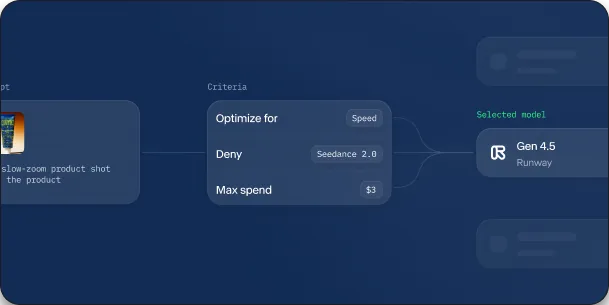
From there, the agent can configure Runway's Model Router, a reusable config that picks a model per request based on your defined preferences. It can create a router that optimizes for cost, latency, or quality across several models, suggest which models to make eligible, and set a max spend per generation. Every call that references the router is matched against those rules and ranked on Runway's own quality, price, and speed data. The agent can also look up which model the router selected for any individual call.
Routing across competitors
Runway's Model Router launched earlier this summer as a preference-optimized router built for generative media rather than LLMs. It routes across Runway's own Gen-4.5, Aleph, and Act-Two alongside third-party models including Seedance, GPT Image 2, and ElevenLabs. A first-party model vendor is now selling the traffic layer that sends work to its competitors.
The MCP server makes that routing layer programmable by agents. Define what "best" means for your use case, and the router selects a model for every request automatically. When new models launch, your routing updates to cover them without any changes to your integration code.
Production triage without curl
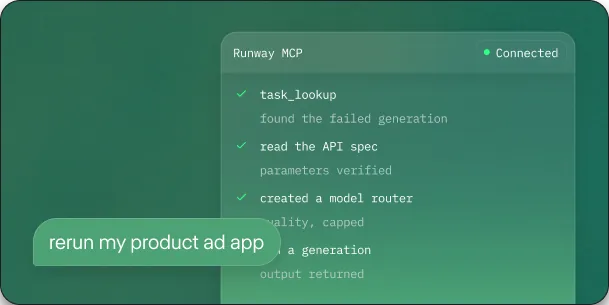
Agents can also handle debugging. If a batch of generations fails overnight, the agent can pull the task record, read the error class, such as asset size limits or moderation rejections, patch the input, and resubmit, all without a human writing curl commands against the API.
Setup
Point your agent at the MCP endpoint, authenticate with your Runway Dev account, and you are ready. A few specifics worth noting:
- The server URL is
https://dev.runwayml.com/mcp, using OAuth, with no local process to manage. - Agents can run a
whoamicommand to verify the integration with the Developer Portal. - Usage is billed against your existing Runway Dev account on the same token-based pricing that covers Gen-4.5, Aleph, Act-Two, and the platform's third-party models.
Teams already building on Runway Dev who want their coding agent to own more of the integration work, choosing models, tuning the router, keeping generations healthy in production, are the clearest fit. If you are wiring generative video or image endpoints into a product inside Cursor or Claude Code, this collapses several context switches into a single conversation.
Comments
