

RobotPan Gives Humanoid Robots Full 360° Vision With 11x Fewer Primitives
A six-camera plus LiDAR humanoid vision stack predicts compact 3D Gaussians in one forward pass, delivering real-time 360-degree perception.
 PRO
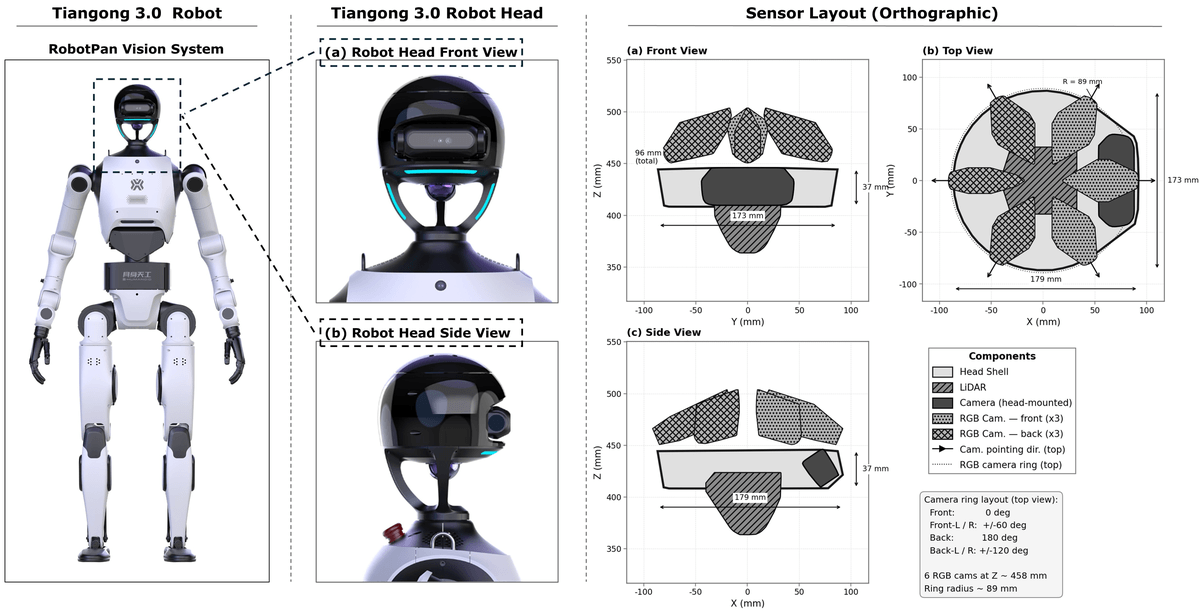
- RobotPan combines six cameras and a LiDAR on Tiangong 3.0 for real-time 360-degree humanoid perception (paper)
- A feed-forward network predicts metric-scaled 3D Gaussians from calibrated sparse views in one pass
- Hierarchical spherical voxels allocate fine detail near the robot, coarse resolution far away, cutting storage by 70%
- Uses only 327K Gaussians versus 1.26M-3.78M for competing methods, with better PSNR/SSIM/LPIPS
- Streaming fusion hits 28.59 dB PSNR at 230 FPS, roughly 26× faster per-frame training than 3DGStream
- A new multi-sensor dataset with 339 clips across navigation, manipulation, and locomotion accompanies the release (project page)
Teleoperating a humanoid robot through a headset is often a nauseating experience. The camera view is narrow, the head bobs with every step, and switching between the half-dozen cameras bolted to the chassis breaks the operator's flow. A new system called RobotPan, built by the X-Humanoid team on the Tiangong 3.0 platform, tries to fix all three problems at once by fusing six cameras and a LiDAR into a single real-time 360-degree scene that a remote pilot or downstream policy can query from any angle.
The accompanying paper describes both the hardware rig and a feed-forward neural pipeline that turns sparse multi-camera input into compact, metric-scaled 3D Gaussians. The claim that got our attention: competitive rendering quality against recent generalizable Gaussian splatting methods while using roughly an order of magnitude fewer primitives.
Why forward-facing cameras keep failing
Many robotic systems rely on monocular or stereo cameras, or camera–LiDAR fusion, thanks to favorable trade-offs in cost, weight, power, and deployment complexity. Such configurations integrate onto diverse platforms and scale across environments. Teleoperators wearing head-mounted displays, however, hit three walls fast.
- A forward-facing camera's limited field of view restricts situational awareness. Operators cannot reliably perceive surrounding obstacles or affordances, which constrains safe motion and often forces uncomfortable body or head rotations to "search" for viewpoints.
- Unlike the human vestibulo-ocular system that stabilizes perception during locomotion, robot-induced jitter and motion blur destabilize the HMD view, causing simulator sickness and shortening effective operation windows.
- Multiple isolated camera feeds force context-switching, adding cognitive overhead during data collection or emergency takeover.
Panoramic fisheye rigs help, but they assume all lenses share (or nearly share) an optical center. RobotPan's cameras cannot be co-located due to hardware constraints, which makes classical image-stitching pipelines inapplicable and demands principled geometry-aware view synthesis. That is the geometric problem the system actually solves.
This story is for Pro members
You've reached the end of the free preview. Upgrade to AlphaSignal Pro to read the full article - and everything else behind the paywall.
Comments
