

Researchers Turn AI Interpretability Into a Surgical Tool to Fix LLMs
A new survey reframes mechanistic interpretability as an actionable toolkit for controlling LLM behavior through a locate, steer, and improve pipeline.
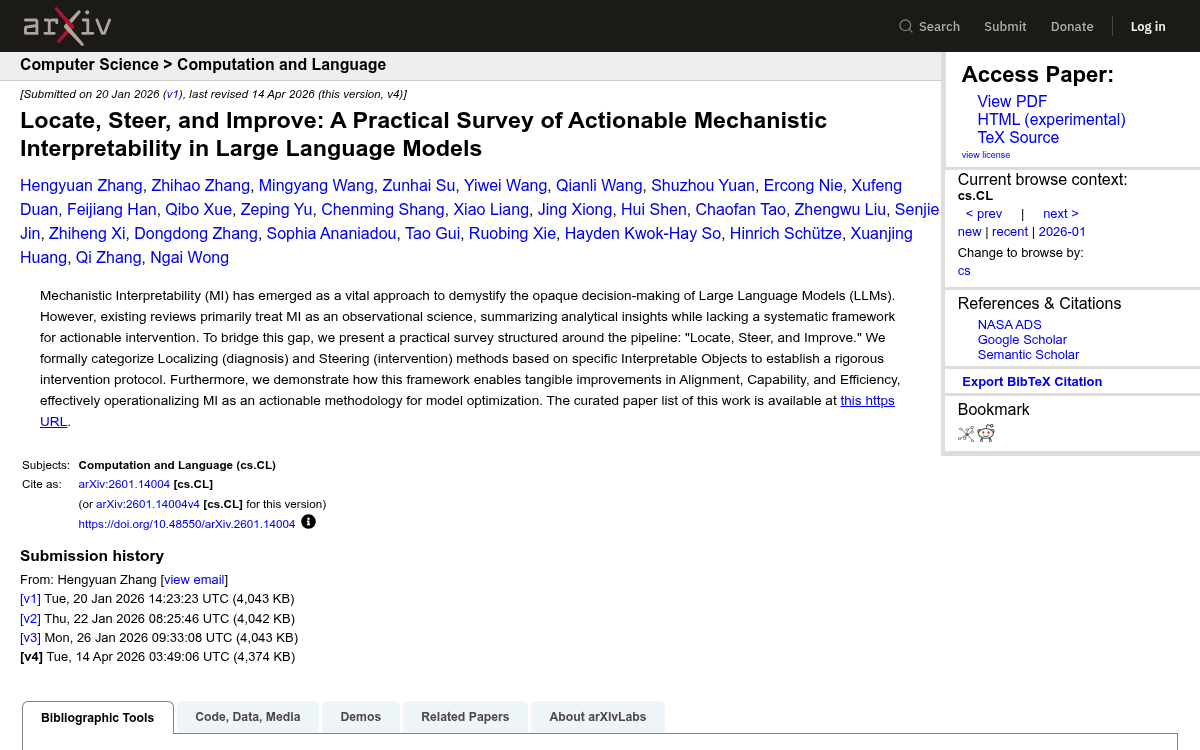 PRO
- A new survey reframes mechanistic interpretability as an actionable pipeline: locate, steer, and improve.
- Localizing methods split into six families from magnitude analysis to circuit discovery, ranked by causal strength versus cost.
- Steering methods split into three: amplitude manipulation, targeted optimization, and vector arithmetic on residual streams.
- Applications span alignment (refusal, bias), capability (multilinguality, reasoning), and efficiency (sparse fine-tuning, quantization).
- Refusal, personas, and reasoning strategies are often encoded as linear directions that can be steered without retraining.
- Curated list of over 200 tagged papers available in the GitHub repo.
Mechanistic interpretability has spent years as a mostly observational science, peering inside transformers to explain what neurons and attention heads do without doing much about it. A sprawling new survey from researchers at Hong Kong, Fudan, LMU Munich, Tsinghua and more than a dozen other institutions wants to change that. It argues that interpretability tools are mature enough to actively steer, edit, and optimize large language models, and it organizes over 200 papers into a single actionable pipeline: locate, steer, and improve.
Scaling is hitting familiar walls. Progress in LLMs has been driven mostly by external factors like larger models, more data, and more compute, and that paradigm is running into bottlenecks. The authors argue the next round of gains has to come from surgically modifying models from the inside rather than piling on more hardware.

Why past surveys fell short
Prior interpretability reviews tend to blur diagnostic tools with intervention techniques, and their application coverage is often too abstract to translate into concrete engineering work. This survey fixes that by first defining what it calls interpretable objects, the specific pieces of a decoder-only transformer you can actually poke at, and then splitting methods cleanly into diagnosis (localizing) and intervention (steering).
Those objects are the usual suspects, formalized with consistent notation: token embeddings, the residual stream, multi-head attention with its QK and OV circuits, feed-forward neurons, and sparse autoencoder (SAE) features. SAEs get particular attention because a single neuron may activate for multiple unrelated concepts, making direct interpretation difficult due to superposition. SAEs disentangle these dense polysemantic representations into monosemantic features you can actually target.
This story is for Pro members
You've reached the end of the free preview. Upgrade to AlphaSignal Pro to read the full article - and everything else behind the paywall.
Comments
