

Researchers Release SHARE to Help Humanities Scholars Think, Not Write Faster
A team out of Erasmus University and the Open University released open-weight language models pretrained only on humanities and social sciences texts, paired with an interface that refuses to generate.
 PRO
- SHARE-4B and SHARE-14B are the first causal LLMs pretrained exclusively on social sciences and humanities texts
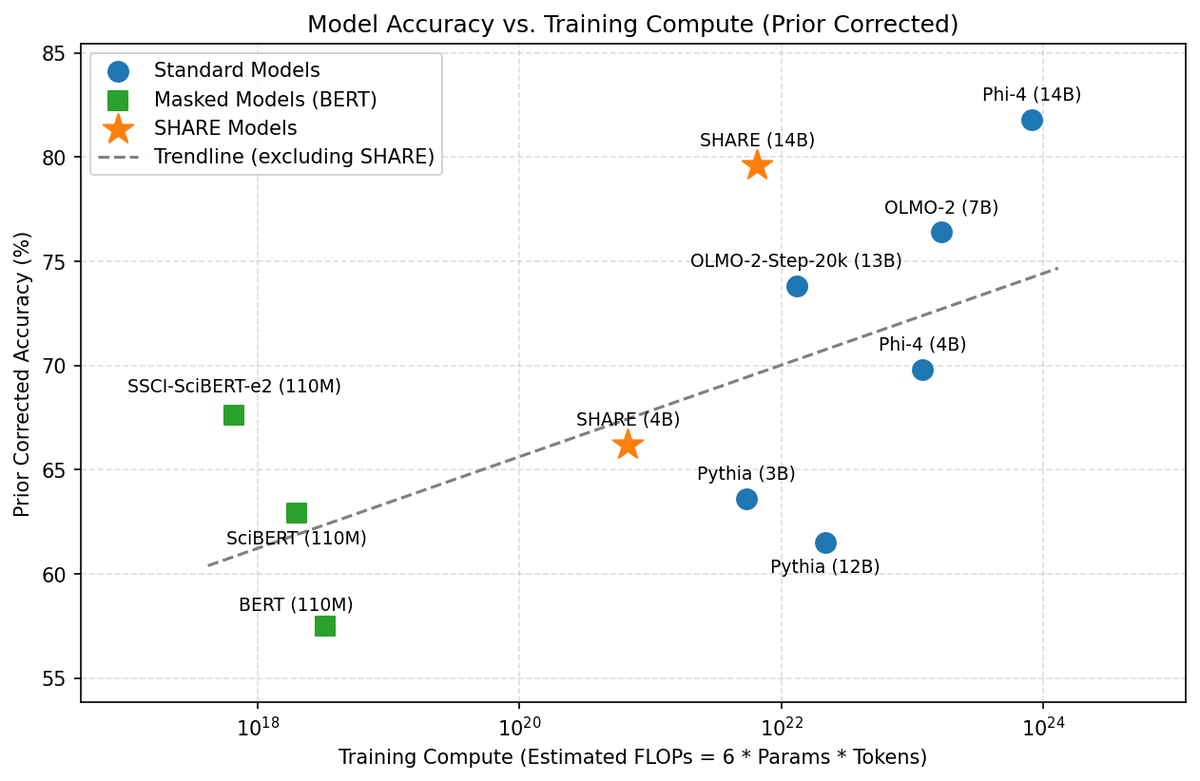
- SHARE-14B matches Phi-4 on a custom SSH Cloze benchmark using 100x fewer training tokens
- MIRROR interface highlights unexpected tokens via surprisal instead of generating any text
- Training data combines Wikipedia, Project Gutenberg, peS2o, and CORE, filtered with AllenAI's Field of Science classifier
- Released under a Responsible AI License forbidding commercial use and model distillation
- Only 15% of SHARE-14B training complete; team is releasing an intermediate technical report for feedback
Most language models are trained on the open web and then bolted onto a chat window that produces fluent, confident prose. That default fits poorly with the social sciences and humanities, where the point of a paragraph is often to unsettle expectations rather than confirm them. A group of researchers has now released SHARE, a pair of causal language models pretrained exclusively on humanities and social sciences (SSH) content, alongside an interface called MIRROR that refuses to generate text at all.
Why a general-purpose model misses the mark
Most claims about AI's impact on scientific work come from fields like mathematics, coding, engineering, and biochemistry rather than SSH. That focus is partly justified by techniques such as Group Relative Policy Optimization (GRPO), which work best in domains with verifiable rewards and suit the interpretive nature of SSH poorly. Reinforcement learning with a check-the-answer reward works for math proofs. It does not work for a close reading of Foucault.
There is also a philosophical objection. For a model pretrained exclusively on an SSH corpus, predicting the next token is equivalent to making explicit what is expected in these disciplines. The authors argue this flips the usefulness of an autoregressive LLM on its head: rather than generating the expected, you can use the probability distribution to signal the unexpected, treating high-perplexity tokens as candidates for a typo, a factual error, or a genuine intellectual contribution.
What is actually in SHARE
SHARE ships as two models based on Microsoft's Phi-4 architecture: SHARE-4B (3.9B parameters, mirroring Phi-4-mini) and SHARE-14B (14B parameters, mirroring Phi-4). Rather than the default Phi-4 tiktoken tokenizer, the team trained a custom byte-pair encoding tokenizer on the full training corpus, with a reduced vocabulary of 50,000 tokens compared to Phi-4's 100,352, since the data is mostly English and Dutch.
This story is for Pro members
You've reached the end of the free preview. Upgrade to AlphaSignal Pro to read the full article - and everything else behind the paywall.
Comments
