

Replit Partners With Shopify to Launch Custom Stores From a Single Prompt
Replit's Shopify integration lets anyone describe a store idea and go live in under 10 minutes — no code, no theme picking, no developer needed.
- Replit + Shopify: New integration lets anyone describe a store idea and launch a fully custom Shopify storefront in ~10 minutes via Replit Agent.
- No themes, fully custom: Agent generates a unique storefront from a prompt — typography, layout, animations, product pages — all editable through conversation.
- Financial stack forming: Shopify joins RevenueCat (subscriptions) and Visa (agentic payments) as the third pillar of Replit's monetization infrastructure for builders.
- Replit's scale: 50M+ users, $9B valuation after a $400M Series D, with ARR growing from $2.8M to $150M+ in under a year.
- Shopify handles the hard parts: Payments, taxes, inventory, shipping, and fraud checks stay on Shopify; Replit never touches merchant banking or tax details.
- Broader market context: Vibe coding is a $4.7B market in 2026; Shopify is also integrating with Lovable, v0, and Manus, signaling a platform race for non-technical founders.
Replit has partnered with Shopify to let anyone build and launch a fully functional e-commerce storefront using nothing but a text prompt. You describe what you want to sell, and Replit Agent generates a custom front end, provisions a Shopify store, and adds your products , all from a single conversation. From the first prompt to taking real orders is roughly ten minutes.
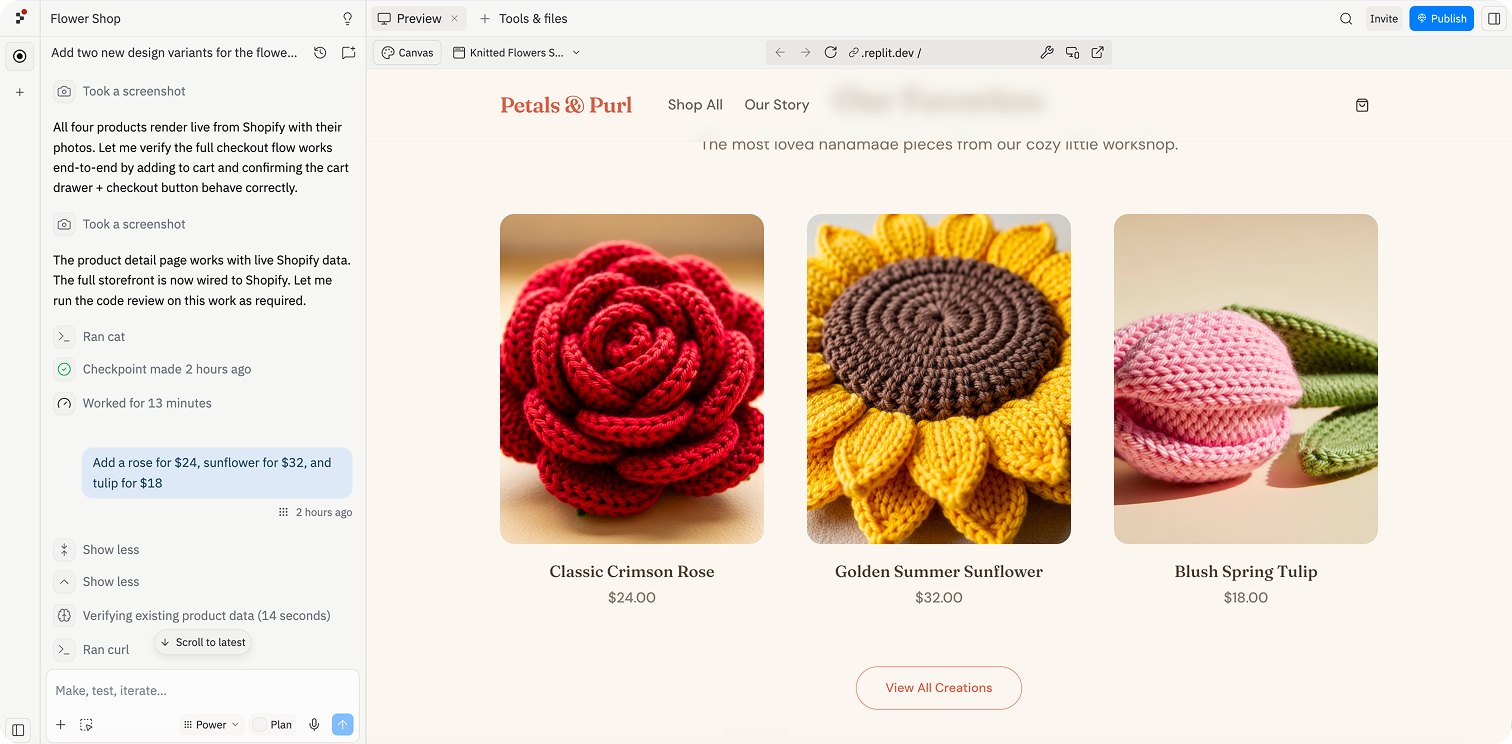
This is not a Shopify theme builder with a chatbot slapped on top. There is no theme to pick. Agent generates the storefront per your stylistic guidance , the brand, the products, the feel you describe , and every design choice, like typography, layout, motion, and product page structure, is something you can change by asking. The result is a real Replit project underneath, meaning you can extend it with a blog, a wishlist, a loyalty program, or custom landing pages down the road.
How it actually works
You only need to visit Shopify once , to sign in or create an account, claim your store, set up payments, and publish. After that, you can build your storefront, manage products, and run your store directly from Replit. Here is the full flow:
- Step 1 , Describe your store: Start a new Replit project and tell the agent what you want to sell. You can mention Shopify explicitly, but Agent will also recommend Shopify on its own when you describe selling a physical good.
- Step 2 , Claim the store: A link to claim your store appears in chat and is sent to your email. Head to Shopify, create an account if needed, claim the store Agent created for you, set up payments, and publish.
- Step 3 , Let Agent build: With the store claimed and connected, Agent designs and builds the storefront. Every part is editable through conversation: copy, layout, animations, product pages, navigation.
- Step 4 , Stay in Replit: From this point on, you can stay in Replit. Create new product listings, update names, descriptions, prices, and images, or launch a new collection. Shopify handles checkout, inventory, and order management in the background.
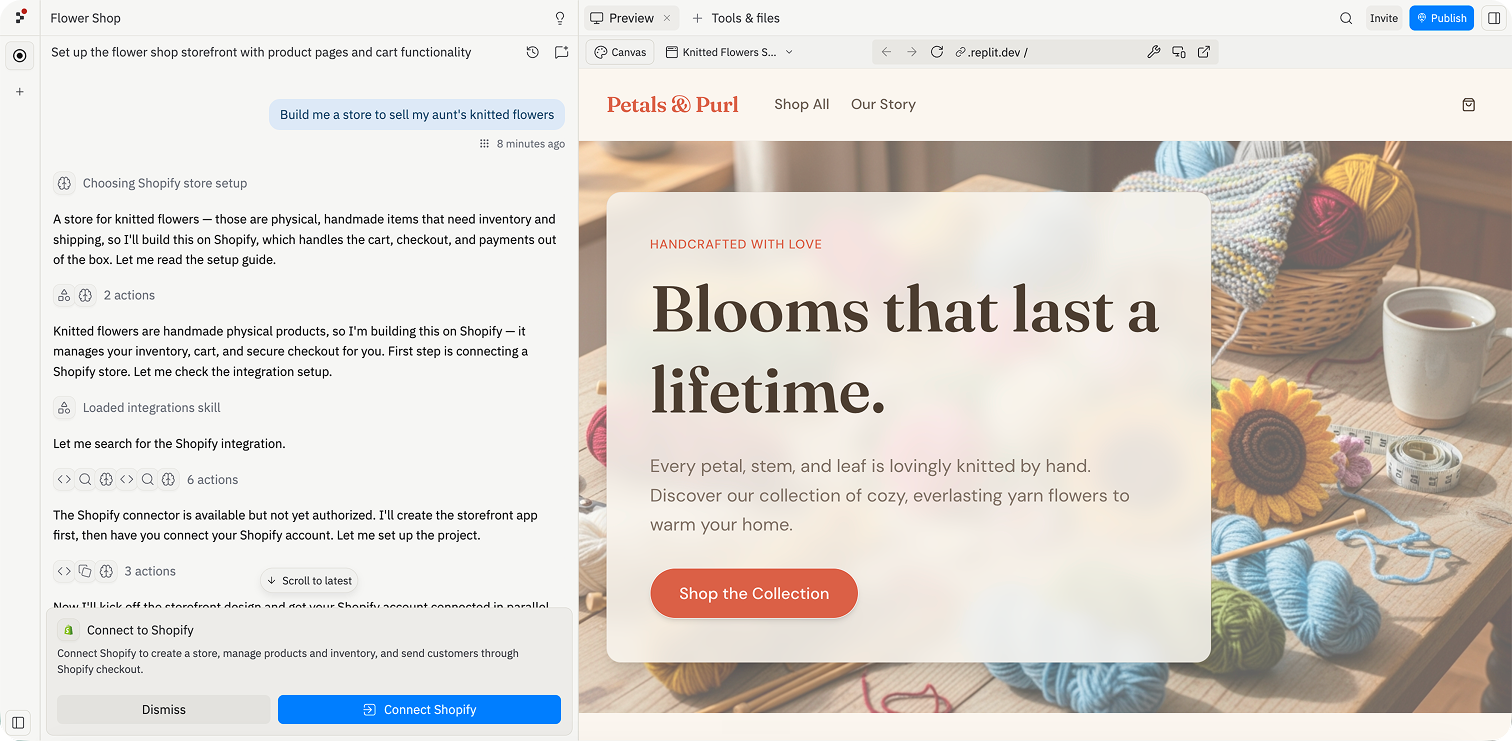
Under the hood, a development store is created in about ten seconds under Replit's Shopify Partner account, the Replit Sales Channel app is installed, and the store is connected , no API keys required, one store per app, password-protected until you claim it. Sensitive commerce infrastructure stays where it belongs: payments, identity verification, taxes, shipping, and fraud checks stay on Shopify. Replit never collects merchant banking details, tax IDs, or other sensitive information.
The bigger play: a financial stack for vibe coders
The Shopify integration is not a standalone feature , it is the third piece of a deliberate monetization strategy Replit has been assembling. Making apps is easier than it has ever been, but making money from them is another matter entirely. While almost anyone can now vibe-code their way to a working app, turning that app into a revenue stream is where things get complicated , and that is a problem Replit has been setting out to solve, quietly assembling a financial stack for vibe-coded apps.
The stack now has three distinct layers:
- Subscriptions (RevenueCat): Replit integrated with RevenueCat, which handles in-app purchases and subscriptions for more than 80,000 apps. Builders can add subscription paywalls and pricing tiers to mobile apps using plain-English prompts, with RevenueCat managing billing logic and app store compliance.
- Physical commerce (Shopify): The new integration, covering product sales, inventory, fulfillment, tax compliance, and multi-channel selling , all the hard parts of running a retail business.
- Agentic payments (Visa): Visa made an undisclosed strategic investment in Replit. As part of the partnership, the companies are exploring how developers on Replit can use Visa's suite for AI-powered payments, called Visa Intelligent Commerce, as well as Visa's Trusted Agent Protocol , a system that allows AI agents to securely identify themselves by sharing information like their intent and relevant customer details, so that payments made by agents can be verified and trusted.
Replit's position in a crowded market
Replit is one of the biggest names in the vibe coding wave , the practice of describing software in plain English and having AI write and deploy it. Replit's annualized recurring revenue jumped in less than a year from $2.8 million to $150 million by late 2025, and it is projected to be on track for $1 billion by 2027. Valuation for the company has grown from $3 billion in September 2025 to $9 billion in March 2026, with a $400 million Series D financing led by Georgian Partners, along with Andreessen Horowitz, Coatue, and Y Combinator.
More than 50 million users around the globe now build apps on Replit. They are not all engineers , they are product managers, operators, founders, students, and small business owners, and increasingly they are shipping production software that runs real businesses. That breadth is exactly why the Shopify integration matters: the next wave of Replit users may not be building SaaS tools at all, but physical-product businesses.
Replit competes with fellow vibe coding platforms Lovable and Cursor. Cursor is more dominant in enterprise and professional markets, and Lovable is the faster-growing tool for non-technical users. Replit has broad reach across beginners, educators, and enterprises alike. The Shopify integration is a differentiator that neither Cursor nor GitHub Copilot are chasing , it targets the builder who wants to run a business, not just ship software.
Who wins, who has to catch up
The clearest winners here are non-technical founders and small business owners who previously faced a painful choice: pay a developer to build a custom storefront, or accept the cookie-cutter look of a Shopify theme. Replit also enables users to build adjacent assets such as mobile apps, loyalty tools, and marketing materials from the same project environment, positioning it as a more comprehensive tool for small businesses seeking end-to-end digital commerce solutions.
For Shopify, the partnership extends its merchant acquisition funnel into a new channel , one where the barrier to entry just dropped dramatically. Shopify is the gold standard for retail commerce, so partnering with Replit is a natural first step in that direction, and it unlocks an entirely new category of business that can now be started on Replit. Shopify has also been expanding similar integrations across the vibe coding ecosystem, with existing connections to Lovable, v0 by Vercel, and Manus.
The vibe coding market hit an estimated $4.7 billion in 2026 with 92% of US developers using AI coding tools daily. As AI code generation capabilities improve, the line between professional developer tooling and anyone-can-build platforms is dissolving. Gartner predicts that 60% of all new code will be AI-generated by the end of 2026. The Shopify integration is Replit betting that the next billion-dollar opportunity is not just in building software , it is in helping people build businesses.
What this means for you
If you have been thinking about launching an online store but dreaded the setup process, this is the most frictionless path that exists today. You get a fully custom storefront , not a template , backed by Shopify's payments, inventory, and fulfillment infrastructure. The Replit x Shopify integration is live now and free to start; you only pay when you activate a Shopify plan to go live with real transactions.
If you are already a Replit user building apps, the more interesting angle is what comes next. The Visa investment reflects a broader race to establish the infrastructure for so-called agentic payments , a world in which AI agents buy and sell things on users' behalf. Replit is positioning itself as the platform where those agents get built and monetized. The Shopify integration is the most tangible version of that vision available today, but the trajectory points toward agents that can run entire commerce operations autonomously.
Comments
