

Renmin University's DeepAnalyze Beats GPT-4 at Data Science With 8B Parameters
Chinese researchers release an 8B open-source agent that runs the full data science pipeline autonomously and beats proprietary workflow agents.
 PRO
- DeepAnalyze-8B is an open-source agentic LLM for end-to-end autonomous data science from RUC and Tsinghua.
- Uses 5 action tags (Analyze, Understand, Code, Execute, Answer) trained via curriculum-based agentic training.
- Outperforms GPT-4-Turbo, GPT-4o-mini, and Claude 3.5 Sonnet on DataSciBench despite being only 8B.
- Fully open source under MIT: model, code, and 500K training trajectories.
- Runs on a 16GB GPU in 4-bit quantized form via vLLM with 49K context.
- Ships with WebUI, JupyterUI, CLI, and OpenAI-compatible API with Docker sandbox.
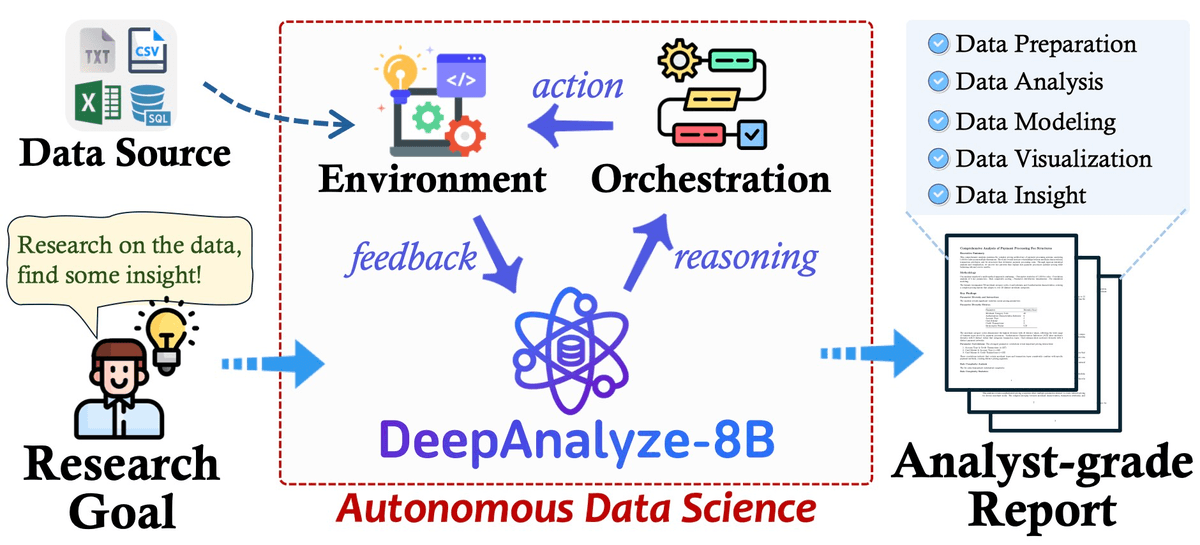
A team from Renmin University of China and Tsinghua has released DeepAnalyze, an 8B parameter open-source model that positions itself as the first agentic LLM built specifically for autonomous data science. Instead of chaining a general-purpose LLM through a hand-written workflow, the model is trained to decide, on its own, when to inspect data, when to write code, when to execute it, and when to write up findings.
DeepAnalyze-8B ships with weights, training code, a 500K trajectory dataset, and multiple frontends (WebUI, JupyterUI, CLI, OpenAI-style API) all under MIT license. Early community reactions highlight the fact that an 8B model is beating agents built on frontier proprietary LLMs on multiple data science benchmarks.
What it actually does
The model can autonomously complete a wide range of data-centric tasks without human intervention, covering the entire pipeline (data preparation, analysis, modeling, visualization, and report generation) as well as open-ended deep research over structured data (databases, CSV, Excel), semi-structured data (JSON, XML, YAML), and unstructured data (TXT, Markdown), producing analyst-grade research reports.
You point it at a folder of files with a task instruction, and it iterates until it produces a written report with charts. A minimal call looks like this:
from deepanalyze import DeepAnalyzeVLLM
deepanalyze = DeepAnalyzeVLLM("path/to/deepanalyze-8b/")
answer = deepanalyze.generate(
    prompt="Generate a data science report.\n# Data\nFile 1: person.csv ...",
    workspace="/path/to/data/"
)
print(answer["reasoning"])
The five-action loop
Where a typical data agent uses a fixed plan-code-execute template, DeepAnalyze is trained to emit one of five action tags at each step. It uses five actions, Analyze, Understand, Code, Execute, and Answer, so the model can switch between thinking and doing. The JupyterUI demo makes this concrete:
This story is for Pro members
You've reached the end of the free preview. Upgrade to AlphaSignal Pro to read the full article - and everything else behind the paywall.
Comments
