

Reka's WMGym Judges World Models on Decision-Making, Not Pretty Pixels
Reka's WorldModelGym shifts world model evaluation from visual realism to decision-making accuracy, launching an open leaderboard with a simple API submission protocol
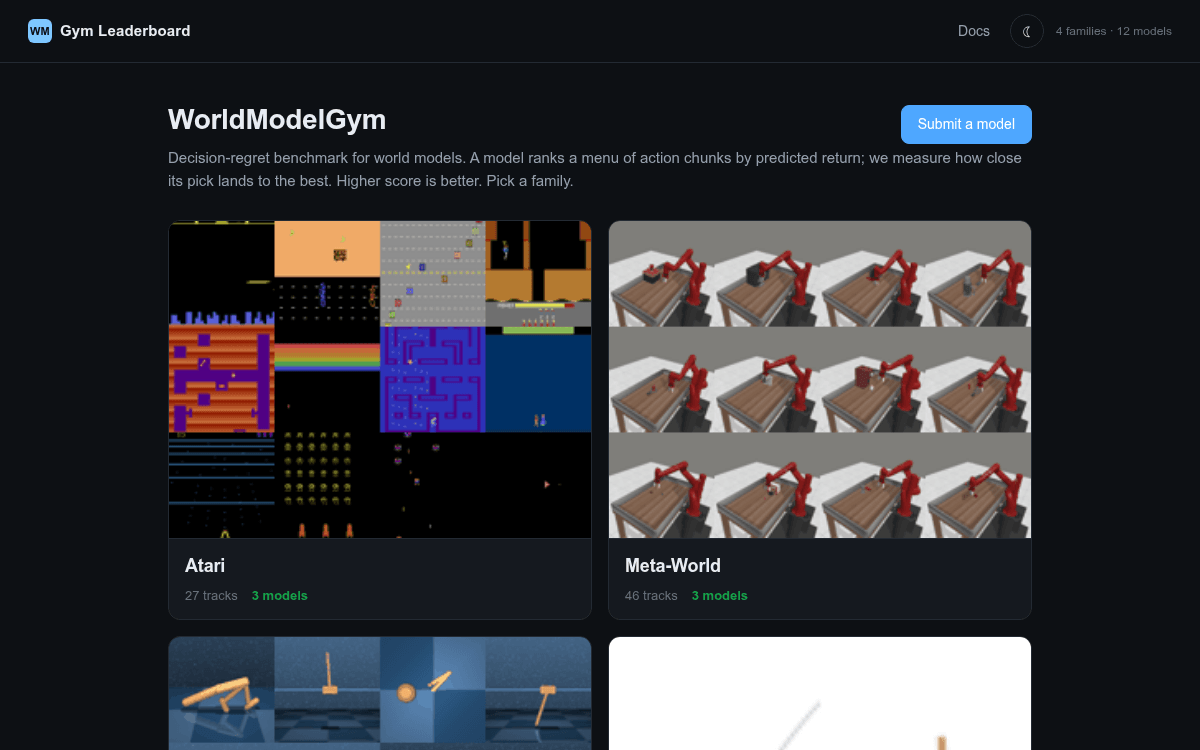
- New leaderboard: Reka launched WorldModelGym (WMGym), evaluating world models on decision fidelity rather than visual realism.
- Core metric: Decision fidelity measures how often a world model correctly ranks which action leads to the best outcome.
- Four benchmarks: Classical Control, DeepMind Control, Meta-World, and Atari form the four evaluation families.
- Baseline results: Reka's Dreamer-v3 leads three of four families, hitting 84% decision fidelity on Classical Control.
- Open submission: Anyone can enter by hosting a
/scoreendpoint; Reka calls it and computes the score — no weight uploads needed. - Free to use: The leaderboard is open and free; the benchmark targets robotics, game AI, and simulation-based planning use cases.
Most world model benchmarks ask one question: does the generated video look real? WorldModelGym (WMGym) from Reka asks something different: given a set of possible actions, can the model correctly predict which one leads to the best outcome? That shift targets the gap between a model that generates convincing pixels and one that actually understands how the world works.
The leaderboard is now open. Reka seeded it with their own Dreamer-v3 implementation as the first entry and is inviting the community to submit models via a lightweight API protocol.
The problem with looking good
The world model field has been dominated by video generation quality metrics: does the output look photorealistic, does motion flow naturally, does physics seem plausible to a human eye? Existing benchmarks treat world models as video generators and ignore their functional role in decision-making. The result is a leaderboard ecosystem that rewards perceptual polish but says nothing about whether a model can serve as a simulator for an RL agent or a planning system.
WMGym addresses that gap directly. Its core metric is decision fidelity: how often does the world model rank actions in the same order as the ground-truth environment would? If a model predicts that pushing left leads to a higher reward than pushing right, and the real environment agrees, that counts as a fidelity hit.
Four benchmark families, one score
WMGym covers four established RL benchmark families, each testing a different flavor of physical reasoning:
- Classical Control — simple physics tasks like CartPole and Pendulum, where the model must predict the outcome of basic mechanical actions
- DeepMind Control (DMC) — continuous locomotion and manipulation tasks on articulated bodies, requiring precise dynamics prediction
- Meta-World — robotic arm manipulation tasks covering a wide range of object interactions
- Atari — classic arcade games, testing whether the model can reason about discrete, pixel-level game dynamics

Reka ran their Dreamer-v3 baseline across all four. It currently leads three: Meta-World, DeepMind Control, and Classical Control, where it hits 84% decision fidelity. It sits second on Atari. These are opening numbers on a fresh leaderboard, so the bar should move quickly once more models are submitted.
What is Dreamer-v3?
Dreamer-v3 is a model-based reinforcement learning algorithm from DeepMind. Rather than learning purely from environment interactions, it builds a compact latent model of the environment using a Recurrent State-Space Model (RSSM) architecture, then trains a policy by running simulations entirely inside that internal model. This dramatically reduces the need for real environment samples, since the agent learns from imagined rollouts rather than costly real-world data collection.
Dreamer-v3 drew wide attention by using a fixed set of hyperparameters that works across DMControl, Atari, Crafter, and Minecraft simultaneously, a rare property for any RL algorithm. With those fixed hyperparameters, it outperforms domain-tuned expert algorithms across a wide range of benchmarks and data budgets. Using it as WMGym's baseline is a deliberate choice: it is the current standard for action-conditioned world modeling across diverse domains.

How to submit your model
The submission protocol is intentionally minimal. You host a /score endpoint on your own infrastructure, and Reka calls it to compute the score. That means:
- You do not need to upload model weights or share proprietary checkpoints
- Reka controls the evaluation data and scoring, preventing leakage or overfitting to the benchmark
- The compute burden of running the model stays with the submitter
The leaderboard is free to use and open to any model that can expose the required endpoint.
Why this benchmark matters now
The world model space is moving fast. In late 2025 and early 2026, Yann LeCun left Meta to launch AMI Labs at a €3B valuation, and Google DeepMind released Genie 3, the first real-time interactive world model capable of generating persistent 3D environments at 24 fps. With that much capital and research attention flowing in, the field needs evaluation infrastructure that goes beyond visual quality.
The term "world model" also means different things across computer vision, robotics, reinforcement learning, and generative modeling. Visual quality belongs in renderer metrics, forward-prediction fidelity belongs in simulator metrics, and decision performance belongs in planner metrics. WMGym focuses on that last category.
For anyone building world models for robotics, game AI, or simulation-based planning, WMGym produces a concrete number that answers the question your downstream application actually cares about: not "does this look right?" but "does this predict the right move?"
Comments
