

Reka Drops RekaDaily-10k, 10,000 Hours of Real Home Footage for Robot Training
Reka open-sources 10,312 hours of unscripted, first-person household video under Apache 2.0, giving physical AI researchers a large-scale real-world training corpus
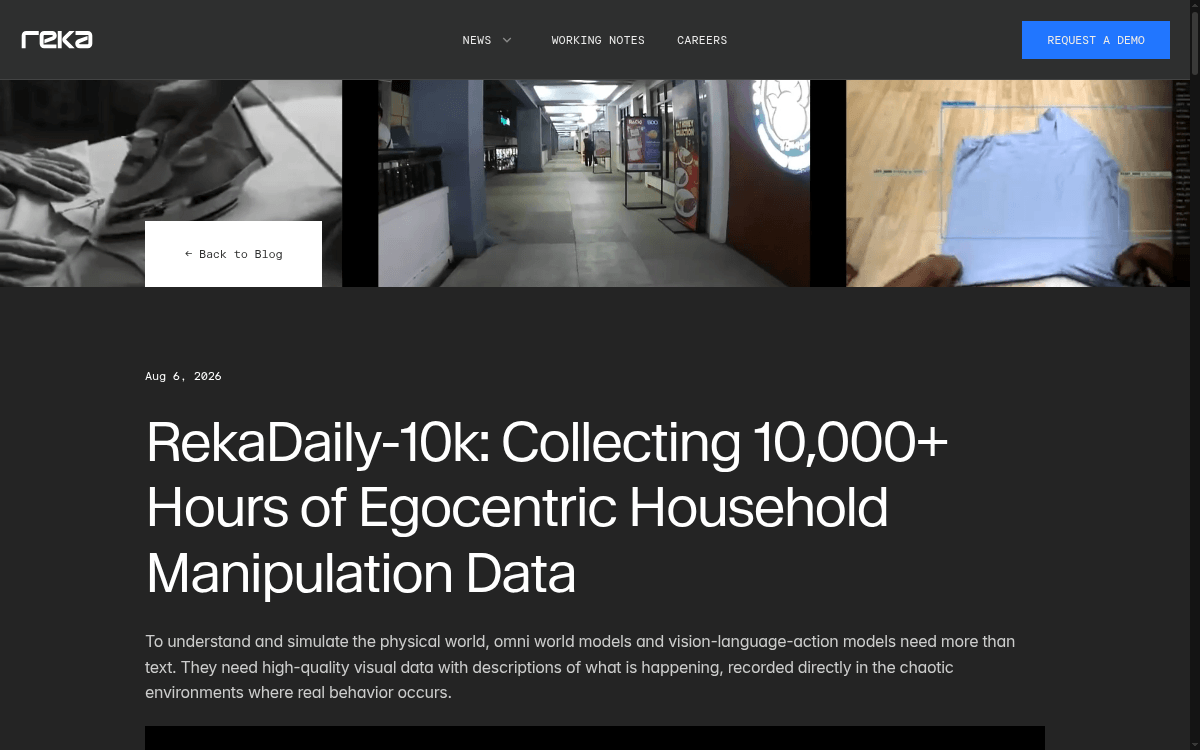
- 10,312 hours released: Reka open-sources RekaDaily-10k, unscripted first-person household video from paid collectors across 4 continents, Apache 2.0.
- Two tiers: Raw footage (no processing) for teams with their own pipelines, plus a processed and captioned tier with session-level language supervision out of the box.
- Collected via Claru: Reka's paid data network of 100,000+ collectors recording in their own homes; footage is unscripted, continuous, and includes real-world clutter and interruptions.
- 1,670 hours in native 4K: Higher resolution than most large egocentric corpora, covering cooking, laundry, cleaning, organizing, and other everyday domestic tasks.
- Privacy pipeline: Automated PII screening plus human review; GPS, device IDs, and timestamps stripped from all video container metadata before upload.
- Strategic context: Reka is building toward a World Language Action Model; this dataset is a public snapshot of what their Claru data engine produces daily.
Training a robot to fold laundry or unload a dishwasher sounds simple until you realize almost no publicly available video shows a real person doing it, uncut, from their own point of view, in their own messy kitchen. Reka just released RekaDaily-10k: 10,312 hours of unscripted, first-person household footage collected by paid contributors in real homes across the US, Latin America, Asia, and Africa.
What it actually is
Egocentric video, shot from a head-mounted camera, is the format that matters most for training physical AI. Models that need to understand how to manipulate objects in the real world need to see what a human sees while doing it, not a third-person camera watching from across the room. One continuous first-person view of somebody actually doing a task, at the speed they actually do it, in the mess they actually live in, is what gives a model something to learn from.
RekaDaily-10k ships in two tiers:
- Raw tier — 10,312 hours of unfiltered footage, letting teams apply their own clipping, filtering, and annotation workflows.
- Processed and captioned tier — Footage cut into shorter clips and captioned, for teams that want language supervision out of the box.
The Apache 2.0 licence covers commercial use and redistribution. Each clip ships as video with a text caption. Roughly 1,670 hours are in native 4K, which is unusually high resolution for a dataset of this type. The raw tier is live now on Hugging Face; the full 10,312-hour set is rolling out incrementally.
Where the footage comes from
Claru is a paid collection network of more than 100,000 people recording the physical world. Collectors join a project, pass a qualification assessment, then record, submit, and get paid per accepted hour. This model differs from teleoperation, where a human remotely controls a robot arm, and from synthetic data, where scenes are computer-generated. Teleoperated data is precise but slow to produce and tends to reflect the tidiness of controlled recording spaces. Synthetic scenes scale but smooth over the clutter of real homes.
The activities recorded are deliberately mundane:
- Laundry from pile to folded stack
- Kitchen cleanup: dishes, unloading groceries, wiping surfaces
- Reorganizing closets and drawers
- Sweeping, taking out the trash, watering plants
- Unboxing items, changing bulbs or batteries
The short, fiddly two-handed jobs are here precisely because no one would commission a teleop session for them, yet they appear on every household task list. Sessions run long, hands leave frame, tasks get abandoned and resumed, and people walk in and interrupt. That is what deployment actually looks like.
The captioning problem
Getting the video is only half the work. The harder part is describing what is happening in a way that is useful as a training signal. A caption that says "a person walks through a kitchen" is technically true of a single frame but useless for teaching a model that a wash cycle is running. Captions need to reflect where an activity sits in the arc of a full session, which matters when somebody loads the washer, wanders off, and comes back twenty minutes later to unload it.
The processed tier handles this by captioning over full session context rather than individual clips in isolation. The raw tier ships without any of this applied, so teams with their own annotation pipelines can start upstream of every decision Reka made.
Quality control
At 10,000-plus hours, bad footage is inevitable. Reka built an automated QC system that flags specific failure modes before anything reaches the processed tier:
- Hands never visible in the frame
- Illumination too poor to make anything out
- Frozen or duplicated frames
- Wrong orientation or solid-color padding
- Footage that does not match the assigned activity
- Time inflation, where a collector stalls to pad a per-hour payout
Every video also gets a perceptual fingerprint, because at this volume near-duplicates stop being hypothetical. The thresholds were calibrated against historical submissions with known human verdicts, and the system is tuned to keep borderline footage for human review rather than automatically rejecting it.
Privacy and consent
Recording inside real homes at scale raises obvious concerns. Collectors are paid contractors who opt in, and every session is recorded with the wearer's knowledge and agreement. Bystanders are handled separately: collectors are instructed to record only with the agreement of other adults present. Every video also goes through automated PII screening for faces in mirrors, names on prescription labels, and pieces of mail, with flagged clips going to a human reviewer before release. Reka acknowledges the screening is imperfect and provides a contact for takedown requests.
On the Hugging Face side, every video has been processed to remove container metadata including GPS coordinates, device identifiers, and capture timestamps, then verified clean before upload.
Where it fits in the egocentric landscape
A wave of large-scale releases in 2025 and 2026 has pushed egocentric human demonstration data into the mainstream of robot learning. RekaDaily-10k sits alongside several key datasets:
- Ego4D — The reference corpus for daily-life egocentric video. 3,000-plus hours, heavily annotated, still the standard benchmark.
- EPIC-KITCHENS — Gold standard for kitchen activity benchmarks: 100 hours, 45 kitchens, 90,000 action segments.
- Build AI Egocentric-1M — Released in April 2026, roughly 1 million hours focused on industrial environments, dwarfing every prior dataset combined.
- RekaDaily-10k — Household-focused, unscripted, with 4K footage and language captions tied to session-level context.
Human egocentric video is far cheaper to collect than robot teleoperation data, covers a vastly larger range of tasks and environments, and when aligned correctly, transfers meaningfully to robot policy performance. The domestic niche is where most prior large-scale releases have the least coverage, which is exactly where RekaDaily-10k lands.
What Reka is building toward
This dataset feeds a larger goal. The team's stated focus is a World Language Action Model (WLAM), an omni-model trained on egocentric and other physical-world data so it can perceive and act in the real world through realistic simulation for planning. Claru, the data engine behind this release, also collects robotics trajectories and world-model footage beyond household video.
The open release under Apache 2.0 is a deliberate positioning move. By contributing the dataset to the research community, Reka establishes Claru as infrastructure for physical AI data collection while generating goodwill and citations from teams that build on top of it. This follows their earlier release of RekaCS2-10k, 10,000 hours of egocentric Counter-Strike 2 footage with per-frame action annotations.
How to use it
The dataset is available on Hugging Face under Apache 2.0, ungated and free. Videos are packed into WebDataset tar archives of roughly 5 to 8 GB, organized by collection project. Loading is straightforward:
import webdataset as wds
url = "https://huggingface.co/datasets/RekaAI/RekaDaily-10k-raw/resolve/main/data/egocentric_household_tasks/shard-00000.tar"
ds = wds.WebDataset(url)
for sample in ds:
    video_bytes = sample["mp4"]   # or .mov
    metadata = sample["json"]     # activity labels, duration, fps, resolution, collector hash
Each video comes with a JSON sidecar carrying activity taxonomy labels, lighting conditions, duration, fps, resolution, and a salted-hash collector ID (distinct values roughly correspond to distinct home environments). The metadata is also available as Parquet for lighter programmatic reads without downloading the full video archives.
The raw tier is the right starting point if you have your own clipping and annotation pipeline. The processed and captioned tier is the faster path to fine-tuning a vision-language model or world model on household activities without building annotation infrastructure from scratch. Both are free for commercial use.
Comments
