
RadixArk's Qwen3.8-27B Squeezes a 27B Model onto One Consumer GPU at 97% Accuracy
RadixArk shipped an NVFP4 W4A4 quantization of Qwen3.8-27B that runs on a single RTX 5090 while keeping GSM8K accuracy above 97%.
 Pro
Takeaways
- RadixArk released Qwen3.8-27B-NVFP4, a 4-bit quantization of Qwen3.8-27B for Blackwell GPUs.
- Uses a mixed recipe: NVFP4 W4A4 for MLPs, FP8 attention, BF16 for MTP and vision tensors.
- Scores 97.27% on GSM8K and 73.81% on Terminal-Bench 2.1 with SGLang on GB300.
- Runs on a single RTX 5090 via vLLM with full 256K context.
- A BF16-lm_head variant ships alongside it for stricter accuracy needs.
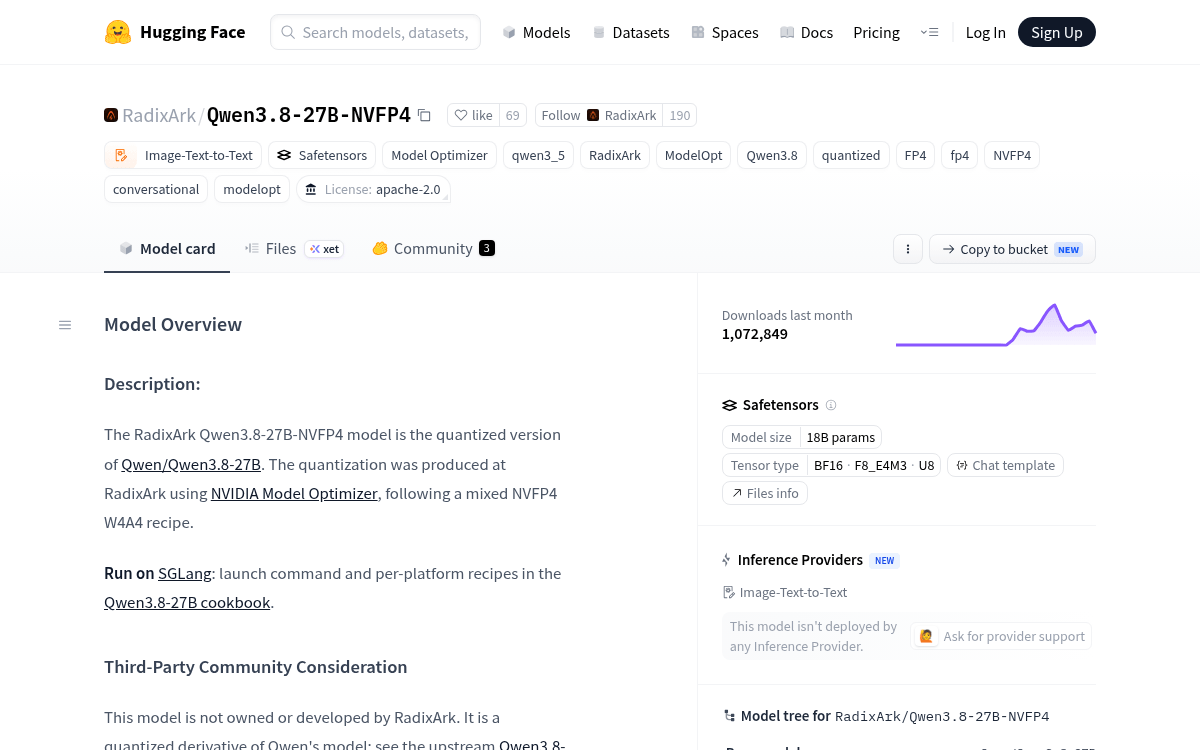
- Over 1M downloads on Hugging Face under Apache 2.0, keeping multimodal input intact.
A new 4-bit checkpoint of Qwen3.8-27B has quietly become one of the most downloaded models on Hugging Face, crossing a million pulls in a few weeks. RadixArk's Qwen3.8-27B-NVFP4 is a post-training quantization of the base Qwen model that shrinks the checkpoint to roughly 22 GB, small enough to fit on a single consumer Blackwell GPU, while holding onto near-BF16 accuracy on reasoning and coding benchmarks.
RadixArk produced the quantization with NVIDIA Model Optimizer, following a mixed NVFP4 W4A4 recipe. NVFP4 is NVIDIA's 4-bit floating point format for the Blackwell generation, where weights and activations are packed into 4 bits (W4A4) with small per-group scale factors rather than a single per-tensor scale. That yields the memory footprint of INT4 without the accuracy collapse that usually follows when you quantize activations.
A recipe that spares the right layers
What did and did not get quantized turns out to be the interesting part. The MLP gate_proj, up_proj, and down_proj layers and lm_head use dynamic NVFP4 W4A4 quantization with group size 16. Attention weights use FP8, while MTP and vision tensors retain the source BF16 precision. The bulky feed-forward matrices get the aggressive 4-bit treatment, attention stays at 8-bit for stability, and the multi-token prediction heads plus the vision tower keep full BF16 precision so multimodal quality does not degrade.
Calibration was lightweight: 1,024 samples from the abisee/cnn_dailymail training split with sequence length 512. No fine-tuning, no distillation, just post-training quantization on top of the base Qwen release.
What survives the squeeze
Accuracy holds up better than a naive 4-bit run would suggest. On GSM8K and Terminal-Bench 2.1, the checkpoint was measured on 4x Blackwell GB300 GPUs with an SGLang tensor-parallel deployment:
- GSM8K: 97.27% (1,283/1,319) in thinking mode, full split
- Terminal-Bench 2.1: 73.81% (62/84) pass@1 via Claude Code 2.1.228
The model keeps the full capability surface of the base: text, image, and video input with a native context length up to 262,144 tokens, and text output. It remains a multimodal reasoning model rather than a text-only stripped variant.
Two variants, and why the lm_head matters
RadixArk shipped a companion checkpoint, Qwen3.8-27B-NVFP4-BF16-LMHead, that keeps everything the same except the output projection. The lm_head is not quantized: it uses the original BF16 lm_head weights from Qwen/Qwen3.8-27B instead of the NVFP4 W4A4 quantized ones. All other tensors are identical to the source checkpoint.
This turns out to matter. The SGLang team noted that pairing FP8 KV cache with a BF16 lm_head gave a significant accuracy improvement, and they updated the cookbook to reflect this new option for users with stricter accuracy requirements. They also flagged that bad experiences with Qwen3.8-27B on NVFP4 often trace back to lm_head quantization. If you are seeing garbled outputs on other NVFP4 ports of this model, the output head is the first place to look.
Running it
The reference deployment path is SGLang on Blackwell. The recommended launch enables NEXTN speculative decoding out of the box:
sglang serve \
  --trust-remote-code \
  --model-path RadixArk/Qwen3.8-27B-NVFP4 \
  --tp-size 4 \
  --mem-fraction-static 0.75 \
  --speculative-algorithm NEXTN \
  --speculative-num-steps 3 \
  --speculative-eagle-topk 1 \
  --speculative-num-draft-tokens 4 \
  --reasoning-parser qwen3 \
  --tool-call-parser qwen3_coder
You do not actually need four datacenter GPUs. A community project shows the checkpoint running on a single NVIDIA RTX 5090 (32 GB, sm_120) via vLLM 0.27.x with full native 256K context, TurboQuant 4-bit KV cache pinned at 5.5 GiB, and MTP-3 speculative decoding, exposed as an OpenAI-compatible API. The model download weighs about 22 GiB, leaving enough headroom on a 32 GB card for a real context window.
For teams working on NVIDIA's small workstation, the nvfp4, nvfp4-fp4, fp8, and bf16 variants of Qwen3.8-27B all fit in the DGX Spark's 128 GB, so on that class of hardware the NVFP4 build buys you latency and batch size rather than relieving pure memory pressure.
Where it fits
The intended target is straightforward: developers looking to deploy an off-the-shelf, pre-quantized model in AI agent systems, chatbots, RAG pipelines, and other AI-powered applications. The strong Terminal-Bench score plus the built-in qwen3_coder tool-call parser make it especially well suited to coding agents and shell-driven workflows, and the retained vision tower means it can also handle image and video inputs without swapping models.
The bigger signal is ecosystem shape. RadixArk is publishing a DSpark speculator for Qwen/Qwen3.8-27B-FP8. DSpark extends DFlash with target-model auxiliary features and a confidence head that dynamically chooses the number of draft tokens. The speculator was trained with SpecForge and is served with SGLang. Combined with NVFP4 weights, FP8 KV cache, and MTP-3 speculative decoding, that adds up to a full stack aimed at squeezing single-node inference throughput on Blackwell hardware, without giving up the reasoning quality that made the base model useful in the first place.