
Qwopus3.6 Beats Q8 Quality at Half the Size on Consumer Hardware
Qwopus3.6-35B-A3B-Coder gets APEX quantization and bundled MTP heads for faster, leaner local coding agents
 Pro
Takeaways
- New release: Qwopus3.6-35B-A3B-Coder-APEX-MTP-GGUF combines APEX quantization and a bundled MTP head for faster local inference.
- APEX quantization assigns different precision per tensor role in MoE models, beating Q8_0 quality at roughly half the file size.
- Self-speculative decoding is enabled with a single
--draft-mtpflag -- no separate draft model required, files are only ~2.5% larger. - 62.4% on SWE-bench (300 cases, thinking-off mode, Q5_K_M quant) -- strong results for a local model running without chain-of-thought.
- Five quantization tiers from 21.3 GB (I-Quality) to 12.2 GB (Mini) cover everything from high-accuracy to consumer GPU deployment.
- Free and open-source under Apache 2.0; best for OpenHands, OpenCode, and Codex-style local coding agent workflows.
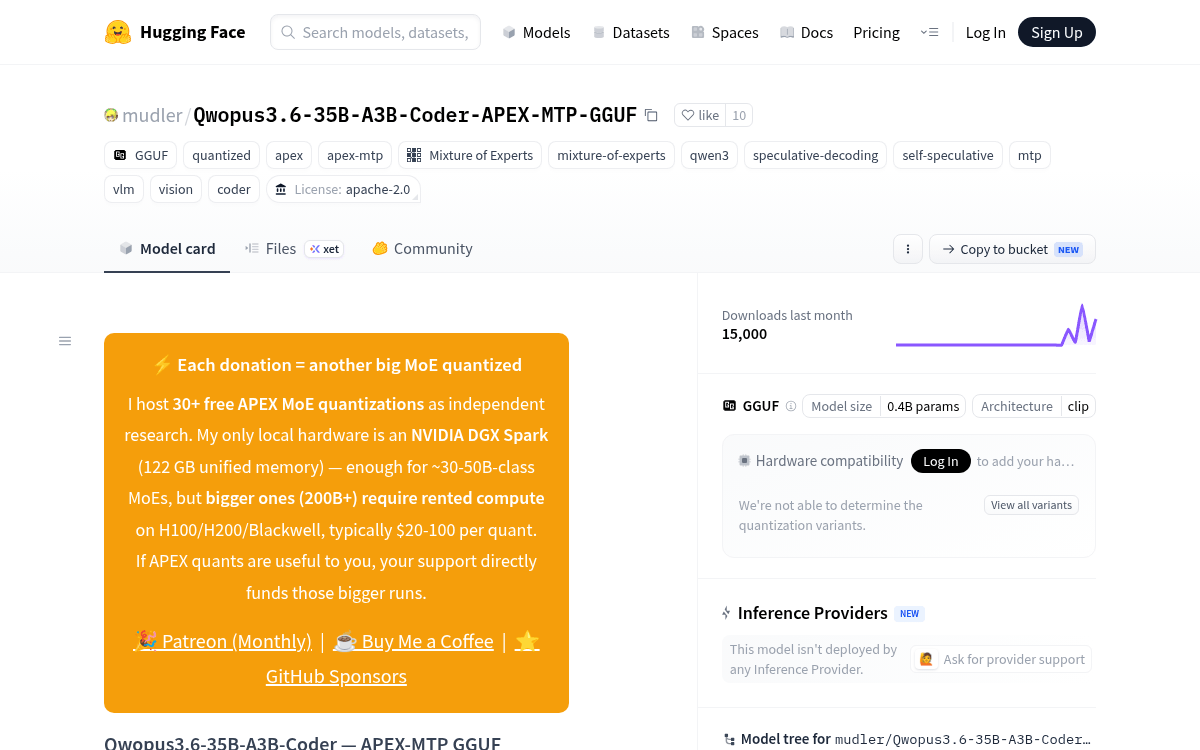
Qwopus3.6-35B-A3B-Coder-APEX-MTP-GGUF is a new community release that combines two independent innovations into a single file: a smarter quantization scheme purpose-built for Mixture-of-Experts models, and a bundled multi-token prediction head that enables self-speculative decoding without any extra setup. The result is a 35B-parameter coding agent that fits on consumer hardware and runs faster than standard quantized builds, with no quality trade-off.
A model built for doing, not thinking
Qwopus-3.6-35B-A3B-Coder is a thinking-off, token-efficient coding agent model designed for real agentic coding workflows where the model repeatedly reads files, chooses tools, edits code, runs tests, reacts to errors, and summarizes work. The core goal is to complete more of these steps with less token waste, lower latency, and more stable behavior when explicit long thinking is disabled.
Most coding-focused LLMs are optimized to reason longer and harder. This one takes the opposite bet: that most steps in a real agent loop (pick a tool, read a file, patch a function) don't need deep deliberation. They need speed and consistency. The model is optimized for repeated tool decisions, patching, test runs, and error-driven debugging without forcing every step into long thinking mode.
The architecture underneath
The coder model builds on the Qwopus3.6-35B-A3B line, itself based on Qwen3.6-35B-A3B. The underlying architecture is a hybrid sparse MoE model with 35B total parameters and approximately 3B active parameters per token, making it attractive for local high-frequency coding workloads. Only 3B parameters fire per forward pass, which keeps inference fast even on a single GPU.
The training workflow is accelerated and memory-optimized with Unsloth. The fine-tuning pipeline layered coding and tool-use adaptation on top of the base MoE, then specifically targeted thinking-off behavior: faster next-step decisions, lower token waste, and better workflow stability across long agent loops.
What APEX actually does
Standard quantization treats every weight the same, compressing all of them to, say, 4-bit. APEX is a quantization strategy for Mixture-of-Experts models that goes beyond uniform bit-width assignment. It classifies every tensor by its role -- routed expert, shared expert, or attention -- and then applies a layer-wise precision gradient.
The key insight is that MoE models have a structural property that standard quantization ignores entirely. APEX exploits three properties unique to MoE models: the structural sparsity of routed experts, which tolerate aggressive quantization because inactive experts contribute no error to forward passes; the heavy-tailed weight distribution of shared experts, which require higher precision to preserve outlier values; and the non-uniform sensitivity of transformer layers, where edge layers are significantly more sensitive to quantization than redundant middle layers.
The practical outcome is striking. APEX beats Q8_0 perplexity at half the size -- and even beats F16. APEX I-Quality (21.3 GB) achieves PPL 6.552 and 83.5% HellaSwag vs Unsloth UD-Q8_K_XL (45.3 GB) at PPL 6.536 and 82.5% HellaSwag. Better quality, half the disk space.
MTP: self-speculative decoding in one file
The MTP (Multi-Token Prediction) head is the second major piece. Speculative decoding is a technique where a smaller "draft" model proposes several tokens at once, and the main model verifies them in parallel -- yielding a significant throughput boost without changing output quality. Normally this requires running two separate models. This release collapses both into one.
These GGUFs bundle the model's MTP head alongside the trunk in a single file, courtesy of llama.cpp PR #22673. With a recent llama.cpp you can enable self-speculative decoding using just this one file -- no separate draft model needed.
Enabling it is a single flag:
llama-server -m Qwopus3.6-35B-A3B-Coder-APEX-MTP-I-Balanced.gguf --draft-mtpEach quant is only ~2.5% larger than its non-MTP counterpart, since MTP shares the trunk's embed_tokens with no embedding duplication. The MTP head itself is kept at Q8_0 precision across all tiers to maintain high draft accuracy and a good token acceptance rate.
Benchmark results
Qwopus-3.6-35B-A3B-Coder scored 62.4% on a 300-case SWE-bench run using thinking off and submitted patches. The evaluated model was the Q5_K_M quantized build. SWE-bench measures whether a model can resolve real GitHub issues by editing repository code and passing hidden tests -- a much harder bar than code completion.
A head-to-head comparison against Ornith-1.0 (a thinking-on model) shows where the tradeoffs land:
| Capability | Qwopus (thinking off) | Ornith-1.0 (thinking on) |
|---|---|---|
| Legit-request compliance | 100 | 70 |
| Multi-turn orchestration | 80 | 70 |
| Sustained debugging | 60 | 50 |
| Engineering competence | 81 | 94 |
| Context-poison resistance | 70 | 85 |
The comparison intentionally contrasts Qwopus in thinking-off mode with Ornith-1.0 in thinking-on mode. Qwopus-3.6-35B-A3B-Coder is positioned as a practical agent execution model. It wins on execution categories and loses on deep reasoning ones -- exactly as designed.
Available quantization tiers
Five tiers from 21.3 GB (I-Quality) to 12.2 GB (Mini) cover every deployment scenario from maximum accuracy to consumer GPU inference. The I-variants (prefixed with "I-") use imatrix calibration -- a technique that measures which weights matter most for real inputs and allocates more precision there.
- I-Balanced -- Best overall quality + self-speculative decoding (recommended starting point)
- I-Quality -- Highest quality with imatrix calibration + self-spec
- I-Compact -- Consumer GPUs + self-spec
- I-Mini -- Smallest viable footprint + self-spec
- Balanced / Quality / Compact -- Non-imatrix variants, slightly smaller
A separate mmproj.gguf vision projector is also included for image understanding tasks.
Who should use this
This model is a strong fit if you are running a local coding agent and care more about throughput and stability than raw reasoning depth. It is designed for real agentic coding workflows where the model repeatedly reads files, chooses tools, edits code, runs tests, reacts to errors, and summarizes work. Compatible harnesses include OpenHands, OpenCode, Codex-style, and Claude Code-style pipelines.
- Repository-level debugging and multi-file patch generation
- Automated test-fix cycles and DevOps scripting
- Long-context codebase navigation
- Local tool-calling agents where latency matters
The model is free under the Apache 2.0 license and available now on Hugging Face. The APEX quantization project is also open-source, with a full technical report for those who want to apply the same strategy to other MoE models. The LocalAI team, which produced the APEX quants, funds larger runs (200B+ models) through community support since those require rented H100/H200 compute beyond their local DGX Spark hardware.