
Qwen3.6-35B Hits 1M Downloads With a No-GPU Denoising Trick
A community-released GGUF blends an uncensored Qwen3.6 MoE base with Hermes function calling, using a math-based tensor repair method called Genesis.
 Pro
Takeaways
- Community GGUF fusing uncensored Qwen3.6 35B MoE with Hermes function-calling finetune.
- Over 1 million downloads in first month, 579 likes on Hugging Face.
- Genesis method denoises tensors via Marchenko-Pastur SVD, no retraining required.
- 35B total, 3B active, 256 experts, 262K context extendable to 1M via YaRN.
- Hybrid Gated DeltaNet plus full attention at 3:1 ratio, 201 languages, multimodal.
- Runs on llama.cpp, LM Studio, Ollama, vLLM; recommended V8 APEX quant.
A 35B-parameter Qwen3.6 mixture-of-experts model has pulled over a million downloads in its first month on Hugging Face. Called Qwen3.6-35B-A3B-Uncensored-Genesis-Hermes-V11-GGUF, the release combines three components: an uncensored Qwen3.6 base from HauhauCS, a Hermes function-calling finetune from DJLougen, and a post-training numerical cleanup pass the author calls Genesis. It ships as a ready-to-run GGUF with vision support and agentic tool calling included.
What Genesis actually does
The premise behind Genesis is that training leaves random noise scattered through a model's tensors alongside real learned knowledge, and that noise makes outputs unstable and verbose. Rather than finetune the result, the author runs a numerical repair pass directly on the GGUF file in three stages.
First, it scans the state-space convolution tensors responsible for long-context memory and rebalances the heads. Second, it scans blocks in chunks and replaces zero-valued segments in broken tensors with better-matching ones, leaving the learned structure untouched. Third, it detects noise using a custom SVD calibrated to the Marchenko-Pastur distribution, a result from random matrix theory that predicts the eigenvalue spectrum of pure noise. Anything outside that band is treated as real signal and kept. Token embeddings, output weights, 1D tensors, biases, and norms are excluded from the SVD pass entirely. The author claims 99% of the signal and learned gradient survives.
Inside the architecture
The underlying model has some genuinely unusual design choices. Specs from the model card:
- 35B total parameters with roughly 3B active per forward pass
- 256 experts, 8 routed plus 1 shared per token
- Hybrid Gated DeltaNet linear attention combined with full softmax attention in a 3:1 ratio
- 40 layers arranged as 10 blocks of three DeltaNet-MoE layers plus one Attention-MoE layer
- 262K native context, extendable to 1M with YaRN, with native support for text, image, and video input
- 248K vocabulary covering 201 languages
The DeltaNet and attention hybrid keeps long-context inference cheap. Linear attention layers handle most tokens with constant memory per step, while the periodic full-attention layers preserve the recall accuracy that pure linear attention tends to lose.
Running it locally
Deployment is straightforward. The GGUF format works with llama.cpp, LM Studio, koboldcpp, and compatible runtimes. A minimal llama.cpp launch:
llama serve -hf LuffyTheFox/Qwen3.6-35B-A3B-Uncensored-Genesis-Hermes-V11-GGUF:F16The author recommends the V8 APEX quant, at least 128K context to preserve thinking capabilities, the jinja flag for chat template handling, and including the mmproj file alongside the main GGUF for vision. Separate sampler presets are suggested for thinking-mode coding versus creative non-thinking use, since Qwen3.6 exposes an explicit thinking toggle.
Strengths and known gaps
Agentic workflows and tool use are the clearest strengths. The Hermes finetune data comes from NousResearch/hermes-function-calling-v1, and the card targets JSON-schema agent prompting explicitly. Multilingual coverage and multimodal input add to the practical surface area.
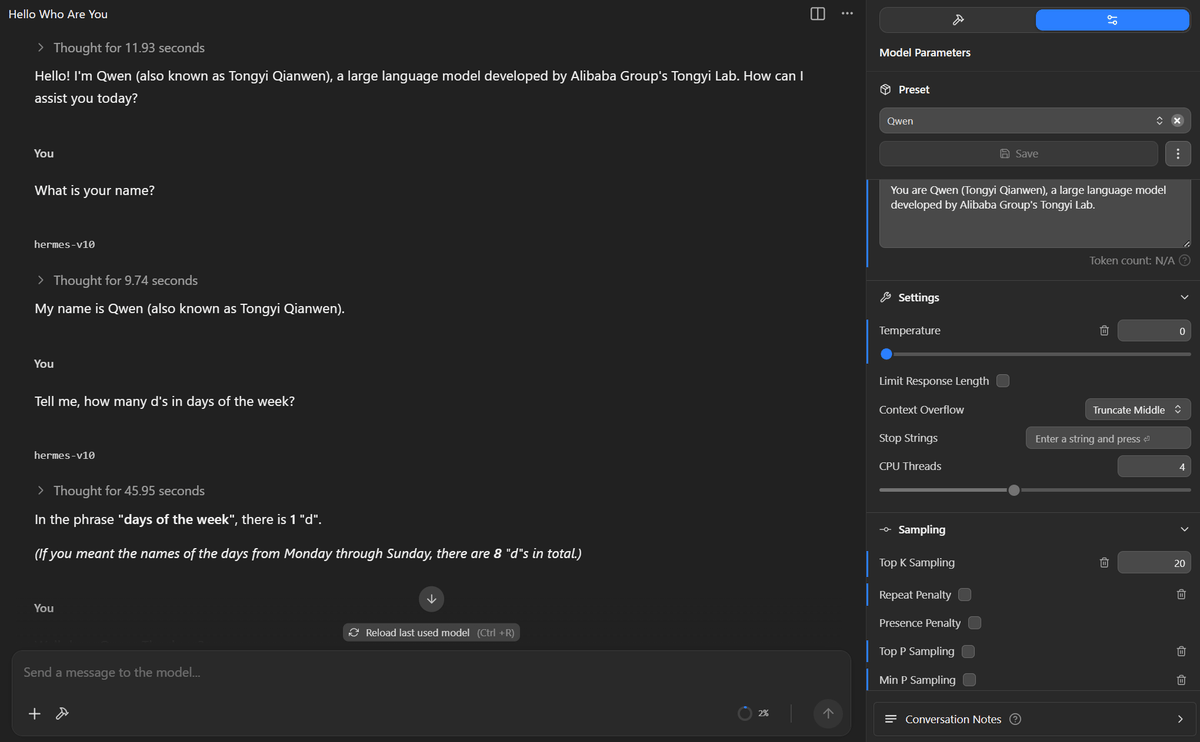
The weaknesses are typical for community releases of this kind. No formal benchmarks are published beyond informal tests such as counting letters in words or generating an SVG of a pelican on a bicycle. The base is explicitly uncensored, with zero refusals across a 465-prompt test, which suits some workflows and disqualifies others. Genesis itself has no peer review behind it, so the consistency improvements should be treated as a hypothesis.
A million downloads and what they signal
That download count for a community remix points to sustained demand for two things: local models with function calling ready out of the box, and post-training improvements that skip the GPU cluster entirely. The author reports running the full Genesis pipeline on a free Google Colab T4. If tensor-level denoising with Marchenko-Pastur thresholding reliably stabilizes existing checkpoints without retraining, similar passes could become routine in open-weights release pipelines, sitting between quantization and finetuning in the stack.