

Qwen's AgentWorld-35B Beats GPT-5.4 by Simulating Environments Instead of Acting in Them
Qwen releases the first open language world model that can simulate 7 agent environments and directly improve downstream agent performance across benchmarks it was never trained on.
 PRO
- Qwen-AgentWorld is the first language model trained to simulate 7 agent environments (MCP, Search, Terminal, SWE, Android, Web, OS) in a single model.
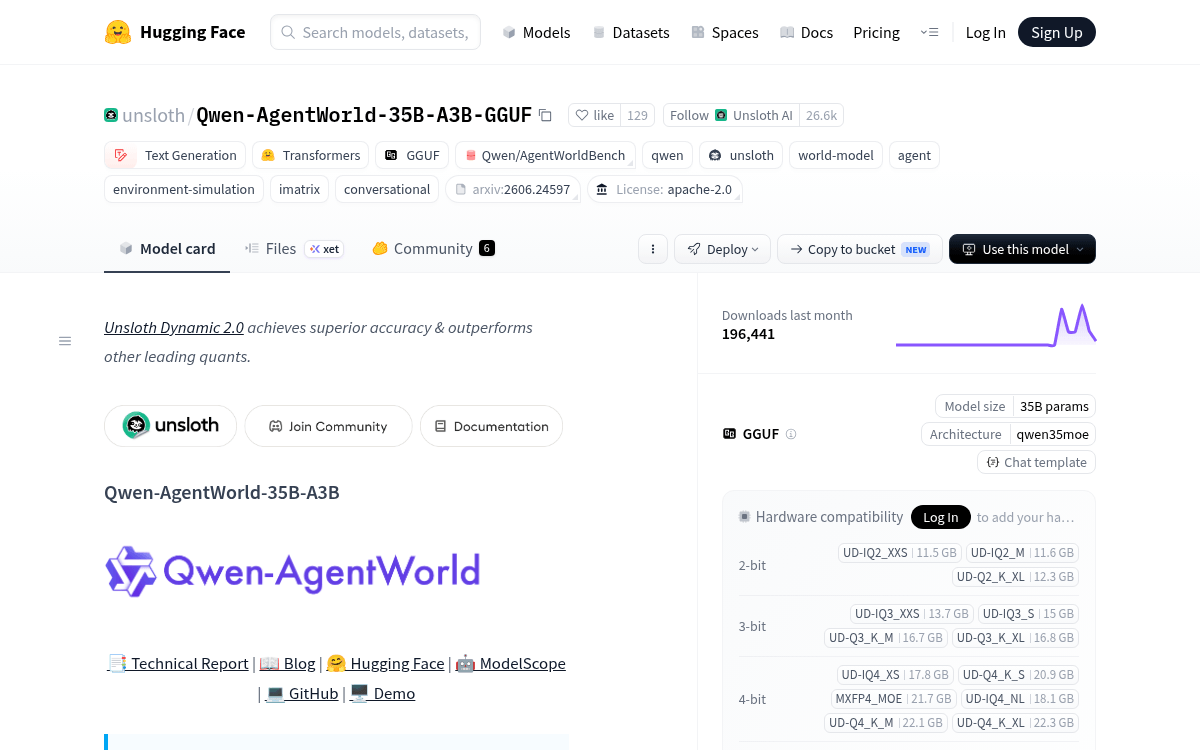
- The 35B-A3B GGUF quantization from Unsloth has 196K+ downloads and is runnable locally with vLLM, SGLang, or Transformers.
- The 397B-A17B variant scores 58.71 on AgentWorldBench, outperforming GPT-5.4 (58.25) and all tested frontier models on overall simulation quality.
- World-model RL warm-up transfers to agent tasks: +11.3 on Claw-Eval, +6.3 on Terminal-Bench 2.0, +3.4 on SWE-Bench Verified — on benchmarks absent from training data.
- Controllable simulation lets you inject natural-language instructions to shape environment behavior, enabling fictional-world training that transfers to real search tasks.
- Released under Apache 2.0; the technical paper and AgentWorldBench dataset are also open.
Training AI agents has always required real environments: live terminals, actual browsers, running sandboxes. Qwen just proposed a different path. Qwen-AgentWorld is a language model trained not to act in environments, but to simulate them , predicting what the environment returns after any given action. The 35B-A3B variant is now available as a quantized GGUF from Unsloth, making it runnable on consumer hardware.
The gap nobody was filling
General agents require robust world modeling capability: learning to predict environment state transitions is both necessary and foundational for effective action selection. Prior LLM agent research disproportionately emphasized state-to-action policy learning, neglecting comprehensive modeling of environment dynamics. Qwen-AgentWorld directly addresses that gap.
The result is the first language world model that simulates seven agent environments through long chain-of-thought reasoning: MCP, Search, Terminal, Software Engineering, Android, Web, and OS. For the three GUI domains, environment observations are represented as accessibility trees and UI view hierarchies rather than pixel frames.
How it was built
Leveraging more than 10M environment interaction trajectories across 7 domains in real-world environments, Qwen-AgentWorld was developed through a three-stage training pipeline: CPT injects general-purpose world modeling capabilities from state transition dynamics and augmented professional corpora, SFT activates next-state-prediction reasoning, and RL sharpens simulation fidelity through a tailored framework with hybrid rubric-and-rule rewards.
The model's architecture is a sparse Mixture-of-Experts (MoE) design , 35B total parameters but only 3B are active during inference, keeping compute costs manageable. It also uses a hybrid attention mechanism combining Gated DeltaNet linear attention layers with standard Gated Attention, and supports a 262,144-token context window, which is critical for long multi-turn environment trajectories.
This story is for Pro members
You've reached the end of the free preview. Upgrade to AlphaSignal Pro to read the full article - and everything else behind the paywall.
Comments
