

Qwen Drops Qwen3.8-Flash-Next, a 125B Open Model That Activates Only 6B Parameters
Qwen ships an FP8 preview of the architecture behind Qwen4, pairing sparse attention, n-gram embeddings and 125B params with 6B active.

 PRO
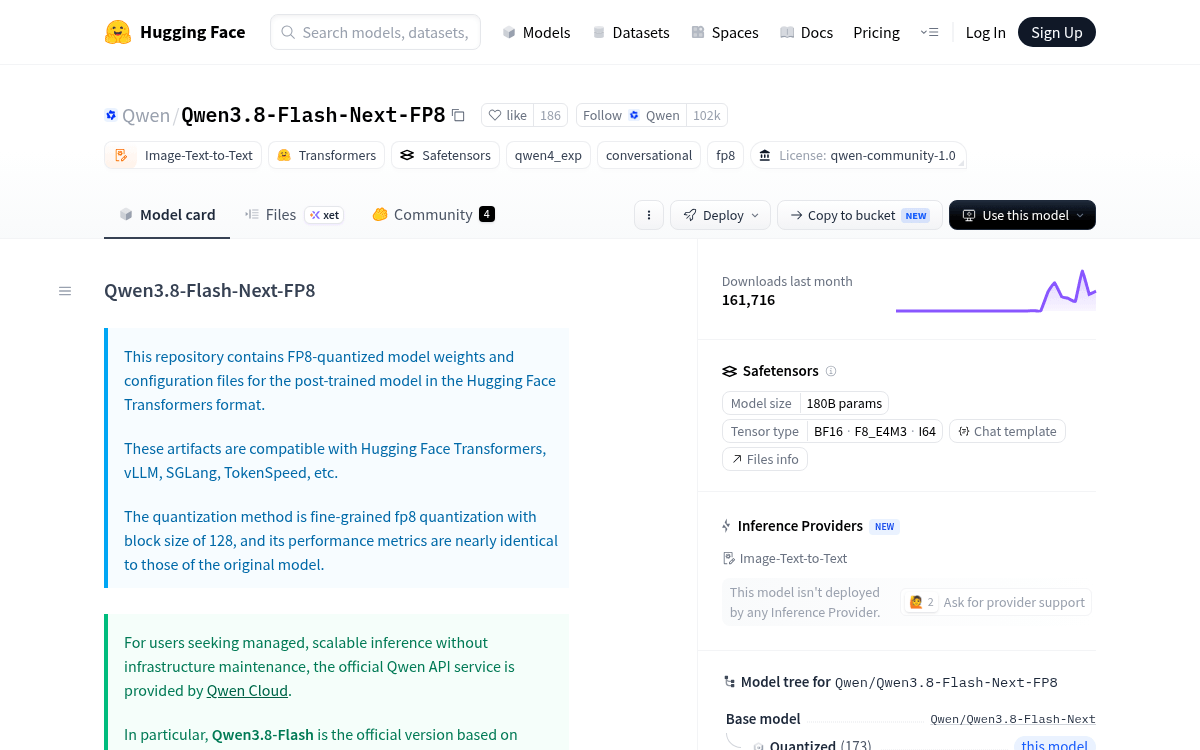
PRO- Qwen released Qwen3.8-Flash-Next-FP8, an experimental preview of the Qwen4 architecture.
- 125B total parameters with only 6B activated per token, plus 51B n-gram embedding table.
- New Qwen Sparse Attention operates on micro-blocks, slashing long-context latency for agents.
- Native 262K context extensible to 1M via YaRN, multimodal text, image, and video.
- Leads SWE-bench Pro (62.5), CoWorkBench (73.9), AndroidWorld (84.5) among peers.
- Deployable via vLLM, SGLang, and Docker with OpenAI-compatible endpoints.
Qwen has released an FP8-quantized checkpoint that doubles as a preview of the architecture powering the upcoming Qwen4 generation. Qwen3.8-Flash-Next-FP8 is a 125B-parameter Mixture-of-Experts model that activates only 6B parameters per token, ships with a 262K native context extendable to 1M, and handles text, images, and video in a single stack.
Four architectural changes are bundled into an openly downloadable checkpoint you can serve today on vLLM or SGLang, each one slated to carry forward into Qwen4. The size is almost beside the point; the plumbing is what makes this worth examining.
What changed under the hood
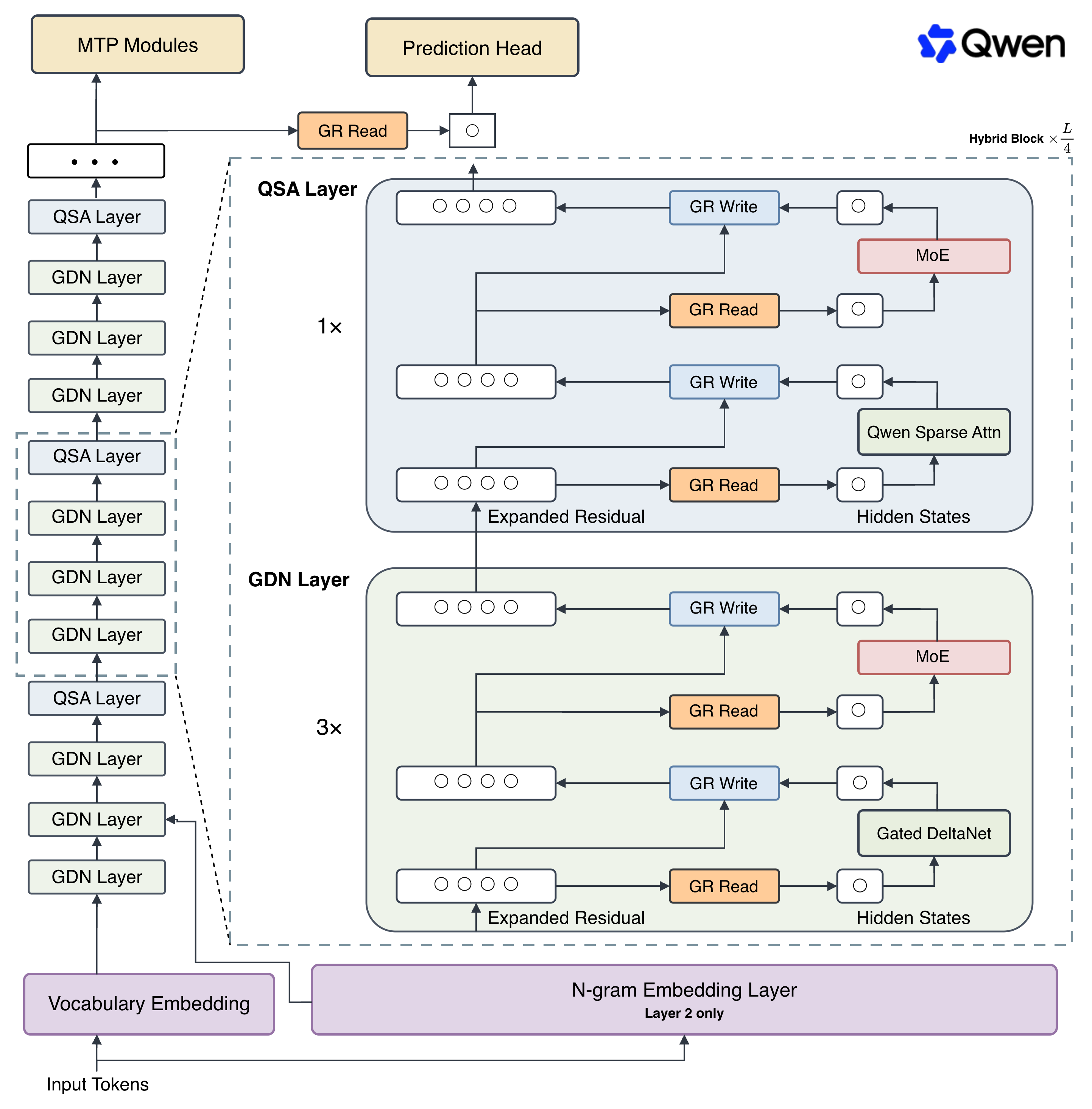
- Hybrid attention with QSA. Rather than selecting individual tokens for processing, QSA operates at the micro-block level, which cuts long-context latency. Layers interleave Gated DeltaNet (a linear-attention variant) with QSA blocks, so most layers use cheap linear attention and only a fraction pay the full attention cost.
- Gated Residual. Information flows through widened residual streams via an element-wise, data-dependent read gate and a per-branch scalar write gate. Four branches with a bottleneck rank of 320 add expressiveness per layer without degrading training stability.
- N-gram embedding. A 20-million-entry table at layer 2 indexes short bigrams and trigrams, adding a parameter-scaling axis that requires less computation and is more amenable to offloading than Mixture-of-Experts. The extra 51B parameters live here and can sit on CPU or slower memory.
This story is for Pro members
You've reached the end of the free preview. Upgrade to AlphaSignal Pro to read the full article - and everything else behind the paywall.
Comments
