

PSL Reads 100K AI Papers so Researchers Don't Have To
A new pipeline profiles over 100,000 AI papers from 22 conferences, mapping topic lifecycles, compute trends, and institutional focus with LLM-driven semantic parsing.
 PRO
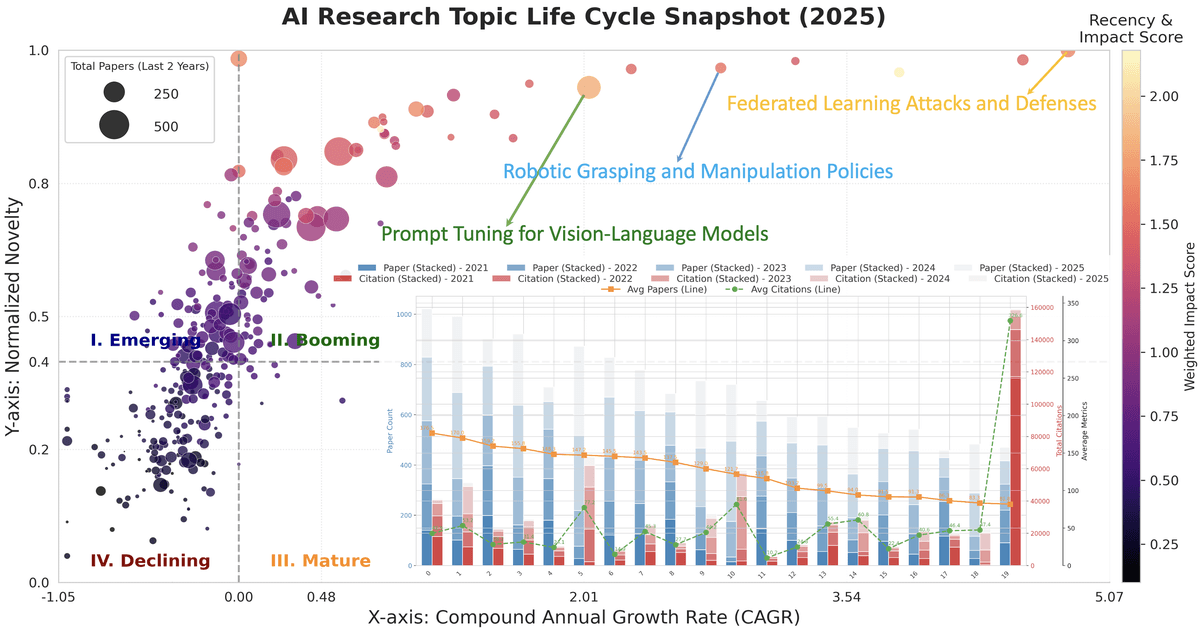
- New framework profiles 104,482 papers from 22 major AI conferences published between 2020 and 2025.
- Uses DeepSeek-R1-32B for semantic parsing plus UMAP and HDBSCAN clustering to build 324 topics.
- Intent-driven hierarchical retrieval with dynamic field weighting beats ChatGPT-5 and SurveyX on expert scoring.
- Full ResearchDB and code released on GitHub and Hugging Face.
- LLM reasoning, safety, and agent topics grow exponentially while NMT and GNN research plateaus.
- MATH, MMLU, GSM8K usage surges post-2023; ImageNet peaked in 2022 as evaluation shifts to reasoning.
Keeping up with modern AI research has become a full-time job. Five years of NeurIPS, ICML, CVPR, ACL and roughly twenty other venues have piled up roughly 100,000 new papers, and traditional bibliometric tools that lean on citation graphs and keyword counts can only say so much about what is actually happening inside those PDFs. A team from Zhejiang University, Shanghai Jiao Tong University, and the National University of Singapore has released a framework that reads every one of those papers with an LLM and turns them into a queryable, structured picture of the field.
The project, called PSL, ships with open code, a Hugging Face dataset containing the parsed profiles, and an intent-driven retrieval system that outperforms plain ChatGPT-5 on literature summarization tasks. Think of it less as a new model and more as a new lens on the last five years of machine learning.
Why citation counts miss the point
Traditional bibliometric approaches rely on metadata, pulling abstracts, authors, journals, keywords, and citations, then applying co-citation and co-word analyses to reveal the structure and evolution of research fields. Those methods lean on surface features and struggle to capture the latent semantic structures within documents. LLM-based tools like PaperQA or AutoSurvey are usually built for single-paper Q&A or narrow retrieval, not for tracking how an entire subfield mutates over time.
The authors wanted something in between: a system that understands what each paper is actually doing (its method, dataset, loss, compute budget, limitations) and can then aggregate those signals across a hundred thousand papers.
This story is for Pro members
You've reached the end of the free preview. Upgrade to AlphaSignal Pro to read the full article - and everything else behind the paywall.
Comments
