
protoLabsAI's Ornith-1.0 Hits 1.7x Faster Decoding With One Flag
A grafted multi-token prediction head turns Ornith-1.0-9B into a self-speculative decoder in llama.cpp, cutting local latency by up to 1.73x with no quality loss.
 Pro
Takeaways
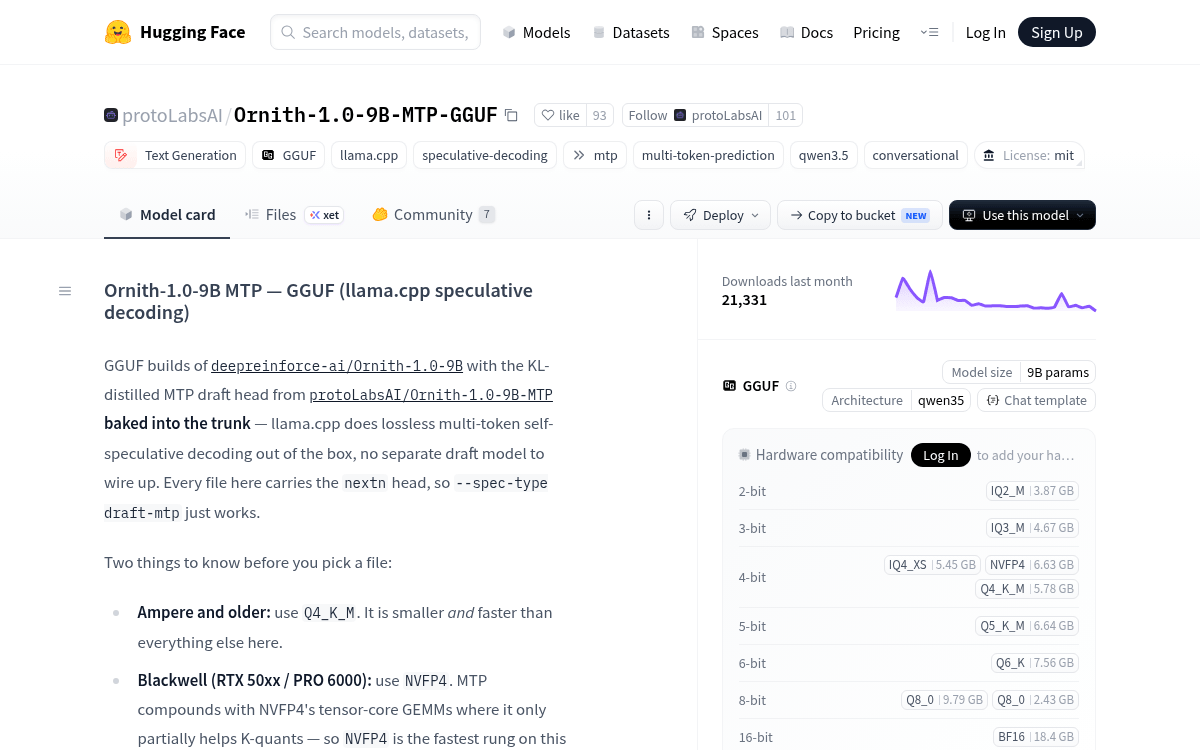
- protoLabsAI shipped GGUF builds of Ornith-1.0-9B with a KL-distilled MTP head baked in for llama.cpp self-speculative decoding.
- Measured 1.4x to 1.73x decode speedup on RTX A6000, distribution-lossless, no separate draft model needed.
- Novel finding: on Blackwell, NVFP4 quant beats Q4_K_M by ~28% because MTP verify is nearly free on FP4 tensor cores.
- Per-token acceptance of 0.766 in llama.cpp matches the vLLM reference (0.762) for the same head.
- Base is DeepReinforce's Ornith-1.0-9B, a Qwen3.5-based agentic coding model scoring 69.4 on SWE-Bench Verified.
- Requires llama.cpp b9616+ with
--spec-type draft-mtp; recipe and standalone head released under MIT.
Speculative decoding usually means running two models side by side: a small draft model that guesses ahead and a large target model that verifies. protoLabsAI just shipped GGUF builds of Ornith-1.0-9B that fold that trick into a single file. The draft head is grafted directly onto the trunk, so llama.cpp handles multi-token self-speculation with one flag and no second checkpoint to load.
The measured payoff on an RTX A6000 is a 1.4 to 1.7x single-stream decode speedup, and it comes without changing the output distribution. Every file carries the nextn head, so the --spec-type draft-mtp flag just works. If you already run Ornith locally through llama.cpp, LM Studio, or Ollama, this is a drop-in replacement.
How the draft head got there
Multi-token prediction (MTP) trains an extra small head that predicts the next N tokens in parallel. Those predictions become the draft, and the main model verifies them in a single batched forward pass. Because acceptance is rejection sampling against the target, the head is trained with KL divergence to the target's own next-token distribution rather than hard cross-entropy, which would sharpen the argmax but miscalibrate the distribution.
The head itself was initialized from Qwen3.5-9B's mtp.* tensors, then re-trained on Ornith-9B's own generations. The recipe is open: graft.py transplants the head, gen_corpus.py produces self-distillation data from the target model, and distill.py trains only the head while the base stays frozen.
The Blackwell surprise
The more interesting finding sits in the benchmarks. On Ampere, a plain Q4_K_M quant is smaller and faster than everything else. On Blackwell, an NVFP4 build pulls ahead by roughly 28 percent, and the reason has less to do with compression than with verify cost.
MTP compounds with NVFP4's tensor-core GEMMs where it only partially helps K-quants, making NVFP4 the fastest rung on Blackwell despite being slightly larger than Q4_K_M. K-quants dequantize to a compute path each step, which adds overhead to the parallel verify. NVFP4 weights sit directly on the FP4 GEMM path where the extra verify is nearly free. The protoLabs card notes this FP4-vs-K-quant split appears to be new data.
Numbers on an A6000 (Ampere) versus a Blackwell (sm120) box, greedy decode, 200 tokens, 6-prompt mix:
| Quant | Size | Ampere no-MTP | Ampere +MTP | Blackwell no-MTP | Blackwell +MTP |
|---|---|---|---|---|---|
| Q4_K_M | 5.8 GB | 104.6 tok/s | 153.4 tok/s | 205.1 tok/s | 239 tok/s |
| NVFP4 | 6.6 GB | 70.7 tok/s | 84.8 tok/s | 201.5 tok/s | 306 tok/s |
Acceptance is quant-stable. At n-max 3 the acceptance rate sits around 0.65 even with a Q4 trunk, and per-token acceptance on llama.cpp matches the vLLM reference (0.766 here vs 0.762). Code prompts run hottest because they are more predictable; creative prose sees the smallest gains.
What Ornith actually is
The base weights come from DeepReinforce's coding-agent family. Ornith-1.0 is an open-source model lineup built for agentic coding, spanning four sizes from a 9B dense model to a 397B mixture-of-experts flagship, shipped under MIT on Hugging Face, post-trained on top of pretrained Gemma 4 and Qwen 3.5. The 9B variant targets single-GPU deployment. It scores 43.1 on Terminal-Bench 2.1 and 69.4 on SWE-Bench Verified, and DeepReinforce claims parity with much larger 31B and 35B models on coding tasks.
Files span the usual quant ladder plus a 2.4 GB standalone head for pairing with an existing base GGUF:
- NVFP4 (6.6 GB): fastest on Blackwell, 306 tok/s with MTP
- Q4_K_M (5.8 GB): fastest on Ampere and older
- Q8_0 (9.8 GB): reference quality, largest relative MTP gain (1.73x)
- IQ2_M through IQ4_XS: low-VRAM i-quants with the head pinned to Q8_0 so acceptance holds on the low-bit trunk (measured about 0.81 to 0.84)
- mtp-head Q8_0 (2.4 GB): standalone head to attach via
--model-draft
Running it
Pull and serve in one line:
llama-server -hf protoLabsAI/Ornith-1.0-9B-MTP-GGUF:Q4_K_M \
  --spec-type draft-mtp -ngl 99 --ctx-size 8192 --flash-attn on --jinja
The --spec-draft-n-max knob controls draft depth. Two maximizes acceptance, three maximizes throughput, four starts to regress. You need llama.cpp b9616 or newer for the Qwen3.5 architecture and draft-mtp support; the NVFP4 rung additionally needs a build with GGML_TYPE_NVFP4.
The lossless caveat worth knowing
Lossless here means distribution-lossless, rather than bitwise identical. MTP's batched verification computes logits in a different floating-point reduction order than sequential decode, which can flip a greedy argmax and fork the text. Both outputs are equally valid samples from the target distribution, but if your pipeline compares tokens byte-for-byte against a non-speculative baseline, expect divergences. That is a llama.cpp property, not a defect of these weights.
For local coding agents where every token of latency matters and the quality bar is set by a well-tuned 9B model, this is one of the cleaner wins available right now without touching the base architecture.