
PriorLabs' TabPFN-3 Beats Every Tuned Model on Tabular Data 20x Faster
PriorLabs releases TabPFN-3, a tabular foundation model that beats 8-hour AutoGluon runs in a single forward pass and scales to 1 million rows
 Pro
Takeaways
- TabPFN-3 released: PriorLabs published a technical report for TabPFN-3, now the default model in the TabPFN library.
- Benchmark-topping performance: A single forward pass beats all tuned and ensembled baselines on TabArena, including 8-hour AutoGluon runs.
- 1M row scale: Scales to 1 million training rows on a single H100 via reduced KV cache and row-chunking, up to 20x faster than TabPFN-2.5.
- Thinking mode: TabPFN-3-Plus (Thinking) uses test-time compute scaling to beat non-TabPFN models by 420 Elo on the largest data subset, 10x faster than AutoGluon extreme.
- Broader data support: New gains on time-series, relational, and tabular-text data; SHAP computation is up to 120x faster with KV caching.
- SAP acquisition context: SAP announced plans to acquire Prior Labs with over €1B investment, with Prior Labs continuing to operate independently.
TabPFN, the foundation model for tabular data from PriorLabs, just got its most significant upgrade yet. The team published a technical report for TabPFN-3, which is now the default model in the library. The headline numbers are hard to ignore: a single forward pass beats every other model on the TabArena benchmark, including tuned and ensembled baselines, and the model is up to 20x faster than its predecessor.
The problem TabPFN solves
Most tabular ML workflows are a grind. You pick a gradient-boosted tree, tune hyperparameters, engineer features, and run cross-validation. Most machine learning inside companies is not about writing poems or generating images. It is about deciding whether a borrower is risky, whether a machine is likely to fail, whether a patient needs follow-up, or whether demand will move in a certain direction next week. Those problems live in tables. TabPFN attacks this by being a pre-trained model that already knows how to handle tabular data , you just hand it your dataset.
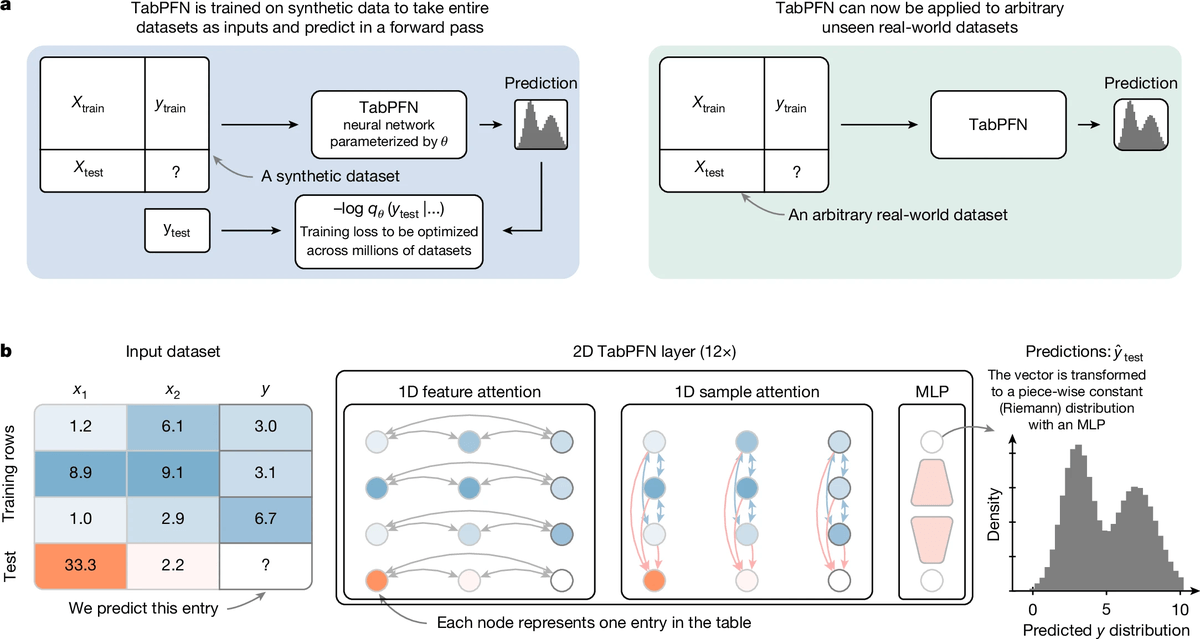
As a Prior-Fitted Network, TabPFN is not trained on the user's data. Instead, it is pre-trained on a vast number of synthetic datasets generated from a broad prior over structural causal models, thereby learning to mimic Bayesian posterior-predictive inference. In plain terms: the model learned a general theory of how tabular data behaves, so it can make good predictions on your specific dataset without ever seeing it during training.
How it actually works
Its architecture assigns a unique representation to each table cell, then employs a two-way attention mechanism: each cell attends to other features within the same sample (row-wise attention) while simultaneously attending to other samples within the same feature (column-wise attention). This design makes the model invariant to permutations of both rows and columns , a critical property for general-purpose tabular data analysis.
At inference time, the entire training set is combined with the test inputs and serialized into one long context sequence. In a single forward pass , without any gradient updates , the model outputs an approximation to the posterior predictive distribution. This is in-context learning (ICL): the model adapts to your data at inference time, not at training time, similar to how large language models adapt to a few-shot prompt.
What's new in TabPFN-3
TabPFN-3 builds on this foundation to scale state-of-the-art performance to datasets with 1M training rows and substantially reduce training and inference time. It is pretrained exclusively on synthetic data from the prior, and brings substantial gains on time series, relational, and tabular-text data.
The key engineering changes that make this possible:
- Reduced KV cache + row-chunking: TabPFN-3 achieves its performance while being up to 20x faster than TabPFN-2.5. A reduced KV cache and row-chunking scale to 1M rows on one H100 with fast inference speed.
- Thinking mode: TabPFN-3 introduces test-time compute scaling to tabular foundation models. The API offering TabPFN-3-Plus (Thinking) exploits this to beat all non-TabPFN models by over 200 Elo on the standard TabArena benchmark, rising to 420 Elo on the largest data subset, and outperforming AutoGluon 1.5 extreme in less than a tenth of its runtime, without using LLMs, real data, internet search or any other model besides TabPFN.
- Broader data types: A specialized TabPFN-3 checkpoint, TabPFN-TS-3, ranks 2nd on the time-series benchmark fev-bench, and SHAP-value computation through shapiq is up to 120x faster with KV caching.
- Many-class decoder: TabPFN-3 ranks first on datasets with many classes, a known weakness of earlier versions.
Benchmark results
On the standard tabular benchmark TabArena, a forward pass of TabPFN-3 outperforms all other models, including tuned and ensembled baselines, by a significant margin, and pareto-dominates the speed/performance frontier. To put that in context, TabArena compares models like XGBoost, LightGBM, CatBoost, and AutoGluon across hundreds of real-world datasets.
A forward pass of TabPFN-3 outperforms all other models, including tuned and ensembled baselines, by a significant margin, and pareto-dominates the speed/performance frontier. TabPFN-3 also scales to more diverse datasets: it ranks first on datasets with many classes, and beats 8-hour-tuned gradient-boosted-tree baselines on datasets up to 1M training rows and 200 features.
Getting started
TabPFN-3 is now the default model when you install the library. The API is intentionally minimal and scikit-learn-compatible:
pip install tabpfn
from tabpfn import TabPFNClassifier, TabPFNRegressor
clf = TabPFNClassifier()
clf.fit(X_train, y_train)  # downloads checkpoint on first use
predictions = clf.predict(X_test)
reg = TabPFNRegressor()
reg.fit(X_train, y_train)
predictions = reg.predict(X_test)
No feature scaling, no one-hot encoding , the model handles raw data directly. On first use, it opens a browser to accept the license terms and caches your token locally. For headless or CI environments, set the TABPFN_TOKEN environment variable instead.
Dataset size limits for TabPFN-3:
- Up to 1,000,000 rows × 200 features
- Up to 100,000 rows × 2,000 features
- Up to 1,000 rows × 20,000 features
GPU is strongly recommended , an older 8GB VRAM card works for most datasets, with 16GB needed for larger ones. No GPU? The free TabPFN Client offers hosted inference via API.
Where it falls short
A few real constraints to keep in mind:
- GPU dependency: On CPU, only datasets under ~1,000 samples are feasible. The model is a transformer doing full attention over your training set at inference time, which is expensive.
- License: TabPFN-3 is released under the TABPFN-3.0 License v1.0, permissive for research and internal evaluation. TabPFN-3-Plus (Thinking) is available via API and enterprise licensing including on-prem and VPC environments (AWS SageMaker, Azure AI Foundry).
- Batch prediction only: Each
predictcall recomputes the full training context. Calling predict on 100 samples separately is nearly 100x slower than one batched call.
The bigger picture
It was in 2025 when the field of tabular foundation models picked up the pace. At the beginning of 2025, TabPFN v2 was published, and that's when tabular foundation models crossed from proof-of-concept to a serious contender in tabular ML. TabPFN-3 pushes that further: the claim is no longer just "competitive with XGBoost on small datasets" but "faster than a 4-hour AutoGluon ensemble on datasets up to a million rows."
SAP announced that it had entered a definitive agreement to acquire Prior Labs, with plans to invest more than 1 billion euros over four years to scale it into a frontier AI lab for structured business data. SAP said the transaction is expected to close in the second or third quarter of 2026, subject to regulatory approval, and that Prior Labs will continue to operate independently. That context matters: TabPFN-3 is not just a research artifact. It is being deployed in production, with Hitachi Rail reportedly using it for predictive maintenance on the Spanish rail network.
For anyone working on structured data problems , fraud detection, demand forecasting, clinical risk scoring, churn prediction , TabPFN-3 is now worth benchmarking seriously against your existing pipeline. The zero-preprocessing, two-line API makes the cost of trying it essentially zero.