

Prime Intellect Ships Multi-Agent RL Training Into Its Open-Source Stack
Prime Intellect's verifiers 0.3.0 and prime-rl 0.8.0 let you define, run, and train multi-agent RL environments with composable Agent and Env abstractions
- Prime Intellect ships multi-agent RL support in verifiers 0.3.0 and prime-rl 0.8.0, available today.
- Two new primitives —
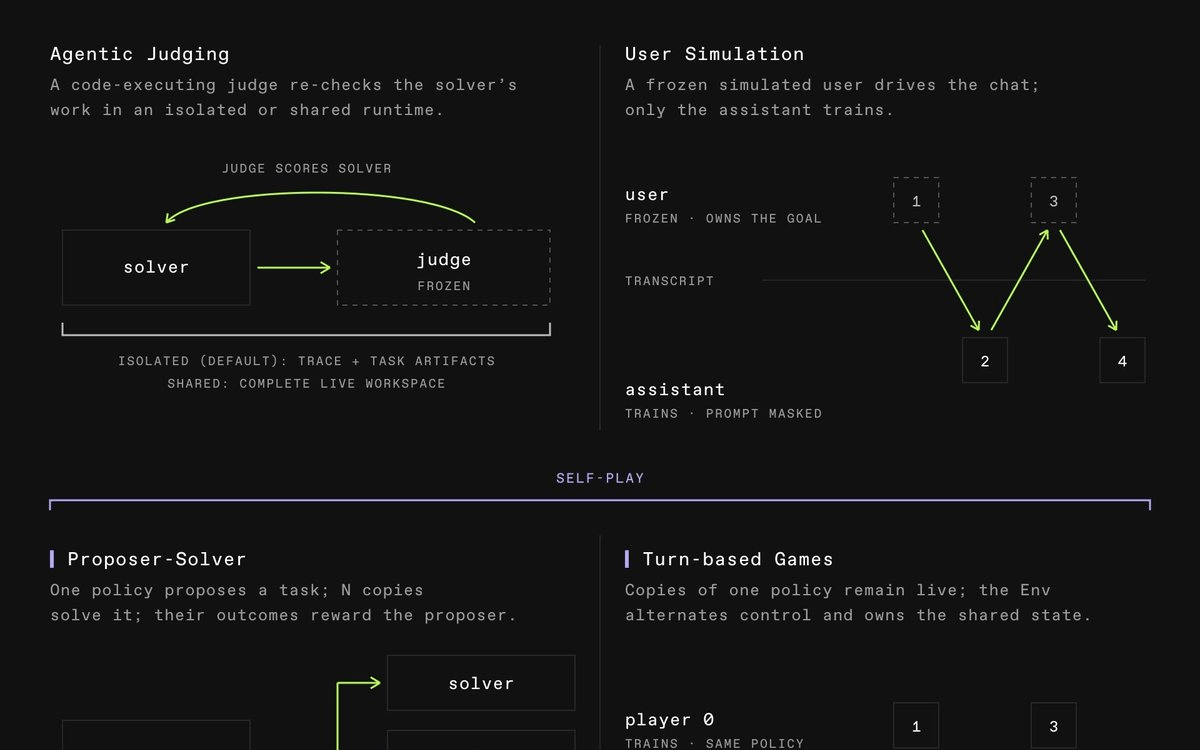
AgentandEnv— let you compose arbitrary multi-agent interactions in plain Python. - Four ready-to-use environments ship out of the box: Agentic Judging, Proposer-Solver self-play, Kuhn Poker, and User Simulation.
- Hierarchical GRPO and Role-Conditioned Advantage Estimation (RAE) solve credit assignment across agents with different reward distributions.
- The Proposer-Solver setup implements a self-play curriculum inspired by Absolute Zero, rewarding task difficulty calibrated to a 50% solve rate.
- The same agent abstraction works for synthetic data pipelines, not just RL training — every trace is a structured, auditable artifact.
Training a single agent with reinforcement learning is already hard. Training multiple agents that interact with each other, assign credit correctly across roles, and produce a coherent learning signal is a different problem. Prime Intellect's latest release takes a direct swing at it, shipping multi-agent support as a first-class feature of their open RL stack.
The update ships in verifiers 0.3.0 and prime-rl 0.8.0, both available today. You can now program arbitrary interactions between agents, choose which roles learn, and assign credit across a complete interaction.
Why single-agent RL breaks down
Most agentic RL setups assume one model, one task, one reward signal. That works for simple benchmarks, but it struggles with real-world problems for two reasons. First, useful learning signal requires tasks close to the agent's current capabilities, and static task sets go stale as the model improves. Second, fixed graders can't handle the ambiguity of open-ended tasks like software engineering, where a test might assert a specific implementation detail and incorrectly penalize a valid solution with zero reward.
An agentic judge that can explore a codebase and reason about failing tests is a far better evaluator. Wiring that up previously required custom plumbing. With this release, it's a two-agent environment you can define in a few lines.
Two new abstractions: Agent and Env
Everything revolves around two composable primitives.
An Agent encapsulates the Taskset, the Harness, and the Runtime that define a single agent rollout. Its core signature is Agent.run(task: Task) -> Trace: given a task, the agent produces a trace, the structured artifact of the rollout.
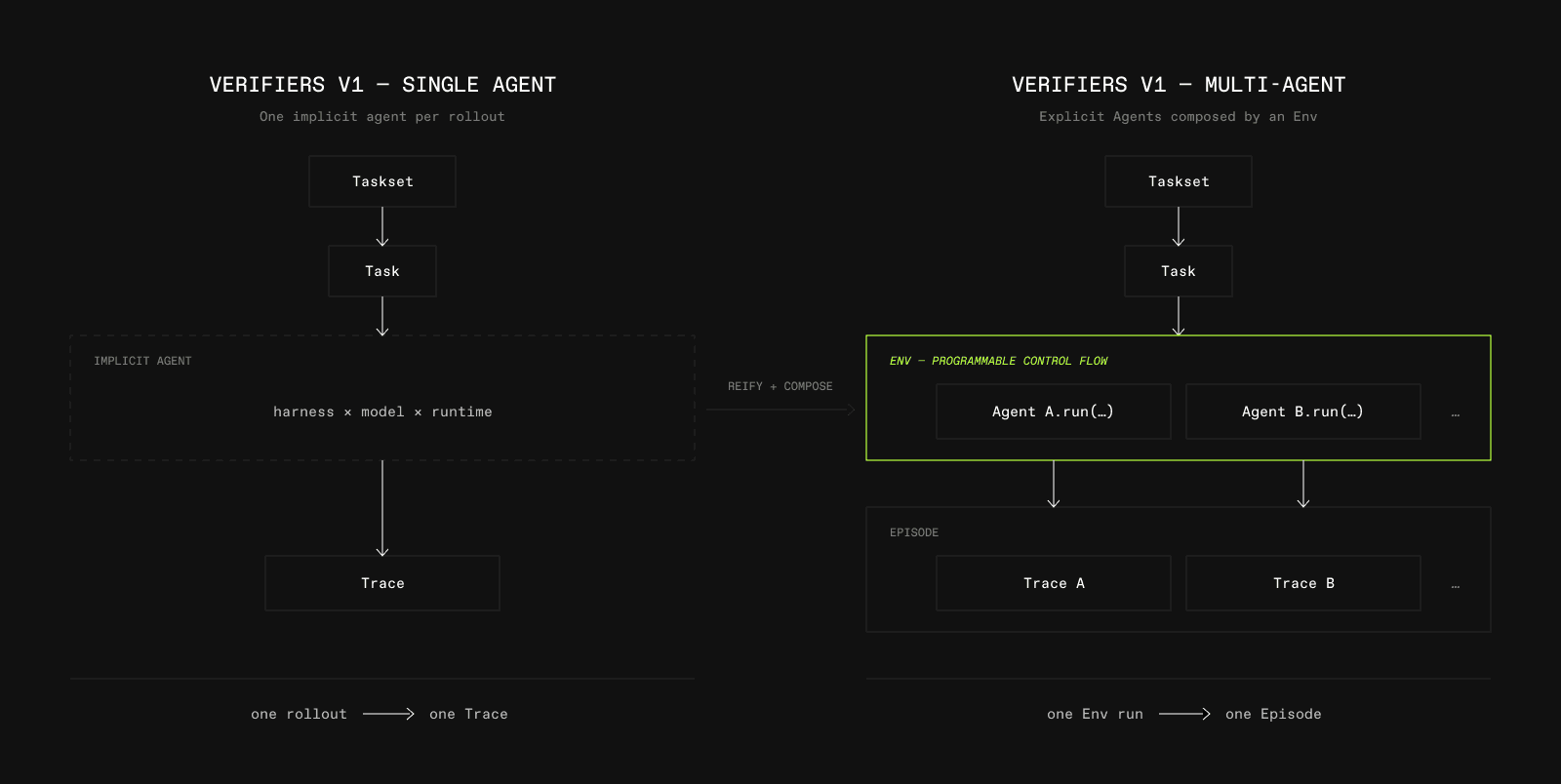
An Env programs the full multi-agent control flow. Its signature is Env.run(task: Task, agents: Agents) -> None: it receives an initial task and a list of pre-initialized agents, then orchestrates them however you want, sequentially, in parallel, or turn by turn, mixing models, harnesses, and runtimes. Every finished agent run automatically joins the resulting Episode. An environment is just a Python program over agents.
Backward compatibility is preserved. Anything that worked in verifiers v1 collapses to a one-line run method in SingleAgentEnv, so existing setups continue working without changes.
Four ready-to-use environments
The release ships four concrete environments that show what the new abstractions unlock:
- AgenticJudgeEnv — A solver agent runs first, then a judge agent inspects the full trace, explores the codebase, and overrules incorrect deterministic test failures. This directly addresses grading brittleness in code RL.
- ProposerSolverEnv — One agent proposes tasks from a seed topic; a group of solver agents attempt them in parallel. The proposer is rewarded for calibration: tasks solved by roughly half the solvers produce the most learning signal, while tasks that are too easy or too hard get penalized.
- KuhnPokerEnv — Two model instances play Poker against each other. As the policy improves, it also becomes a stronger opponent, creating a self-improving curriculum without a separate opponent service.
- UserSimEnv — A user agent holds private context and interacts turn-by-turn with an assistant agent. The assistant is trained; the user is frozen. Different personas and hidden goals can be plugged into the same interface.
Credit assignment across roles
Multi-agent training introduces a subtle challenge: different roles produce structurally different reward distributions, and mixing them into a single advantage estimate corrupts the learning signal.
GRPO (Group Relative Policy Optimization) works by comparing a batch of rollouts against each other to estimate which were better. That only makes sense when the rollouts are comparable. Mixing a proposer's traces with a solver's traces breaks that assumption, so Prime Intellect implemented Hierarchical GRPO, which preserves comparison sets without mixing roles or problem difficulties.
For turn-based game settings, the system supports Role-Conditioned Advantage Estimation (RAE), which measures each role relative to its own reward history rather than against a shared baseline. RAE matters when one role systematically earns higher rewards than another: a shared baseline would make the lower-reward role look perpetually bad even as it improves.
Self-play as a curriculum engine
The ProposerSolver setup draws from the Absolute Zero paper, which showed that a model can generate its own training curriculum without human-curated data. In that paradigm, a single agent simultaneously learns to propose tasks that maximize its own learning potential and to solve them, verified by an environment that validates task integrity and provides grounded feedback.
Prime Intellect's version separates the proposer and solver into distinct agents, which can be different model instances, and adds an explicit learnability reward: the environment's learnability peaks at a 50% solve rate, pushing the proposer to generate tasks that yield maximum training signal. As the model improves, the difficulty stays calibrated automatically.
Synthetic data pipelines
The team expects the agent abstraction to extend beyond training and evaluation. They are already building synthetic data generation and curation pipelines where each agent's trace is a unified, auditable data artifact. The same Agent.run() call that produces a training rollout also produces a structured trace you can inspect, filter, and use for supervised fine-tuning.
Running a single agent for data collection looks like this:
import asyncio
import verifiers.v1 as vf

async def main():
    agent = vf.make_agent(
        vf.AgentConfig(
            model="poolside/laguna-s-2.1",
            harness={"id": "pool"},
        )
    )
    task = vf.Task(
        vf.TaskData(prompt="Find the latest released version of the `verifiers` Python package on PyPI.")
    )
    async with agent:
        trace = await agent.run(task)
    print(trace.last_reply)

asyncio.run(main())
What changes for practitioners
Verifiers exposes token-level rollouts across multi-turn conversations, letting you apply RL signals at the granularity where language models actually make decisions. That's particularly useful if you're exploring algorithms that need token-level credit assignment across multi-turn interactions.
The broader shift is conceptual. Most RL frameworks treat the environment as a fixed wrapper around a task. Prime Intellect's framing treats it as a program you write in Python, with agents as first-class objects you can compose, sequence, and mix. The framework also includes native integration with the Environments Hub, end-to-end post-training covering both SFT and RL, and multi-node deployment via Slurm and Kubernetes.
One practical constraint worth noting: the tight coupling to Prime Intellect's platform simplifies scaling RL training, but it means production workloads depend on their infrastructure. If you run your own training stack, extracting traces for use elsewhere is possible but requires extra work.
Multi-agent support is available now. Install via pip install verifiers==0.3.0 and pip install prime-rl==0.8.0. The verifiers repo has full implementations of all four environments, and the official docs cover the Agent and Env APIs in detail.
Comments
