

Prime Intellect Raises $130M to Open RL Training Labs Once Locked Inside OpenAI
Prime Intellect raises $130M led by Radical Ventures to give any company the same RL training infrastructure used by frontier AI labs

- $130M Series A: Prime Intellect raises $130M led by Radical Ventures, with NVIDIA, Intel Capital, and Dell Capital, bringing total funding to $150M+. Blog post
- $100M+ ARR: The company hit over $100M in annualized revenue in under a year, serving 6,000+ customers including major AI startups and enterprises.
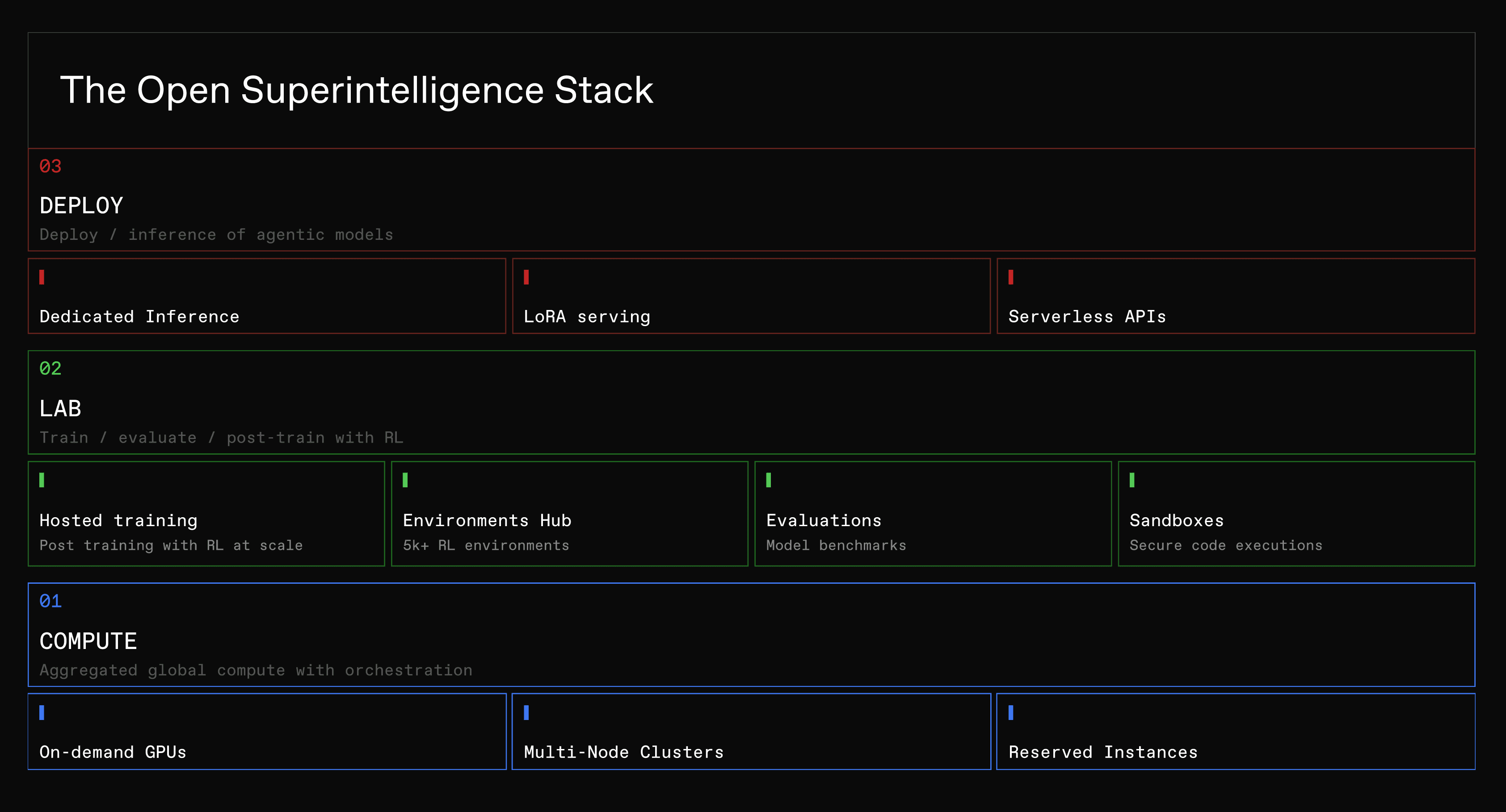
- Open Superintelligence Stack: Full-stack platform covering RL training (prime-rl), inference serving, and GPU compute clusters, all open-source and available to customers.
- Star-studded angels: John Schulman (Thinking Machines), Karim Atiyeh (Ramp), Harrison Chase (LangChain), Matthew Prince (Cloudflare), and Milan Kovac (Tesla) among angel investors.
- RLM research bet: Prime Intellect is scaling Recursive Language Models (RLMs), an architecture that lets agents manage their own context and operate over inputs exceeding 10M tokens.
- Continual learning vision: The company is building toward a world where training and inference merge into one loop, with models that improve continuously in production.
Prime Intellect has raised a $130M Series A, bringing its total funding to over $150M. The round was led by Radical Ventures, with strategic participation from NVIDIA Ventures, Intel Capital, and Dell Technologies Capital. The thesis is blunt: the infrastructure that lets AI labs build self-improving models has been locked behind closed doors, and Prime Intellect wants to hand it to everyone else.
The company is building what it calls the Open Superintelligence Stack, a full-stack platform spanning training, inference, and compute. The angel roster reads like a who's-who of the current AI moment: John Schulman (Thinking Machines), Karim Atiyeh (Ramp), Aaron Levie (Box), Harrison Chase (LangChain), Matthew Prince (Cloudflare), and Milan Kovac (Tesla), among many others.
Why RL changes everything
To understand why this raise matters, you need to understand what reinforcement learning (RL) actually unlocks. Pre-training, the process of feeding a model billions of tokens of internet text, is extraordinarily expensive and requires massive compute clusters. Only a handful of labs can do it. RL post-training is different: it lets you take an existing open model and teach it to get better at your specific task by having it practice in a simulated environment and rewarding correct behavior.
Companies can now own their model optimization loop, training directly on their own product, optimizing for their specific workflows, and building agents that improve continuously in production. Owning this loop is how you build a compounding moat in the agentic era. The missing piece has always been the infrastructure to do this at scale, outside of a lab setting.
RL is now a cornerstone of AI infrastructure tooling, teaching agents complex behaviors without the cost and risk of real-world trial and error. The problem is that until recently, the tooling to run serious RL at scale was entirely internal to labs like OpenAI and Anthropic.
What the stack actually looks like
Prime Intellect's platform has three layers:
- Lab (Training): Hosted RL training via prime-rl, their open-source agentic RL framework, plus environments, sandboxes, and evals.
- Deploy (Inference): Dedicated and serverless serving for custom models, with native LoRA support and a continual learning loop that feeds production data back into training.
- Compute: Frontier GPU clusters, from single nodes up to large-scale multi-node deployments.
prime-rl is a fully asynchronous RL framework built for high-throughput agentic training at scale, capable of training 1T+ MoE models on 1,000+ GPUs with FSDP2 for training and vLLM for inference, with FP8 inference, prefill/decode disaggregation, and expert parallelism. The framework is open-source and ships with six built-in RL algorithms including GRPO and ECHO, each selectable per environment in a single training run.
The Environments Hub is another key piece. Prime Intellect open-sources their environments and is fostering the Environments Hub, which aims to be a one-stop shop for RL environments. The platform now gives access to 2,500+ open-source RL environments and a community of researchers and developers.
The numbers behind the bet
The traction metrics are hard to ignore for a company that's barely a year into serious product mode. In under a year, demand has scaled to over $100M in annualized revenue. The company now serves over 6,000 customers, including many leading AI startups, neolabs, and enterprises building across RL, compute, sandboxes, inference, environments, and evaluations.
The open-source community has also grown fast. The company reports 500+ environment creators and 100k+ downloads of its tooling. As of May 2026, Prime Intellect had 51 employees, making the revenue-per-employee figure genuinely striking for an infrastructure startup.
Customer proof points are concrete:
- Ramp trained a 35B model using Prime Intellect's Lab that beat Claude Opus at spreadsheet search, running 27% faster and far cheaper than Haiku.
- Arcee used the full stack for pre- and post-training Trinity, a leading 400B model.
- Zapier turned AutomationBench into a continuous agent improvement loop using the platform.
The research frontier: RLMs and continual learning
Beyond the platform business, Prime Intellect is making bets on what comes next. The most interesting is their work on Recursive Language Models (RLMs). Instead of forcing a model to read a giant prompt in one pass, RLMs treat the prompt as an external environment and let the model decide how to inspect it with code, then recursively call itself on smaller pieces. On long-context benchmarks, RLMs maintain strong performance at inputs exceeding ten million tokens where standard models degrade sharply.
The RLM allows the model to actively manage its own context. Prime Intellect has implemented their version of the RLM in their verifiers framework so it is ready to be used in any environment and for training with prime-rl. They believe this will be the dominant paradigm for agents that need to work for hours or days at a stretch.
The other major bet is continual learning. Continual learning enables AI to accumulate knowledge and skills across tasks over time, maintaining earlier capabilities while acquiring new ones. Unlike traditional models trained once and deployed statically, continual learning systems evolve in production, getting smarter with each interaction. Prime Intellect's stack was designed from the start for this world, where training and inference collapse into a single continuous loop.
Who wins, who should pay attention
The clearest winners are mid-sized AI companies and enterprises that want model sovereignty without building their own lab infrastructure. The big labs are adamant about owning the intelligence layer and closing off their models behind a black box. As long as you depend on their closed APIs and closed models, you don't have sovereignty over your intelligence. Prime Intellect's pitch is the exit ramp from that dependency.
The competitive landscape is heating up. Baseten recently announced a $300M raise at a $5B valuation. Fireworks AI secured $250M at a $4B valuation. But most of these players are focused on inference serving for existing models. Prime Intellect is targeting the training and optimization loop itself, which is a different and arguably more defensible position. The hardware backing from NVIDIA Ventures, Intel Capital, and Dell Capital also signals that the chip and server ecosystem is betting on this approach to distributed model ownership.
For teams building agents today, the practical question is whether RL post-training on your own data and workflows is worth the investment. The Ramp case study suggests the answer is yes for high-stakes, domain-specific tasks. RL is not only a path to better models, but also the foundation for building AI-native products. The most successful future startups will emerge by creating novel and differentiated environments tailored to their needs. Prime Intellect is betting that the infrastructure to do that should be open, and with $130M more in the bank, they have the runway to find out if they're right.
Comments
