

Poolside Releases Laguna XS.2, an Open-Weight Coding Agent Beating Google's Gemma 4
Poolside opens up with a 33B mixture-of-experts coder that activates only 3B parameters, runs on one GPU, and ships under Apache 2.0.
 PRO
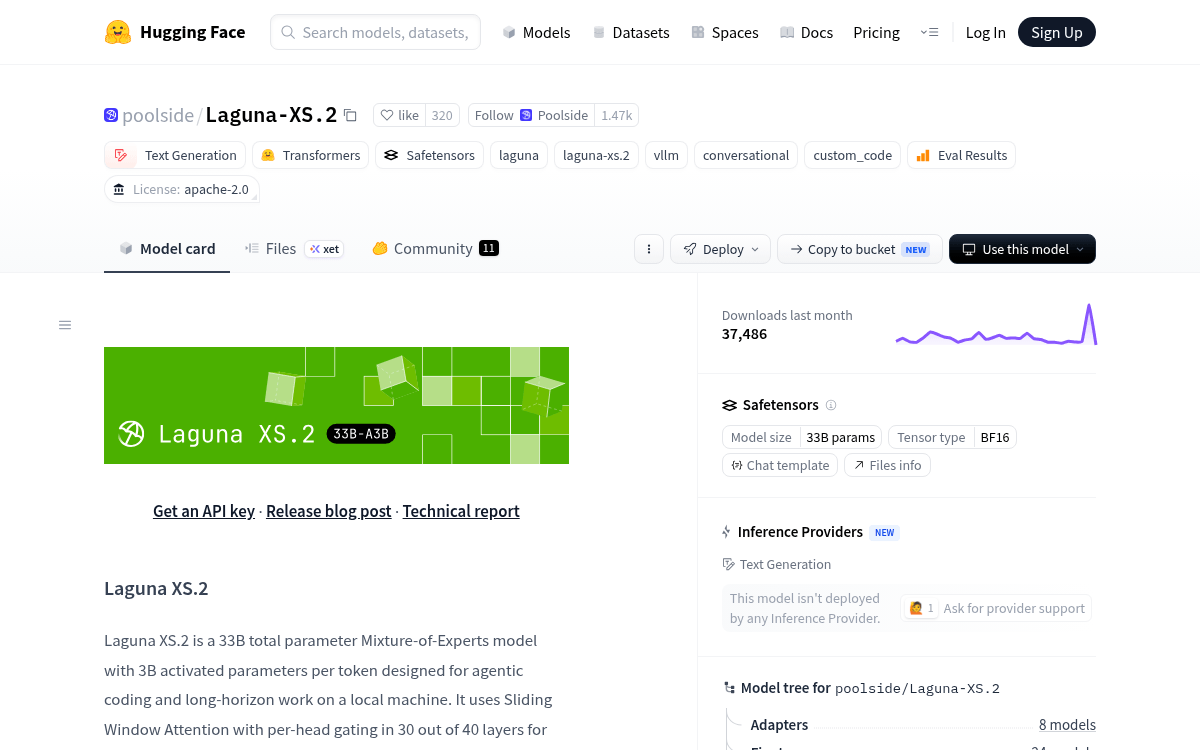
- Poolside released Laguna XS.2, a 33B/3B active MoE for agentic coding under Apache 2.0.
- Trained from scratch on 30T tokens in five weeks using Poolside's internal Model Factory stack.
- Scores 68.2% on SWE-bench Verified, 44.5% on SWE-bench Pro, ahead of Gemma 4 31B.
- Uses mixed sliding-window and global attention in 3:1 ratio with FP8 KV cache and 262k context.
- Launch-day support in vLLM, Transformers, SGLang, TRT-LLM, MLX, and Ollama with DFlash speculator.
- Runs on one 24-32GB GPU or a Mac with 36GB unified memory via Poolside's stack.
Poolside, the well-funded foundation model lab that has spent most of its life shipping models into government and enterprise environments, just made its debut in the open ecosystem. The lab released Laguna XS.2, a mixture-of-experts model built for agentic coding, alongside a much larger sibling and a full agent harness. The pitch is straightforward: a coding model small enough to run on a single GPU or a Mac, capable enough to compete with frontier systems, and licensed permissively enough to ship in production.
Two foundation models are landing at once. Laguna XS.2 has 33B total parameters with 3B activated, runs on a single GPU, and holds up against dense models several times its size on agentic coding tasks. It is the lab's first open-weight release. Alongside it comes Laguna M.1, a 225B / 23B-active model that served as the training ground for XS.2.
The architecture, in plain terms
Laguna XS.2 leans on a few specific choices to hit its efficiency targets. It uses sigmoid gating with per-layer rotary scales, enabling a mixed Sliding Window Attention (SWA) and global attention layout in a 3:1 ratio across 40 total layers: 30 SWA layers and 10 global attention layers. Sliding Window Attention limits each token's attention to a local window of 512 tokens rather than the full sequence, dramatically cutting KV cache memory.
The full spec sheet from the release blog and model card:
- 33B total parameters, 3B activated per token
- 256 experts plus 1 shared expert
- 40 layers total: 10 global attention, 30 sliding-window (512 tokens)
- KV cache quantized to FP8 to shrink memory per token
- 262,144 token context window
- Muon optimizer for pre-training
- Native interleaved thinking, toggleable per request
The wide context and quantized KV cache matter because agentic coding runs eat context fast. Long tool-call chains, file dumps, and preserved reasoning traces all pile into the buffer, and SWA plus FP8 KV is what makes a 262k window practical on modest hardware.
This story is for Pro members
You've reached the end of the free preview. Upgrade to AlphaSignal Pro to read the full article - and everything else behind the paywall.
Comments
