

Pokémon Company Launches $240K AI Battle Challenge on Kaggle
The Pokémon Company and Kaggle launch a $240,000 two-stage AI competition to build the best Pokémon TCG playing agent, culminating in a live tournament in Japan.
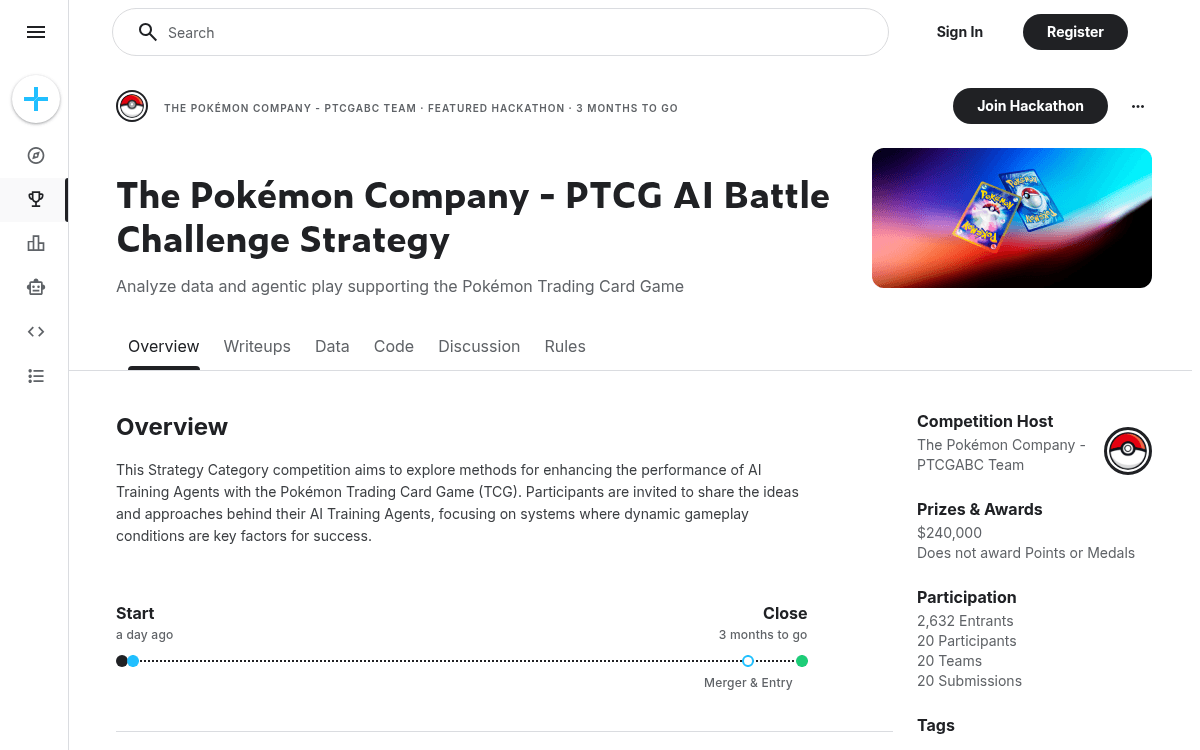
- The Pokémon Company and Kaggle launched the Pokémon TCG AI Battle Challenge with a $240,000 prize pool.
- Two connected tracks: a Simulation Category (AI agents battle each other) and a Strategy Category (written methodology report), both required for a valid entry.
- Top 8 teams in the Strategy Category each receive $30,000; a live Japan finals adds $50,000 (1st) and $30,000 (2nd) on top.
- Organized by The Pokémon Company with HEROZ, Matsuo Institute, Google, NVIDIA, and Kaggle; this is one of the first times TPC has publicly engaged with AI.
- Agents must handle hidden information and randomized draws -- closer to RL for imperfect-information games than anything LLM-based.
- Simulation entry deadline is August 9, 2026; Strategy entry deadline is September 6, 2026.
The Pokémon TCG AI Battle Challenge is now live on Kaggle, and it is one of the most interesting AI agent competitions to drop this year. The competition is organized by The Pokémon Company in partnership with HEROZ and the Matsuo Institute, with support from Google, Google Cloud, NVIDIA, and Kaggle. The total prize pool is $240,000, and the goal is straightforward: build an AI agent that can play the Pokémon Trading Card Game better than everyone else's.
Chess, Go, Shogi -- and now Pokémon TCG
The competition asks participants to build AI systems that can compete in Pokémon TCG matches, testing whether artificial intelligence can handle the game's strategic complexity, deck-building decisions, and unpredictable gameplay scenarios. That framing is deliberate. AI has already conquered perfect-information games like Chess and Go. The challenge of writing an AI that can play Pokémon is that, unlike in games such as chess, the game has an element of randomness based on what the player draws, as well as more complex card relationships based on status effects, elemental affinities, and just a general lack of predictability.
Organizers highlighted several reasons why Pokémon TCG presents a difficult challenge for AI systems, including the large number of available cards, diverse gameplay tactics, type matchups, draw-based decision making, hidden information, and the need to adapt to unpredictable developments during a match. The Pokémon Company will provide the official rules, environment, a simulator for training and evaluation, and a database of 2,000 cards from the game's Standard format.
Two tracks, one complete submission
The competition is structured as two connected categories that must both be entered for a valid submission. Think of it as a performance track paired with a methodology track.
- Simulation Category -- The Simulation Category runs from June 16 through August 17, 2026, with teams developing AI training agents that will compete in automated matches on Kaggle. Each team can submit up to five agents per day. No prize money is offered for this category directly, but your rank here feeds directly into the Strategy scoring.
- Strategy Category -- The Strategy Category runs from June 16 through September 14, 2026. Participants must submit a report explaining the strategic logic behind their AI systems, with rankings based on factors including agent stability, deck design concepts, and performance in the simulation phase.
Participation in the Simulation Category is required to enter the Strategy Category. Participants must enter both the Simulation Category and Strategy Category for a complete submission. This two-track design is intentional: the organizers want agents that are not just effective, but explainable.
Where the $240,000 goes
The full prize structure breaks down across two phases:
- The top eight teams from the Strategy Category will each receive $30,000 and advance to the Final Stage. That is $240,000 distributed before a single finalist match is played.
- The Final Stage is scheduled for September 2026 in Japan, where the AI players will compete in a live tournament that will be streamed on Pokémon's official YouTube channel. The finalists will present their approaches and methodologies, and an additional $50,000 will be awarded to first place and $30,000 to second place.
- Finalists will also receive $3,000 in Google Cloud credits per participant.
The structure means the top eight teams are guaranteed $30,000 each just for qualifying, before the live finals add another $80,000 on top. Total potential payouts across all prizes exceed $300,000.
What kind of AI actually wins this?
This is not a generative AI competition. The competition is for developers to submit their own agents that play against other agents entirely on their servers, and matches are time-limited. The example code shows rules-based approaches and one reinforcement learning example. With no guarantee that the code will even be run on a GPU, large generative models are completely impractical if not impossible to use.
Reinforcement learning (RL) -- where an agent learns by playing thousands of games and receiving rewards for winning -- is the natural fit here, the same family of techniques that powered AlphaGo and AlphaZero. The wrinkle is that Pokémon TCG involves hidden information: you cannot see your opponent's hand or the cards left in their deck. That forces agents to reason under uncertainty, which is a meaningfully harder problem than perfect-information games and closer to real-world decision-making challenges.
Why this matters beyond the game
This challenge marks one of the first times The Pokémon Company is exploring AI publicly, and it could provide new insights into how AI systems approach complex TCGs that blend strategy, probability, and imperfect information. The research implications are real: agents that can handle hidden state, stochastic draws, and evolving board conditions are directly relevant to domains like financial trading, logistics planning, and multi-agent negotiation.
There is also a practical angle. The competition rules grant The Pokémon Company a license to use winning submissions. That has led some observers to speculate the results could feed into future AI opponents in official Pokémon TCG digital products -- though the company has made no such announcement.
Key dates and how to enter
- Simulation Category entry deadline: August 9, 2026 -- enter here
- Strategy Category entry deadline: September 6, 2026 -- enter here
- Strategy final submission deadline: September 13, 2026
- Judging period: September 14 -- October 11, 2026
- Final Stage live tournament: September 2026, Japan (streamed on Pokémon's YouTube)
If you have experience with RL for game-playing agents, this is a well-resourced sandbox with a real prize attached. The organizers provide the simulator, the card database, and the battle environment -- you just need to bring the agent. The hidden-information constraint is the interesting research problem, and with $240,000 guaranteed to the top eight teams, the bar for a meaningful return is lower than it looks.
Comments
