

Perplexity Swaps Claude for Grok 4.5 at Half the Cost
Perplexity swaps in xAI's freshly-launched Grok 4.5 as the orchestrator brain of Computer, beating every rival configuration on WANDR at roughly half the cost of Claude Opus 4.8
- Grok 4.5 is now the orchestrator model in Perplexity Computer for Pro and Max subscribers, replacing Claude Opus 4.6 in the conductor role.
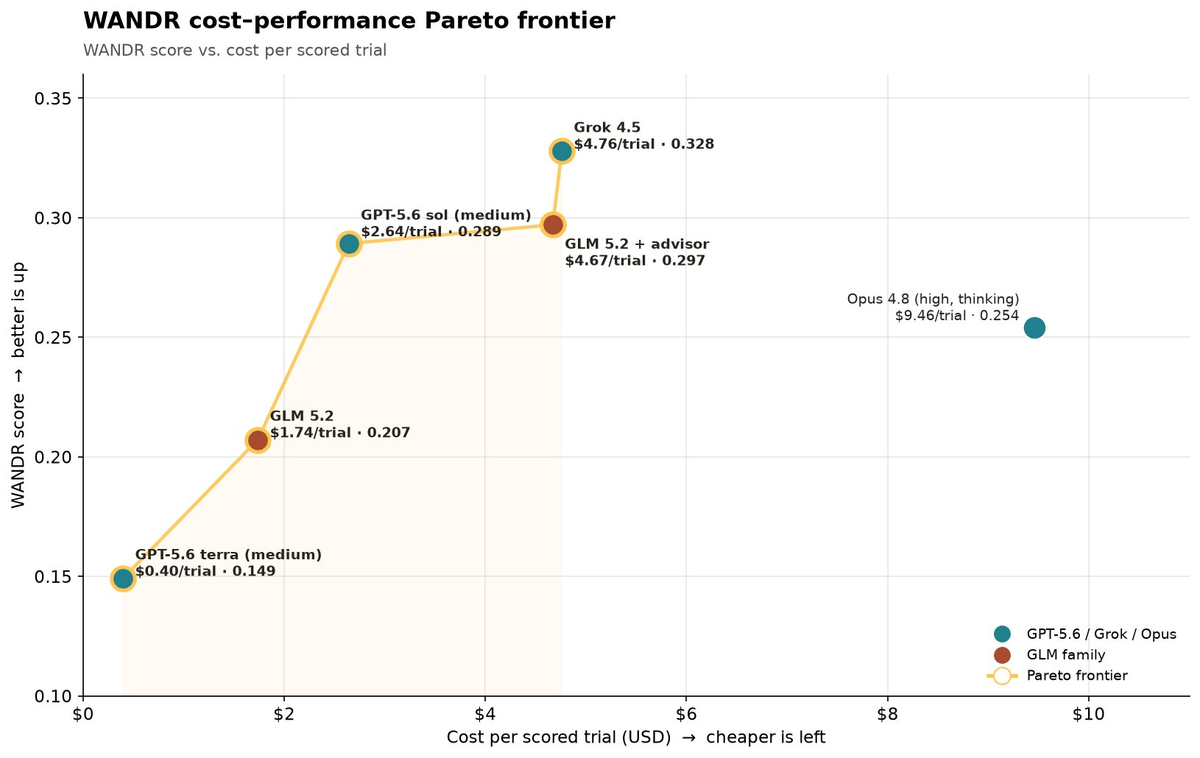
- It outscored every other orchestrator config Perplexity tested on WANDR, their in-house professional research benchmark.
- Cost advantage is dramatic: Grok 4.5 runs at $2/$6 per million tokens vs. $5/$25 for Claude Opus 4.8 -- roughly half the cost.
- Grok 4.5 has the best agentic tool-use score of any model on Artificial Analysis's board, making it well-suited for orchestration workloads.
- Perplexity Computer is available to Pro ($20/mo) and Max ($200/mo) subscribers, routing tasks across 20+ models and 400+ app integrations.
- The model-agnostic bet pays off: Perplexity swapped orchestrators the moment a better cost-performance option shipped, validating its "orchestration is the product" strategy.
Perplexity just made a quiet but consequential swap inside its Computer platform: Grok 4.5, xAI's brand-new flagship model, is now available as the orchestrator model for Pro and Max subscribers. The announcement came alongside an internal benchmark result that will raise eyebrows across the industry -- Grok 4.5 outscored every other orchestrator configuration Perplexity tested, at roughly half the cost of Claude Opus 4.8.
What is Perplexity Computer, and why does the orchestrator matter?
Perplexity Computer is a multi-agent orchestration platform -- a cloud-based AI system that coordinates 19 frontier AI models simultaneously to complete complex, end-to-end tasks. Instead of asking one AI model to do everything, Computer breaks your request into subtasks and assigns each piece to the model best at it. Think of it as a general contractor that hires the best specialist for each part of the job.
The orchestrator is the brain of the whole operation. Computer's orchestration engine analyzes your task, breaks it into subtasks, and assigns each subtask to the optimal model. Previously, Perplexity Computer ran Opus 4.6 for its core reasoning engine and orchestrated sub-agents with the best models for specific tasks: Gemini for deep research, Nano Banana for images, Veo 3.1 for video, Grok for speed in lightweight tasks, and ChatGPT 5.2 for long-context recall and wide search. Now, Grok 4.5 steps into the conductor role.
Who is Grok 4.5?
Grok 4.5 is SpaceXAI's smartest model built to excel at coding, agentic tasks, and knowledge work. It is their strongest model ever and was trained alongside Cursor. Grok 4.5 was trained on datasets spanning knowledge in coding, science, engineering, and math.
The pricing is the headline. Grok 4.5 runs at $2 per million input tokens and $6 per million output tokens, against $5 and $25 for Claude Opus 4.8. That is a 60-75% cost reduction at the input level. And the efficiency story goes further: the model achieves roughly 2x the token efficiency of comparable leading models, solving tasks in under half the number of steps.
On benchmarks, Grok 4.5 landed at #4 of 168 on Artificial Analysis's Intelligence Index, and posted the single best agentic tool-use result of any model on the board. That last point is particularly relevant for an orchestrator role, where the model spends most of its time calling tools and delegating -- not just generating text.
The benchmark that matters here: WANDR
Perplexity evaluated Grok 4.5 against five other orchestrator configurations on WANDR -- a benchmark worth understanding. WANDR is Perplexity's in-house wide benchmark, built to mirror real professional research workloads. When Perplexity's own Search as Code system was tested, it scored 0.386 against the next best system's 0.152. The benchmark is specifically designed to test the kind of broad, multi-step information gathering that Computer's users actually do -- not synthetic puzzles.
Grok 4.5 scored higher than every other orchestrator configuration Perplexity tested on WANDR. This is not a cherry-picked academic result; it is Perplexity's own internal production evaluation across configurations they actually run for paying users.
The real story: model-agnosticism as a competitive moat
Perplexity is the only major AI company without its own foundation model, which lets it act as a neutral orchestrator across all the big providers. That neutrality is the whole strategy. Perplexity's model-agnostic harness allows these to change as models advance. When a better or cheaper model ships, Perplexity can swap it in -- and that is exactly what just happened.
CEO Aravind Srinivas has framed this philosophy plainly: "The orchestration is the product. The model is a tool." He borrowed from Steve Jobs: musicians play their instruments, Perplexity plays the orchestra. Grok 4.5's addition is a live demonstration of that thesis.
The timing is also notable. xAI pushed Grok 4.5 to the public a day after Musk pitched it as an Opus-class model at a fraction of Anthropic's price, built using data from Cursor, the coding startup SpaceX is buying for $60 billion. Perplexity moved fast to integrate it -- and now has a public benchmark to back the decision.
Who wins from this?
- Pro subscribers ($20/month): As of March 2026, Pro subscribers gained access to Perplexity Computer, the platform's multi-model orchestration tool that was previously limited to Max users. They now get a more capable orchestrator at no extra cost.
- Max subscribers ($200/month): Perplexity Max costs $200/monthly and unlocks the highest level of access to advanced AI models, Comet's Max Assistant, Create files and apps, and Brain in Research Preview. Max users get higher credit limits and spend ceilings on top of the new orchestrator.
- xAI: Getting Grok 4.5 embedded as the default orchestrator in a major consumer AI platform is significant distribution. Cursor now has hundreds of thousands of paying developers who touch a model selector every day, and xAI just bought its way into a default option there through the SpaceX deal. Perplexity Computer adds another high-visibility integration.
- Anthropic: Claude Opus 4.8 just lost the orchestrator slot in a platform that explicitly benchmarked it as the cost comparison point. That is a reputational and revenue hit, even if indirect.
What this means for the broader AI stack
Perplexity applied distributed-systems logic to LLMs. They realized that frontier models aren't commoditizing -- they are specializing. The orchestration layer is where the real value accrues, and the model underneath it is increasingly interchangeable. This is the multi-model era in practice, not in theory.
Computer routes tasks across 20 specialized models and connects to 400+ applications. As that routing layer matures, the question for every model lab is not just "how good is your model?" but "can you get into the orchestration layer?" Grok 4.5 just answered yes -- and did it on a cost-performance argument that is hard to ignore.
For teams already running multi-agent pipelines, the practical takeaway is straightforward: if you are building your own orchestration stack, Grok 4.5's agentic tool-use scores and $2/M input pricing make it a strong candidate for the planner role. Perplexity just ran the benchmark for you.
Comments
