

Perplexity's Search API Tops Agent Leaderboard, Beating Rivals at $5 Flat
Perplexity's new Search API takes the top three spots on the Artificial Analysis Search Index, extending the quality-cost Pareto frontier for agentic search.
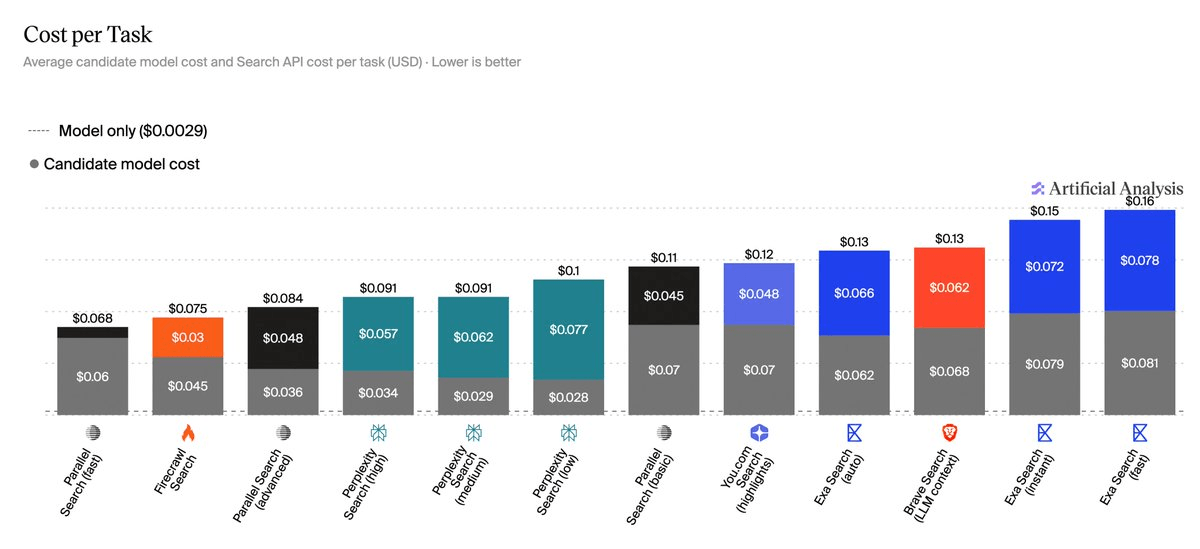
- Perplexity Search API debuts at the top of the Artificial Analysis Search Index with all three variants.
- Medium context scores 80, ahead of previous leaders Parallel (advanced) and Brave (LLM context) at 75.
- Flat $5.00 per 1,000 queries across low, medium, and high context settings.
- Lean payloads yield lowest model inference cost per task tested, $0.028 to $0.034.
- Quality plateaus between medium and high; low variant costs more due to extra searches.
- Benchmark runs on open-source Stirrup harness with GPT-5.6 Luna as the fixed candidate model.
Perplexity has quietly entered the search-for-agents market, and the debut is a strong one. All three context-size variants of its new Search API landed at the top of the Artificial Analysis Search Index, edging past incumbents like Parallel and Brave on a benchmark that measures how well an LLM agent can answer hard questions when it can hit a given search backend.
Three knobs, one price
The Perplexity Search API exposes a single endpoint with three settings (low, medium, and high) that control how much extracted page content is stapled to each search result. Pricing is flat at $5.00 per 1,000 queries regardless of context size, so richer payloads do not cost more per call. That design choice matters, because it lets an agent trade off between many cheap searches and fewer heavier ones without touching a pricing tier.
Here is how the three variants shook out on the index, on a scale where higher is better:
- Perplexity Search (medium): 80
- Perplexity Search (high): 79
- Perplexity Search (low): 77
- Previous leaders Parallel (advanced) and Brave (LLM context): 75
Why the leaderboard moved
The benchmark itself is a provider-swap test. Artificial Analysis holds the model, harness, and settings constant and only swaps the tool behind web_search. The candidate answer model is GPT-5.6 Luna at medium reasoning, temperature 0.6, with a 25-turn budget, unlimited tool calls within that budget, and up to 10 results per search. The agent runs inside Stirrup, Artificial Analysis's open-source harness, which gives the model a web_search tool and a web_fetch tool for pulling page text.
Quality is a blended score across three public benchmarks. DeepSearchQA covers deep-research questions with list-style answers scored by F1, BrowseComp uses a hard 200-sample subset of exact-answer web questions, and AA-Omniscience contributes accuracy on a private 600-question factual set balanced across six domains. Perplexity's lead is concentrated in BrowseComp, the multi-hop browsing benchmark, while its AA-Omniscience and DeepSearchQA numbers sit in the same neighborhood as other top providers.
Lean payloads, cheaper inference
The most interesting technical finding sits downstream of the top-line score, in what happens to model spend. Because Perplexity's search results are relatively compact, the agent reads fewer tokens per task, which drops candidate-model inference cost to between $0.028 and $0.034 per task depending on variant. The next-lowest provider comes in at $0.036. Total cost per task, which combines the search API bill and the model tokens, lands around $0.091 for the medium and high variants against $0.084 for Parallel (advanced) and $0.13 for Brave (LLM context).
That combination pushes out the quality-cost Pareto frontier. Perplexity Search (medium) hits an index score of 80 at roughly $0.091 per task, where the previous frontier peaked at 75 for $0.084. Parallel's turbo and fast tiers still own the cheaper positions on that curve, and Firecrawl holds a spot too, but the top of the frontier now belongs to Perplexity.
Diminishing returns above medium
The three context settings also expose a clean scaling story that developers can use directly:
| Variant | Index | Searches per task | Total cost per task |
|---|---|---|---|
| Low | 77 | 15.4 | ~$0.105 |
| Medium | 80 | 12.5 | ~$0.091 |
| High | 79 | 11.4 | ~$0.091 |
Quality plateaus between medium and high, and the low variant is actually the most expensive overall because the agent compensates for thin payloads by running more searches. On BrowseComp specifically, the model issues 18.0 searches per task on low versus 13.1 on high. Latency follows the same pattern: low takes about 36 seconds per task while medium and high sit around 27 to 29 seconds, against a full-board range of roughly 19 to 62 seconds. Per-query speed is about 1.1 seconds across all three.
What to actually pick
For most agent builds, medium is the obvious default. It scores highest, costs the least in total, and searches the fewest times among the useful settings. High is worth trying if your workload leans on multi-hop tasks where fewer, richer results reduce reasoning overhead. Low is hard to justify given it costs more overall and answers slightly worse. If you already have an evaluation harness, the fact that Stirrup is open source means you can rerun this comparison against your own task distribution rather than trusting the aggregate. And if you are shopping across providers, the public leaderboard now covers 13 provider variants with per-benchmark breakdowns, which is the closest thing the space has to an apples-to-apples reference.
Comments
