

Peking University's PartCrafter Builds Separate 3D Parts From One Photo 30x Faster
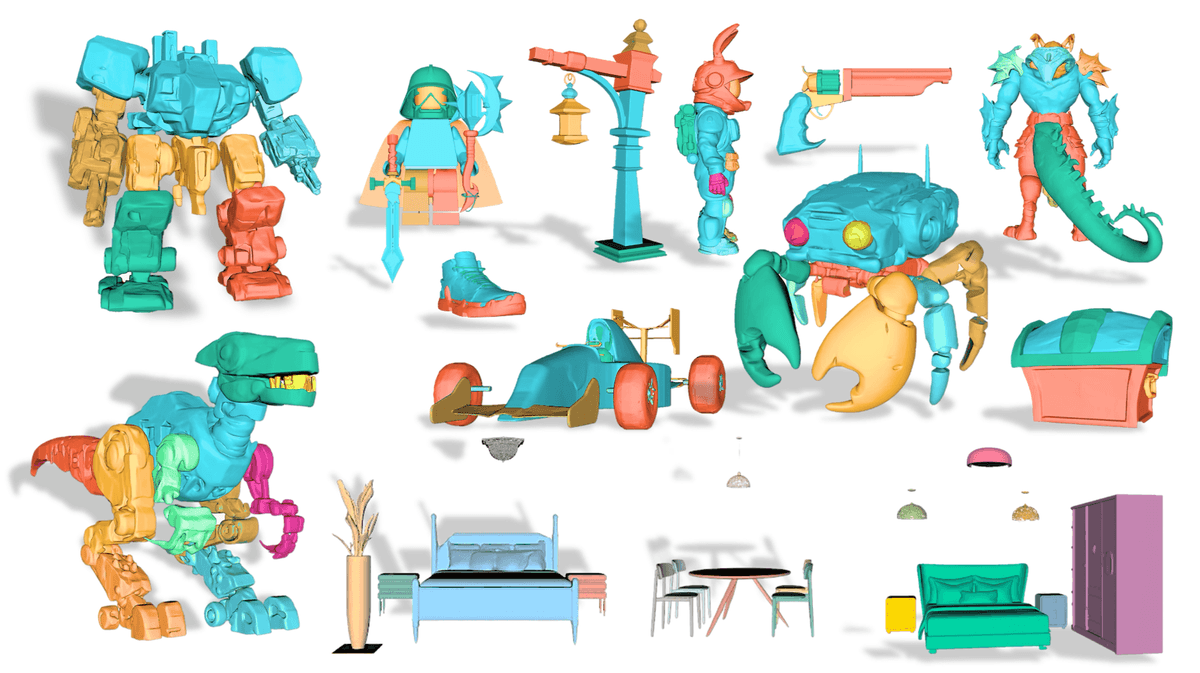
A single image goes in, a decomposable multi-part 3D mesh comes out. No segmentation, no two-stage pipeline, invisible parts included.
 PRO
- PartCrafter generates multi-part 3D meshes from a single RGB image in one shot, no segmentation needed. Repo
- Accepted to NeurIPS 2025, fully open-sourced under MIT with object and scene checkpoints on HuggingFace.
- Built on TripoSG with compositional latent tokens and local-global attention across 21 DiT blocks.
- Beats HoloPart 34s vs 18min on 4-part objects; holds up on heavily occluded scenes where MIDI collapses.
- Trained in 2 days on 8 H20 GPUs using 50K part-labeled objects mined from Objaverse, ShapeNet, ABO.
- Runs on 8GB VRAM with optional VLM-based part-count suggestion and photo style transfer. Paper
Most image-to-3D models today produce a single monolithic blob of geometry. That is fine for a screenshot, but useless the moment you want to animate a robot's arm, retexture a chair's cushion, or drop individual objects into a physics simulator. PartCrafter, a NeurIPS 2025 paper from Peking University, ByteDance, and CMU, takes a different route: it generates all parts jointly from one RGB image, in one shot, with no segmentation step in front of it.
The repository is now fully open-sourced under MIT, has crossed 2.4k stars, and ships with pretrained weights for both object-level and scene-level generation plus a HuggingFace demo.
What actually comes out the other end
Given a prompt RGB image and a user-specified number of parts N, PartCrafter generates a structured 3D asset where each component is a separate, semantically meaningful mesh. Every part has its own vertices and faces, and all vertex coordinates live in the same global canonical space, so the pieces assemble into a complete object or scene without additional transformations.
Practically, you get N separate .glb-friendly meshes that already snap together. A robot arrives as chassis, limbs, and head. A dining room arrives as table, chairs, and lamp, each addressable on its own.
Why two-stage pipelines were breaking
The dominant recipe until now: segment the image (or a coarse mesh) first, then reconstruct each segment separately. Concurrent work HoloPart and MIDI both follow variants of this. The two-stage pipeline suffers from segmentation errors, extensive computational costs from extra models, and difficulties in scaling up, limiting both robustness and fidelity.
Segmenters can only find what they can see, so occluded parts get lost. PartCrafter sidesteps this because it never segments at all, and the generative prior over parts lets it hallucinate reasonable geometry for pieces the camera cannot see.
This story is for Pro members
You've reached the end of the free preview. Upgrade to AlphaSignal Pro to read the full article - and everything else behind the paywall.
Comments
