
Parlor Runs a Full Voice-and-Vision AI Assistant Locally on a Laptop
Parlor runs voice and vision conversations entirely on a laptop, using Gemma 4 E2B and Kokoro to hit sub-3-second replies with 3 GB of RAM.
 Pro
Takeaways
- Parlor is an open-source app for local voice and vision chat, powered by Gemma 4 E2B and Kokoro
- Runs entirely on-device with roughly 3 GB RAM, no cloud API dependencies
- End-to-end latency of 2.5 to 3 seconds on Apple M3 Pro, 83 tokens per second decode
- Features browser-side Silero VAD, barge-in interrupts, sentence-level TTS streaming
- FastAPI server with WebSocket audio and JPEG frame transport, MLX on Mac, ONNX on Linux
- Apache 2.0 licensed research preview aimed at language learning and offline assistants
A new open-source project called Parlor shows just how far on-device multimodal AI has come in a year. It runs a full voice-and-vision conversational assistant on an Apple Silicon laptop, with no API calls to the cloud, no server hosting, and no push-to-talk. You speak, point your camera at something, and it answers back in a synthesized voice, all locally.
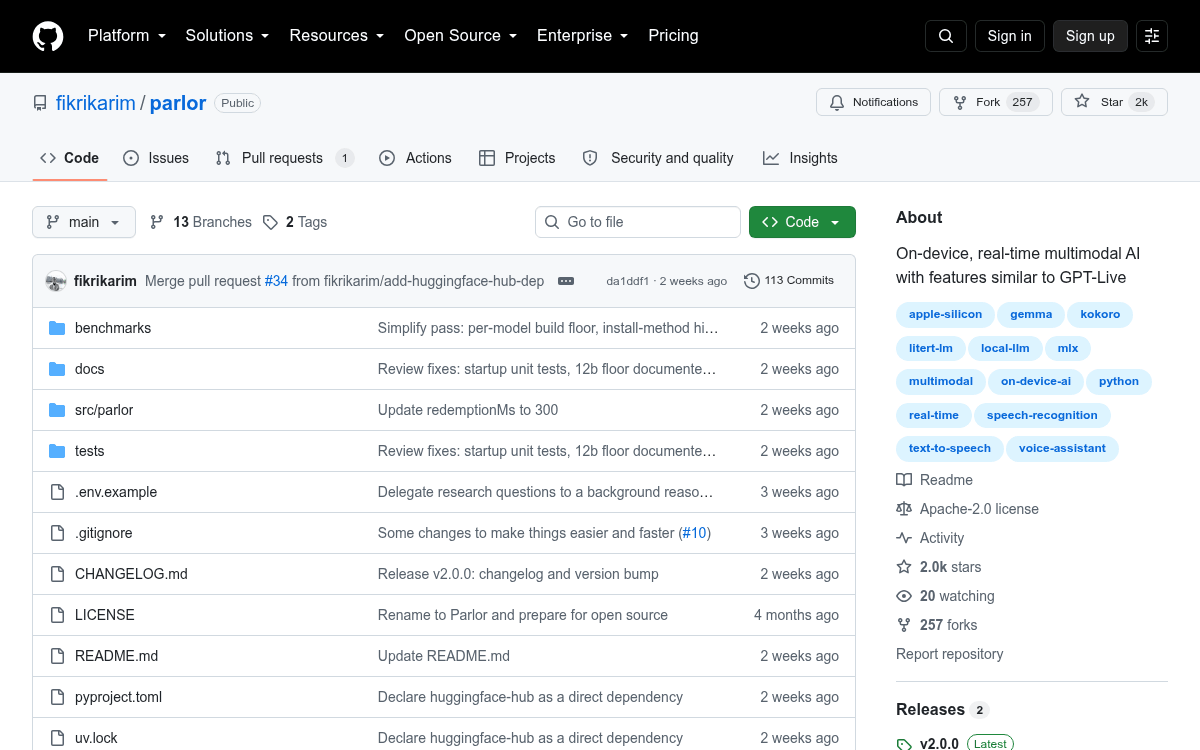
The repo has climbed to nearly 2,000 stars and stitches together three recent pieces of on-device tech: Google's Gemma 4 E2B for understanding speech and images, Kokoro for text-to-speech, and Silero VAD in the browser for voice activity detection. Parlor uses Gemma 4 E2B for understanding speech and vision, and Kokoro for text-to-speech.
The RTX 5090 problem, solved by a small model
The author frames the motivation clearly. They run a free voice AI service that helps people learn English, and hosting costs are the enemy of "free." Six months ago running the voice models in real-time required an RTX 5090. A capable small multimodal model changes that math: push inference to the user's device and the server bill collapses to zero.
The practical vision is a language-learning app where users could point their phone camera at objects and talk about them, with multilingual fallback to their native language, essentially the OpenAI GPT-4o demo but running locally.
Under the hood
The architecture is deliberately minimal. A FastAPI server holds two WebSocket connections open to the browser, one for uploading audio PCM plus JPEG camera frames, and one for streaming synthesized audio back. Gemma 4 E2B runs on the GPU through LiteRT-LM, and Kokoro TTS runs through MLX on Mac or ONNX on Linux.
Three design choices make it feel like a real conversation rather than a walkie-talkie:
- Voice activity detection happens in the browser using Silero VAD, so there is no push-to-talk button.
- Barge-in support lets you interrupt the AI mid-sentence by speaking.
- Sentence-level TTS streaming means audio starts playing before the full response has finished generating.
The latency budget on an M3 Pro
Numbers matter here, because "real-time" is often oversold. On an Apple M3 Pro, the total round trip lands between 2.5 and 3 seconds. That is slower than a cloud service like Realtime API, but competitive enough for tutoring and casual chat.
| Stage | Time |
|---|---|
| Speech and vision understanding | ~1.8 to 2.2s |
| Response generation (~25 tokens) | ~0.3s |
| Text-to-speech (1 to 3 sentences) | ~0.3 to 0.7s |
| End-to-end total | ~2.5 to 3.0s |
Decode speed clocks in at roughly 83 tokens per second on the M3 Pro GPU. Memory footprint is modest: Python 3.12 or later, Apple Silicon macOS or a supported Linux GPU, and roughly 3 GB of free RAM for the model.
Trying it in five commands
Installation is a git clone and a uv sync. Models download automatically on first run, weighing in at roughly 2.6 GB for Gemma 4 E2B plus the TTS models.
git clone https://github.com/fikrikarim/parlor.git
cd parlor
curl -LsSf https://astral.sh/uv/install.sh | sh
cd src
uv sync
uv run server.py
Open localhost:8000, grant camera and mic permissions, and you are talking to a local model.
What it is good at, and what it is not
The author is upfront about scope. This is a research preview and an early experiment with rough edges and bugs. Gemma 4 E2B is a small model, so it is not going to do agentic coding, but for people learning a new language it looks like a real shift. Good fits include:
- Language tutors that describe what the camera sees
- Accessibility tools that narrate the physical environment
- Offline voice assistants for privacy-sensitive settings like healthcare or classrooms
- Kiosks and embedded devices where a network round trip is impractical
Bad fits are the obvious ones: long-context reasoning, code generation, tool use, and anything that benefits from a frontier model's world knowledge. You are trading capability for locality, cost, and privacy.
Why this release lands now
The interesting shift Parlor represents is not the code, which is a few hundred lines of Python and HTML under Apache 2.0. It is the confirmation that a laptop-class device can now host the full stack, ASR, VLM, LLM, and TTS, at conversational latency. That closes the loop cloud-based voice agents opened, and puts a lot of "we need an API" product ideas back on the table as local software.