
opencodex Hits 11K Stars Breaking Codex and Claude Code Model Lock-In
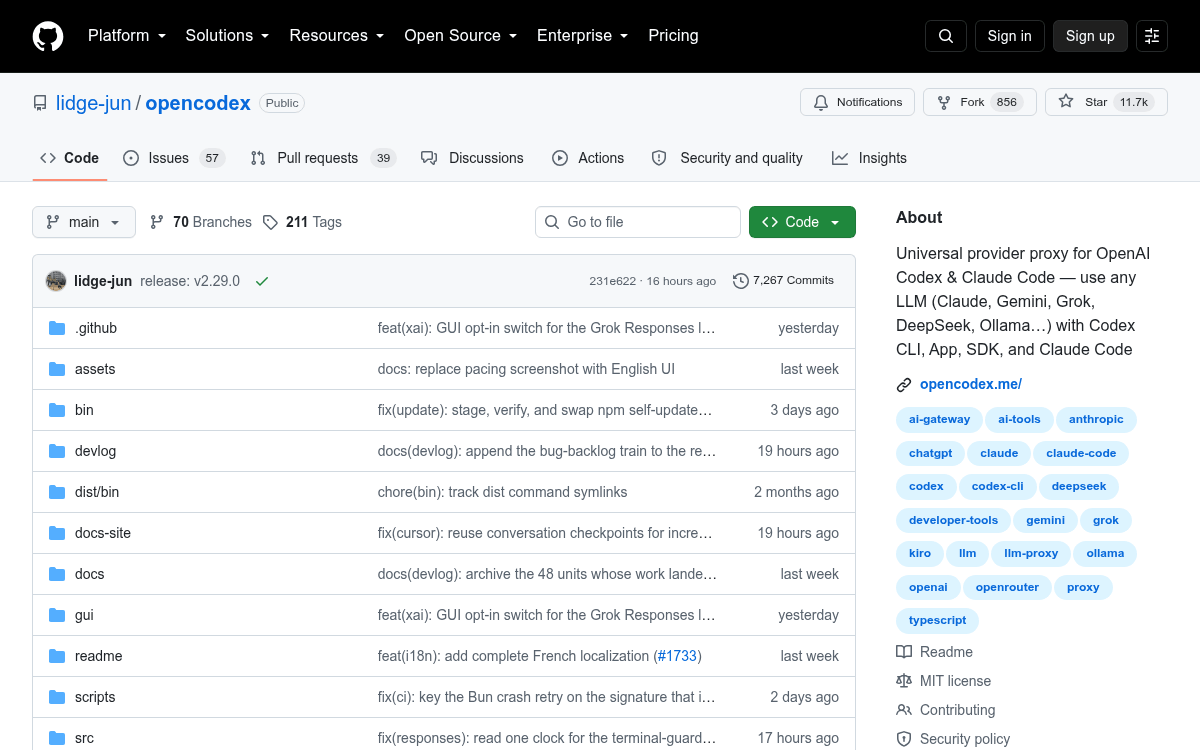
A local proxy that lets Codex CLI and Claude Code talk to Claude, Gemini, Grok, DeepSeek, Kimi, Ollama and 40+ other LLMs.
 Pro
Takeaways
- Opencodex is an MIT-licensed local proxy that lets Codex and Claude Code run on any LLM
- Five adapters cover Anthropic, Gemini, Azure, OpenAI Responses, and any Chat Completions endpoint, 40+ providers
- OAuth login for Anthropic, xAI, and Kimi means no API keys needed for your existing subscriptions
- Non-OpenAI models get web search and image understanding via a gpt-5.4-mini sidecar
- Install with
npm install -g @bitkyc08/opencodex, runs on Bun on macOS, Linux, and Windows - Docs and dashboard live at lidge-jun.github.io/opencodex, project has 11k+ GitHub stars
OpenAI's Codex and Anthropic's Claude Code are two of the most polished coding agents around, but each is welded to its parent model. A new open-source project called opencodex tries to break that lock-in by sitting between the client and the provider, translating requests on the fly so you can point either tool at whichever model you actually want.
The repo has climbed past 11,000 stars and describes itself as a universal provider proxy. It runs locally and translates Codex's Responses API into whatever your provider speaks, with streaming, tool calls, reasoning tokens, and images all flowing in both directions.
One port, every wire format
The core trick is protocol translation. Five adapters cover Anthropic Messages, Google Gemini, Azure, OpenAI Responses passthrough, and every OpenAI-compatible Chat Completions endpoint, which adds up to 40+ providers out of the box. When Codex fires off a request to /v1/responses, opencodex reshapes it into the format the target backend expects and streams the reply back in the shape Codex is waiting for.
Auth works the same way. OAuth support for xAI, Anthropic, and Kimi lets you sign in with an existing account, tokens auto-refresh, and you can also forward your codex login, paste an API key, or use environment variable references. That is the piece that unlocks the use case which put the project on many developers' radar: wiring a Kimi or Claude subscription you already pay for into Codex without touching an API key.
Getting it running
Setup is deliberately short. The proxy runs on Bun and installs from npm:
npm install -g @bitkyc08/opencodex
ocx init      # interactive provider setup, injects into Codex
ocx start     # proxy comes up on localhost:10100
codex "Write a hello world in Rust"
Running ocx gui opens a dashboard at http://localhost:10100 where you can pick from 40+ built-in providers or enter a custom OpenAI-compatible endpoint. Paste an API key or sign in via OAuth for Anthropic, xAI, and Kimi, and models are auto-discovered from the provider's /v1/models endpoint.
Routing uses a provider/model syntax, so codex -m "anthropic/claude-opus-4-8" forces one request through Anthropic while codex -m "ollama/llama3" hits a local server. Omit the prefix and opencodex routes to the default provider or auto-matches based on the model name pattern.

More than a wrapper
Two features push it past being a simple request forwarder. Sub-agents let you feature up to five routed or native models in Codex's subagent picker, routing complex tasks to a reasoning model and fast tasks to a cheap one. Capability backfilling gives non-OpenAI models real web search and image understanding via a gpt-5.4-mini sidecar over your ChatGPT login, which papers over the gap when a cheaper model doesn't natively support those tools.
The Claude Code integration runs on the same port. ocx claude launches Claude Code with every routed model available in the /model picker, auto-context stretched up to 1M tokens, roster sub-agents, and your claude.ai login left untouched.

Where it fits, where it doesn't
Good fits:
- Using an existing Kimi, Anthropic, or xAI subscription inside Codex without generating API keys
- Running a local Ollama, vLLM, or LM Studio server as the backend for a polished agent UI
- Mixing providers per task, cheap models for search, reasoning models for planning
- Adding web search and vision to models that lack them natively
Rough edges to be aware of:
- The project ships with a warning that some providers may restrict accounts that route traffic through third-party proxies, so terms of service are worth checking
- It depends on Bun 1.1+ being on your PATH, which is an extra runtime for teams standardized on Node
- 105 open issues suggest edge cases in adapter translation, especially around tool calls and reasoning tokens, are still being ironed out
The bigger picture
Coding agents have converged on a UX pattern (tight terminal loop, streaming tool calls, structured reasoning) that is genuinely hard to build. Opencodex is a bet that the interface layer is now good enough to reuse across providers, and that the wire format differences between Anthropic, OpenAI, and Google are shallow enough to bridge in a few thousand lines of TypeScript. If that bet holds, expect more projects like this and less pressure on any single vendor to be your one-stop coding assistant.