OpenCode Adds Alibaba's Qwen3.7 Plus to Its $10 Coding Subscription
OpenCode Go adds Qwen3.7 Plus to its $10/month coding subscription — a multimodal, 1M-context model that costs roughly 6x less than Qwen3.7 Max
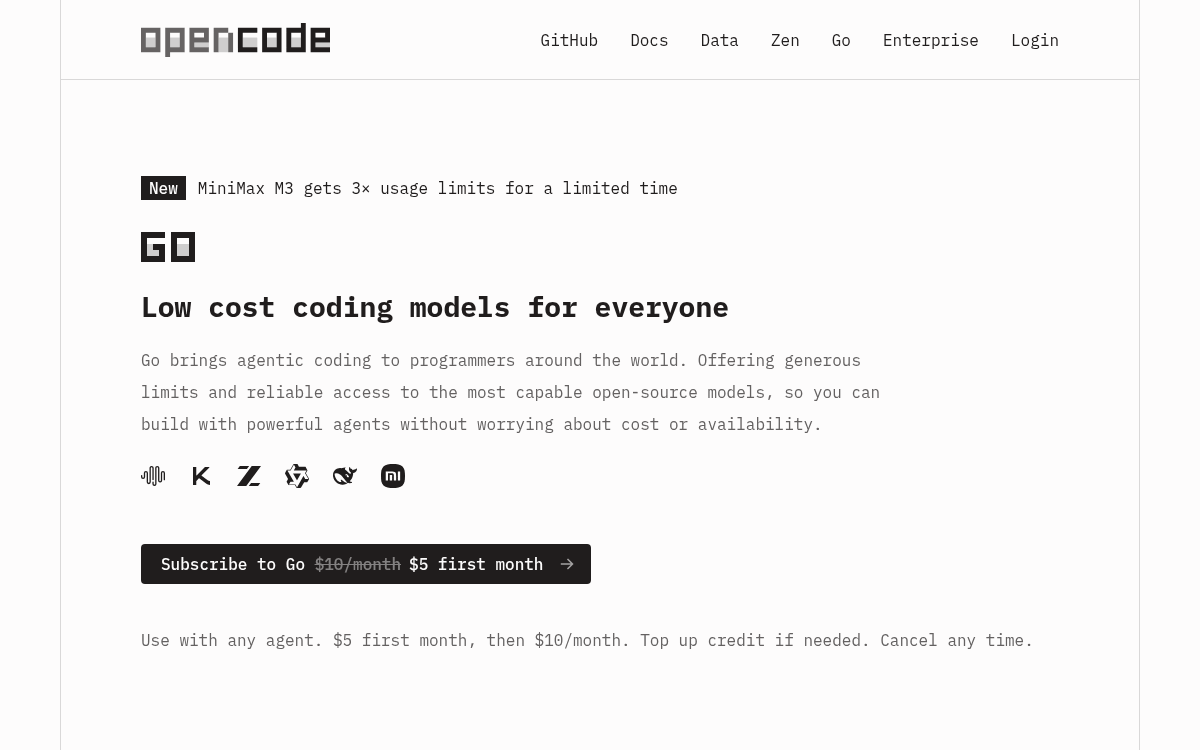
- New model: Qwen3.7 Plus is now available on OpenCode Go, Alibaba's multimodal agent model with 1M context and image input.
- Price: Accessible via Go's $10/month subscription ($5 first month), with ~4,300 requests per 5-hour window.
- Key capability: Reads screens, grounds GUI click targets, navigates mobile apps, and generates code from visual references.
- Cost advantage: Roughly 6× cheaper than Qwen3.7 Max ($0.40 vs $2.50 per 1M input tokens), making visual agent loops economically viable.
- Trade-off: Trails Qwen3.7 Max by ~3 points on pure-text SWE-Bench Pro; slow at ~53 tokens/sec and tends toward verbose outputs.
- Closed weights: Ships API-only with no open-weight release — a notable departure from Alibaba's historically open-source Qwen lineage.
OpenCode just quietly dropped one of the more interesting model additions to its Go subscription: Qwen3.7 Plus is now available to all Go subscribers, bringing a multimodal, 1-million-token context window model into a plan that costs $10 a month. The tweet got 3,000+ likes , a signal that the community noticed.
What is Qwen3.7 Plus, exactly?
Qwen3.7 Plus is a cost-effective model in Alibaba's Qwen3.7 series. It supports text and image input with text output, building on the series' text capabilities with a comprehensive upgrade to its vision-language abilities while retaining full-stack, agent-level intelligence for coding, tool use, and productivity workflows.
Its distinguishing trait is multi-modal interactive hybrid agent capability: it can perceive real-world scenes, read screens and interact with GUIs, generate code from visual references, and perform end-to-end navigation within mobile apps. In short, it is not just a chat model with a vision bolt-on , it is designed to operate as an autonomous agent that sees and acts.
It adds vision and video understanding to Alibaba's agent backbone at about one-sixth the per-token price of Qwen 3.7 Max , and, notably, ships proprietary and API-only, breaking the lab's open-weight habit.
The numbers that matter
Here is the full spec sheet for Qwen3.7 Plus on OpenCode Go:
- Context window: 1,000,000 tokens, with a max output of 65,536 tokens
- Modalities: Text and image input, text output
- Reasoning: Yes , the model supports extended chain-of-thought
- API format:
Uses the
anthropic-messagesformat , not OpenAI-compatible - Pricing on Go: $0.40 per million input tokens, $1.60 per million output tokens, $0.04 per million cache reads, $0.50 per million cache writes (for contexts under 256K)
The price gap is the real story: Plus is roughly 6× cheaper than Max on input, ~4.7× cheaper on output, and ~3.1× cheaper on cached reads , for the same context window and the same agentic ceiling.
What it is good at
Alibaba's own benchmark tables show a clear pattern of where Plus leads. The headline number is GUI grounding , the ability to identify exactly where to click on a screenshot. Qwen reports a ScreenSpot Pro score of 79.0, ahead of GPT-5.4 (67.4) and Claude Opus 4.6 (49.5) on their own harness. Take that with a grain of salt since it is vendor-run, but the directional signal is real.
- Long-context retrieval: MRCR-v2 128k score of 91.7, ahead of Opus 4.6 Max (84.0) and DeepSeek V4-Pro Max (74.4) , vendor-stated
- Mobile navigation: AndroidWorld score of 81.0 vs Gemini 3.1 Pro's 70.7
- Terminal work: Terminal-Bench 2.0 score of 70.3 vs DeepSeek V4-Pro's 67.9
- STEM reasoning: GPQA Diamond of 90.3, within a point of Opus 4.6 Max (91.3)
- Coding rank: On independent coding benchmark indexes, Qwen3.7 Plus ranks in the top quartile of the field for code generation and debugging
Where it falls short
On SWE-Bench Pro, the text-only Qwen 3.7 Max scores 60.6 versus Plus at roughly 57.6 , about a 3-point quality gap on pure-text software engineering. That is the expected trade-off for a cheaper, multimodal variant: you get perception and price, you give up a little on pure coding depth.
There is also a verbosity issue worth budgeting for. Independent evaluator Artificial Analysis measured Qwen3.7 Plus generating roughly 110 million output tokens during testing against a 29 million median. The model generates output at 53.3 tokens per second, which is at the lower end compared to other reasoning models in a similar price tier. For chatty agent loops, slow and verbose is a combination that can quietly erode the cheap-input advantage.
One more caveat: it ships proprietary and API-only, breaking the lab's open-weight habit. If self-hosting is a hard requirement, this model is not for you.
How to use it on OpenCode Go
OpenCode Go is a low cost subscription , $5 for your first month, then $10/month , that provides generous limits and reliable access to the most capable open source models. Getting Qwen3.7 Plus running is three steps:
- Sign in to OpenCode Zen, subscribe to Go, and copy your API key
- Run
/connectin the TUI, selectOpenCode Go, and paste your key - Run
/modelsto confirmopencode-go/qwen3.7-plusis available
You can also hit the model directly via the API endpoint:
POST https://opencode.ai/zen/go/v1/messages
Model-ID: qwen3.7-plus
SDK: @ai-sdk/anthropic
You can access Go models through the API endpoints directly. The model ID in your OpenCode config uses the format opencode-go/<model-id>. For example, for Qwen3.7 Plus, you would use opencode-go/qwen3.7-plus in your config.
How many requests does $10 actually buy you?
The Go plan offers approximately 4,300 Qwen3.7 Plus requests per 5-hour window , a generous ceiling for most coding sessions. The full usage limits are:
| Window | Dollar limit | Qwen3.7 Plus requests (est.) |
|---|---|---|
| 5 hours | $12 | ~4,300 |
| Weekly | $30 | ~10,800 |
| Monthly | $60 | ~21,600 |
If you also have credits on your Zen balance, you can enable the Use balance option in the console. When enabled, Go will fall back to your Zen balance after you've reached your usage limits instead of blocking requests.
The bigger picture: why this addition matters
The real unlock here is multimodal agentic coding at subscription pricing. Until now, getting a model that could read a screenshot, ground a GUI click, and write code from a visual reference in a single loop meant paying frontier API prices. The 1M token context window enables full-codebase or long-document reasoning in a single pass, making it suited for software engineering agents, long-document analysis, multimodal content workflows, and autonomous task pipelines.
The preserve_thinking API parameter is worth calling out specifically. It retains the model's internal reasoning chain across conversation turns , meaning a long-horizon agent task does not reset its working memory every time it calls a tool.
Alibaba positions it as a multimodal interactive hybrid agent that perceives real-world scenes, reads screens, operates GUIs, and writes code from visual references.
That is a genuinely different capability class from a text-only coding assistant.
For the Go subscriber base, the practical use cases are clear:
- Browser and RPA automation: Screen reading plus GUI grounding at budget pricing is a strong combination for robotic process automation pipelines
- Large codebase navigation: 1M tokens means you can load an entire repo into context without chunking
- Visual debugging: Paste a screenshot of a broken UI and ask the model to diagnose and fix it
- Long-document agents: High MRCR-v2 retrieval scores make it a solid pick for document Q&A at scale
Qwen3.7 Plus scores 53 on the Artificial Analysis Intelligence Index, placing it well above average among other reasoning models in a similar price tier. That independent signal, combined with the $10/month access point OpenCode Go provides, makes this one of the more compelling additions to the subscription since its launch. The caveat remains: validate the grounding benchmarks on your own screenshots before wiring it into a production pipeline.
Comments