
OpenBMB's VoxCPM2 Clones Voices Across 30 Languages Without Speech Tokenizers
VoxCPM2 is a fully open-source 2B-parameter TTS model covering 30 languages, voice cloning, and natural-language voice design — no discrete tokenizer required
 Pro
Takeaways
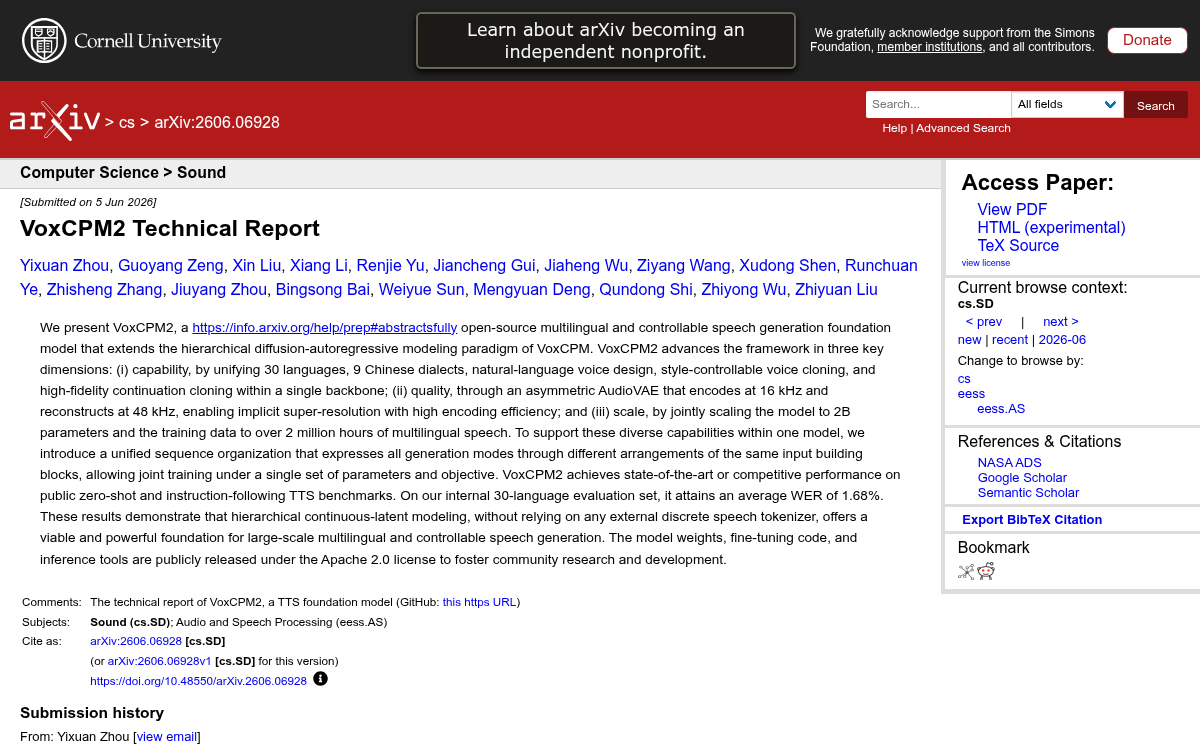
- VoxCPM2 is a fully open-source 2B-parameter TTS model from OpenBMB/Tsinghua that covers 30 languages and 9 Chinese dialects without any discrete speech tokenizer.
- It unifies zero-shot voice cloning, natural-language voice design, style-controllable cloning, and continuation cloning in a single backbone with shared weights.
- The asymmetric AudioVAE V2 encodes at 16 kHz and decodes at 48 kHz, achieving implicit super-resolution while keeping the autoregressive sequence compact at 6.25 Hz.
- On a 30-language internal benchmark it achieves 1.68% average WER/CER; on MiniMax-MLS-Test it leads speaker similarity on 22 of 24 languages.
- Inference runs at 0.13 RTF (7x real-time) on a single RTX 4090 with ~8 GB VRAM using the Nano-vLLM backend.
- Weights, fine-tuning code, and inference tools are released under Apache 2.0 at GitHub and Hugging Face.
VoxCPM2 is a bold bet against the dominant approach in modern speech synthesis. While nearly every major TTS system today , from CosyVoice to Qwen3-TTS , converts audio into discrete tokens before generating speech, VoxCPM2 skips that step entirely. The result is a single 2B-parameter model that handles 30 languages, zero-shot voice cloning, natural-language voice design, and style-controllable synthesis, all without ever touching a discrete speech tokenizer.
Why tokenizers are a bottleneck
The mainstream TTS pipeline works like this: encode audio into discrete tokens using a neural codec (like EnCodec or RVQ), train a language model to predict those tokens, then decode back to a waveform. It works well, and it inherits LLM-style scaling properties. But there's a catch: quantization throws away fine-grained acoustic detail. To compensate, most high-quality systems add a second-stage diffusion or flow-matching decoder to restore what was lost , creating a fragmented pipeline where semantic planning and acoustic rendering are optimized separately.
Although effective in achieving strong perceptual quality, this decoupled design fragments high-level semantic planning from low-level acoustic rendering, preventing end-to-end joint optimization. Moreover, overall performance remains heavily dependent on the modeling capacity of the intermediate discrete speech tokenizer. VoxCPM2's predecessor, VoxCPM, proposed a different path: model continuous speech representations directly, but use a hierarchical internal structure to keep semantic and acoustic concerns cleanly separated.
The architecture: a hierarchy without hard splits
VoxCPM introduced a hierarchical backbone consisting of a Text-Semantic Language Model (TSLM), a differentiable semi-discrete bottleneck based on Finite Scalar Quantization (FSQ), and a Residual Acoustic Language Model (RALM). The TSLM primarily captures high-level semantic and prosodic structures, the FSQ bottleneck compresses them into a stable skeleton, and the RALM recovers fine-grained acoustic details. A Local Diffusion Transformer (LocDiT) then generates the actual continuous latent patches from all of this context.

Think of it like a two-level plan: the TSLM decides what to say and roughly how (prosody, rhythm), the FSQ bottleneck creates a compressed but differentiable "sketch," and the RALM fills in the acoustic texture. The whole thing is trained end-to-end , no external tokenizer, no frozen codec, no separate acoustic model.
VoxCPM2 scales this foundation in three directions:
- Capability: VoxCPM2 unifies four user-facing capabilities within a single backbone: basic TTS supporting multilingual and cross-lingual synthesis, natural-language voice design that generates entirely new voices from free-form text descriptions without any reference audio, controllable cloning that clones a speaker from a short reference audio while following style instructions, and continuation-based cloning for high-fidelity audio continuation from a paired reference audio and its transcript.
- Quality: A new asymmetric AudioVAE V2 that encodes at 16 kHz but decodes at 48 kHz , implicit super-resolution without lengthening the autoregressive sequence.
- Scale: The model is jointly scaled to 2B parameters and the training data to over 2 million hours of multilingual speech covering 30 languages and 9 Chinese dialects, while maintaining a compact 6.25 Hz token rate.
One model, five modes , same weights
The most practically interesting design choice is the unified sequence organization. Instead of building separate modules for each capability, VoxCPM2 expresses every generation mode as a different arrangement of the same three input building blocks: a text segment (optionally prefixed with a voice/style description), a reference audio segment, and a target audio segment. The model infers what to do from the input layout alone.
The five modes look like this:
- Basic TTS:
<text> → <target audio> - Voice design:
<voice description + text> → <target audio> - Reference cloning:
<ref audio> | <text> → <target audio> - Controllable cloning:
<ref audio> | <style description + text> → <target audio> - Continuation cloning:
<prompt text + target text> | <prompt audio> → <target audio>
For voice design and controllable cloning, the natural-language description is simply concatenated with the synthesis text, allowing the same TSLM to handle both semantic content and control instructions without additional modules. No dedicated style encoders, no per-mode routing heads , just text.
The AudioVAE V2: asymmetric by design
AudioVAE V2 is an asymmetric variational autoencoder whose encoder operates at 16 kHz and whose decoder reconstructs at 48 kHz. On the decoder side, lifting the output rate to 48 kHz improves waveform fidelity to a high-quality regime without increasing the cost of the autoregressive generation loop. On the encoder side, restricting the input rate to 16 kHz enables seamless reuse of the large-scale 16 kHz training corpus from the original VoxCPM, and avoids the typical explosion in sequence length caused by a higher input rate.
The backbone still operates at a compact 6.25 Hz token rate (one autoregressive step per 160 ms of audio), keeping inference fast even at 2B parameters. With the optimized Nano-vLLM serving engine, VoxCPM2 achieves an RTF of 0.13, delivering over 7× real-time generation speed on a single NVIDIA RTX 4090 GPU while consuming approximately 8 GB of peak VRAM.
Training: three stages, one curriculum
Getting a single model to do all five modes well required a careful progressive training strategy:
- Multilingual TTS pretraining on large-scale transcription-audio pairs, capped at 60s segments, to establish solid pronunciation across all 30 languages.
- Joint TTS + controllable pretraining, gradually introducing annotated expressive speech and reference-audio triplets, extending context to 8192 tokens and audio up to 3 minutes.
- High-quality annealing SFT on a curated subset with more expressive speech, higher ratio of controllable examples, and balanced language sampling.
One clever data trick: to prevent the model from learning to recover style from text content (e.g., cheerful styles correlating with positive sentences), the team uses the model itself to generate content-decoupled examples , starting from an annotated utterance, cloning its voice and style onto a semantically unrelated transcript, while preserving the original natural-language description as the control prompt. This breaks the spurious correlation and also helps extend controllable training to low-resource languages.
Benchmarks: strong across the board, with known gaps
On the Seed-TTS-Eval zero-shot voice cloning benchmark, VoxCPM2 achieves 1.84/75.3 (WER/SIM) on test-EN, 0.97/79.5 on test-ZH, and 8.13/75.3 on the challenging test-ZH-Hard subset, demonstrating strong speaker similarity while maintaining good intelligibility.
Speaker similarity is where the continuous-latent approach really shines. On the MiniMax-MLS-Test 24-language benchmark, VoxCPM2 achieves the highest speaker similarity (SIM) on 22 out of 24 languages, demonstrating strong and consistent voice preservation across diverse language families. Even on Czech and Romanian , languages not seen during training , the model shows meaningful speaker preservation, suggesting emergent cross-lingual transfer.
On the internal 30-language benchmark, VoxCPM2 achieves an average WER/CER of 1.68% across all 30 languages, with error rates below 3% on 28 languages and below 1% on six languages. The model is particularly strong on Southeast Asian languages like Khmer, Lao, Burmese, and Thai.
The main weaknesses are Arabic and Hindi intelligibility on some benchmarks, and abstract instruction-following in Chinese (the DSD and RP subtasks on InstructTTSEval). The gap on the more abstract Chinese tasks may be attributed to current limitations in annotation diversity for higher-level stylistic and persona descriptions. Czech and Romanian, being completely unseen during training, also show higher WER.
On controllable generation (InstructTTSEval), VoxCPM2 scores 84.2 / 83.2 / 71.4 on English APS/DSD/RP , the best among all open-source systems tested, and competitive with Gemini-TTS-Pro on the role-play task.
What's now possible
The unified design unlocks a few things that were previously awkward or impossible with specialized pipelines:
- Voice design without reference audio: Describe a voice in plain text , "a warm, slightly husky middle-aged woman with a calm pace" , and get a consistent, synthesizable voice identity back. No speaker recording needed.
- Style-steered cloning: Clone a speaker's timbre from a reference clip, then override their speaking style with a text instruction. The identity is preserved; the emotion or pace is not.
- Multilingual continuation: Feed a few seconds of audio as a prompt and the model continues it in the same voice, even across languages.
- Preliminary singing: Thanks to the inclusion of song-style annotated data during training, VoxCPM2 also exhibits preliminary singing voice generation ability, although singing quality remains an area for further improvement.
Getting started
The model is released under the Apache-2.0 license, free for commercial use. Weights are on Hugging Face, and the repo includes fine-tuning code and inference tools. Requirements are Python ≥ 3.10 (<3.13), PyTorch ≥ 2.5.0, and CUDA ≥ 12.0. Basic inference looks like this:
from voxcpm import VoxCPM
import soundfile as sf
model = VoxCPM.from_pretrained("openbmb/VoxCPM2", load_denoiser=False)
# Basic TTS
wav = model.generate(text="Hello, this is VoxCPM2.")
sf.write("output.wav", wav, samplerate=48000)
# Voice design from description
wav = model.generate(
    text="Welcome to the demo.",
    voice_description="A calm, deep male voice with a slight British accent."
)
# Zero-shot voice cloning
wav = model.generate(
    text="This is a cloned voice.",
    reference_audio="path/to/reference.wav"
)
The broader implication here is architectural: VoxCPM2 is the clearest evidence yet that you don't need a discrete speech tokenizer to build a competitive, scalable, multilingual TTS foundation model. The continuous-latent approach preserves acoustic richness, enables richer speaker representations, and , crucially , allows all capabilities to share a single set of parameters. Whether that's enough to displace the dominant codec-LM paradigm will depend on how the community picks it up, but the Apache 2.0 release makes that experiment easy to run.